
Resources by Lindsey Goetz

My husband and I moved eight times in the first seven years we were married. Our early marriage was marked by a kind of instability and precariousness that had been foreign to both of us before. Once we moved states so that my husband could work at a new job, which he ended up losing just nine months later. We were blindsided and reeling from grief and fear.One night, a friend texted us that his five-year-old had prayed for our family at dinner. “He prayed that you’ll remember your baptisms,” the friend wrote. This memory still can move me to tears. We were so young and scared. We were feeling deep rejection from the community we had moved to join, and there were so many practical things to worry about: our three young daughters, groceries, a place to live, and new jobs. That five-year-old’s prayer was a gift. In the midst of some of the worst circumstances our family had yet faced, we were reminded of our belonging—to God and to God’s people. Our baptisms remind us that our belonging depends upon Jesus, not on our worthiness or our efforts. Though my husband and I were still very unsure of what our future would hold, we were reminded that we were, in a deep and unchanging way, beloved by God and a part of his family. BelongThe first question of the Heidelberg Catechism asks, “What is your only comfort in life and in death?” The answer begins with belonging: “That I am not my own, but belong—body and soul, in life and in death—to my faithful Savior, Jesus Christ.” That we belong to Jesus is a foundational truth of Christian identity. In the Reformed tradition, because we believe that this belonging is not contingent on our behavior or even our consent, we baptize our infants, declaring with both our words and our actions what is true about them even before they are able to declare it for themselves. At their baptisms, we commit to helping children experience this belonging and to understand the gospel story, and we pray that they will choose to participate in God’s work in the world.But how do we actually live these promises as a community? Whether or not we baptize our children as infants, how do we continue to communicate to the children in our churches this message of belonging? Are we sending mixed or confusing messages to the children in our churches about who belongs among the people of God, whom worship is for, and what a child’s place is among God’s people? If we are honest, children are probably some of the last people we think about when we plan a worship service. In many churches, children are not even present for the worship service. However, there is not a single time in Scripture when God’s people worship God in age-segregated groups. When God’s people worship, they do it all together. In many churches today, instead of treating age segregation as a contextual consideration that we must navigate as the people of God, we often elevate it to a foundational position of our church (Holly Allen and Christine Lawton Ross, Intergenerational Christian Formation, 2012, p. 114.). To put it another way, we often assume age segregation based on our cultural position rather than allowing our theology to shape the way we gather to worship. But if we believe that in worship God’s people gather to rehearse the story of Scripture and respond to the God who calls us to himself, then it makes sense that we would want children to be present with us. Who knows the language of story better than children, and what better way for them to learn a story than to live it—to experience it with all of their senses?Yet even if children are present in our services, we rarely think about them when we plan our worship services, and the idea of having children help us plan or lead our worship services is completely foreign. We are not suggesting here that worship services be changed to be more appealing to children. We are instead suggesting that children can learn to appreciate a worship service and, even more, that it is the job of parents and churches to help them do so. Furthermore, because of the way God made them, children offer unique gifts to congregations that are willing to see, include, and learn from them as they rehearse God’s story together. When we age-segregate our worship services, well intentioned as we may be, there are consequences for every generation.Resources for Intergenerational WorshipIt can be difficult for a church to locate resources designed to help multiple generations worship together. More resources are becoming available that are created to appeal to the strengths and interests of children while also encouraging adults to exercise childlike faith, to remember that play can be a part of worship, and to practice coming to Jesus as little children. At Word & Wonder (wordandwonder.org), we’ve created resources that we hope will help your church and families enjoy entering into worship across generations in rich, authentic ways.Our Advent Cards provide an opportunity for households to gather together, use wondering questions to reflect on Scripture and on an image, and pray in response. This simple weekly practice can help people of all ages slow down and wait during this season of preparation. Each card has an image on one side and Scripture and suggested prayers on the other. The cards also suggest a weekly hymn and a practice or activity to help people of all ages engage with the themes of Advent. These are available to download at wordandwonder.org/shop/free-advent/.The Gospel Story Hymnal organizes a collection of more than 150 hymns by the movements of the gospel story. It is intended to help churches welcome children into the sanctuary and to provide households with a beautiful way to share the story of Scripture as told through hymns. It includes beautiful illustrations, child-friendly and family-focused hymn notes, and a three-year plan for working through the hymnal in weekly family worship. More information can be found at wordandwonder.org. Our prayer is that these tools would serve you and the households in your church as you take the next step toward encountering God as people of all ages. Planning Worship with Children in MindFor some of us, imagining intergenerational worship is difficult. The idea of planning worship with children in mind seems gimmicky at best and downright chaotic at worst. But what if planning intergenerational worship isn’t about gimmicks or catering to different age groups, but instead about telling the gospel story and helping people find their place in it? We would want to think about what kinds of accommodations will help the people in our churches experience the story of the good news of the gospel and offer their response to God together.This doesn’t necessarily mean that our liturgy will change. In my experience, children respond very well to a set liturgy that is predictable and has lots of parts they can memorize. Dr. Robbie Castleman has pointed out that for children who are exposed to worship from a young age, church becomes like a familiar bedtime story (Dr. Robbie Castleman, interview with Lindsey Goetz and Dr. Ahyuwani Akanet, The Child in Our Midst, May 6, 2024, pod.link/1738960877). What an image! Isn’t that what we want for everyone in our churches—to so identify with the flow and feel of worship that we can somehow both relax into familiar rhythms, remain poised for what is next, and just know when something gets skipped? If children aren’t experiencing the story of scripture in our worship, something has gone wrong. We ought to help everyone in the congregation enter into the story week after week. This can be a daunting task. Many Christians admit to not reading the Bible regularly. The worship leader’s job is a big one. However, collaboration is key. Who are the people in your congregation who can help you consider the ways that people in different life stages and social locations will most naturally enter the gospel story? The idea for intergenerational worship is “something for everyone,” not “everything for everyone” (Sarah Bentley Allred, “An Introduction to Intergenerational Worship,” Intergenerate, May 24, 2021). We are formed as we worship, and a part of that formation is recognizing that we are gathered up among people who are different from us.Belonging is also a vital part of worship, and it is important that the implicit messages we send as we gather to worship tell everyone that they belong and that they are beloved by God. Including people of different generations and abilities in worship planning can help us create worship services that authentically engage people of all ages. We can also think carefully about the scripture passages we choose, how we present them, the way our spaces are set up, and what the environment communicates. How are we showing hospitality to the people in our churches, both young and old? Practical SuggestionsSpecial seasons of the church year are excellent times to experiment with intentionally intergenerational congregational and family worship. Certain seasons of the church year just feel different, and we can use that to our advantage. The colors of the church calendar, special symbols, and stories from the life of Jesus can fuel a child’s imagination. And some seasons are only a few weeks long, making experimentation a bit easier. We can put up with almost anything for four weeks! These seasons also offer us a chance to become like the children among us as we watch and learn from the wonder and awe they bring to these stories of salvation history. During Advent, for example, a church might choose to focus on different characters in the Christmas story. At our church, we chose four narratives, in part because narratives are easier passages of scripture for children to connect with. These passages were assigned to the four weeks leading up to Christmas and were included in a guide for households worshiping at home. They also dovetailed with an intergenerational Sunday school class in which participants reflected on and engaged with the narratives in different ways each week. The idea is not for your church to replicate what happened at our church, but to imagine what it could look like for a group of people to collaborate—to include representatives from different age groups in the planning of worship and learning experiences. The synergy that can come from a group of people thinking ahead about sermon series, education, and household discipleship resources for a focused period of time can bear great fruit in the life of a church.One of my favorite services of the church year is our church’s family Christmas Eve service. It’s a very light version of a Christmas pageant. There are no rehearsals and no lines. We sing short parts of several carols, and we hear the Christmas story. Throughout the service, children wearing very simple costumes picked up on their way into the sanctuary slowly walk to the chancel to create a living nativity. Sometimes I read the narration; sometimes older children in our church do it. In all the years I have read it, I have never made it through the story without crying. This service is chaotic, but the gospel never seems truer to me than when I’m reading that the congregation will “find Jesus in the streets, in their homes, and in their hurts and broken places” while I’m sharing the stage with the children I have come to love and worship with Sunday after Sunday. I’ve never felt more commissioned for weekly work than when the children process out of the sanctuary carrying the baby Jesus and charging us to “Go Tell It on the Mountain” or when the service ends with the words of Revelation 21 read in a booming voice: “I am making all things new.” Every year, these children help us remember the Christmas story in a truly authentic way. Both of these examples are just the beginning of the fruitful worship that can occur when a group of people at a church collaborate to plan a season of the church year, intending to make their worship accessible to everyone in the congregation.

Read The Article

Dear Storyteller, This is a letter to the high school theater kid who loves to be on stage, to the grandfather who spins better yarns than Rumpelstiltskin, to the mother who does all the voices when reading the bedtime story, and to the pastor called to bring the gospel each Sunday. This is a letter to the storytellers of the church, and I want to start by telling you my story. I remember standing as a young wife in the sanctuary of the church my husband and I first attended as a married couple. This was the place that would nurture, train, and love us well through seminary, through our first years of marriage, and through the birth of our first child, but I had walked through the doors that morning uncertain of how the wife of a seminary student should break it to her husband that she isn’t sure she wants much to do with church anymore. After growing up in the church, I had come away with a deep respect for but little familiarity with the Bible. I read the Bible devotionally on and off over the years, but it wasn’t until college that someone took the time to explain to me the shape of the story of Scripture. At that point, my new relationship with Scripture was mostly intellectual; I had not yet begun to love the story of Scripture, much less to understand it as my own story. But this Sunday in our new church, all that changed. I don’t remember anything specific about the sermon, but I remember crying as the pastor spoke about Jesus in a way I had never heard a pastor speak about Jesus. On this Sunday—and for many Sundays afterward—God’s story began to sink deeply into my heart. I remember listening to the pastor and thinking, If this is who Jesus is, I want to follow him. In the years that followed, I began not just to know the story of Scripture, but to love it, to see my own story as a part of it, and to look for ways to continue to tell this story to myself over and over again. In fact, this experience is the reason I am in children’s ministry. Many of us who minister with children did not set out to do so, yet we somehow found ourselves gently led, coaxed, or even bribed into the positions we currently hold, volunteer or otherwise. Whatever journey we took to get here, we all share a deep desire for children to come to know Jesus and his deep love for them. We want children to know and love the truth of the gospel, and as they mature we long for them to grow into their faith rather than out of it. But those who minister to children face many challenges, not least of which is that in formal ministry settings we often have just one or two hours a week to spend on the spiritual nurture of children. Curriculum publishers offer a host of ideas about what churches should prioritize in those hours: teaching moral lessons that (one hopes) lead to good behavior, making it the most exciting hour of the week, giving adults time away from their children so they can focus on worship, or emphasizing memorization and knowledge attainment. When these conflicting messages are mixed with the expectations of the staff and parents in your congregation, things can get overwhelming pretty quickly. Singer-songwriter Andrew Peterson says, “If you want someone to know the truth, tell them. If you want someone to love the truth, tell them a story.” So, storyteller, this is your encouragement, your permission slip, your duty: tell the children in your church the stories of Scripture. Give them the most beautiful, true, and wonderful story in the whole world. Give it to them over and over. Every time you tell them one of the little stories in Scripture, remind them of how it fits into the larger story of Scripture: the story of how God made a good world, how sin broke that world, how Jesus rescued the world from sin, Satan, and death, and how God will one day make everything new again. Invite the children in your church to recognize God’s story, to expect its presence in their everyday life, and to see themselves as part of the story. In his gospel about Jesus’ life, John said, “These [stories] are written so that you may believe that Jesus is the Christ, the Son of God, and that by believing you may have life in his name” (John 20:31, ESV). As I sat in that church several years ago, struggling with my faith, a story was a lifeline for me. After preaching a sermon on several miracles, our pastor summed them up in this way: “These words are not written to promise you that Jesus will do the exact same things for you. They are written so you will know who Jesus is, whom you can trust whether the storm is raging or not, whether your child is dying or has died.” When the pastor spoke those words, I knew the gospel was a gift infinitely better than I had once believed it to be. When we try to distill the good news of the story of Jesus into talking points, tips for a moral life, or an easy-to-remember how-to list, we run the risk of oversimplifying, of giving children half-truths that they will outgrow when they face the brokenness of this world or simply the nuances of life in the already-but-not-yet. In the stories of Scripture, we do not get assurance that we will be protected from earthly suffering, a self-help book, or even a list of people to imitate. In the pages of this story, we come to know Jesus—the real, living Jesus who does not watch us suffer from far off, but who comes near to us and sits with us in our despair and our weakness, the very same Jesus who lived, died, and rose again, who now reigns in heaven praying for us and is united to us by the Holy Spirit. This is the most powerful story in the world because it is absolutely true. I have been in children’s ministry for more than a decade. I know the variety of challenges those in children’s ministry face. But we have riches too. We have the greatest story in the world and people who are eager to hear it. If all we do is tell them this story, we will have been faithful to our calling. The story of the Bible is the truest story of the whole world, and at its center is the God who created, authored, and inhabits this story. Whether we know it or not, whether we live like it or not, our lives are also a part of this story, which means that to understand the shape of our lives we must become familiar with and learn to love the bigger story of which we are a part. Whether in congregational worship or in other settings, let’s keep telling the stories, week after week, year after year. Let’s pass on a faith that children can grow into, not one they will grow out of. And let’s remember to hear the story ourselves, because one of the gifts of ministering with children is remembering that we never grow out of the need for the gospel. May God bless you with imagination and insight, A fellow storyteller

Read The Article

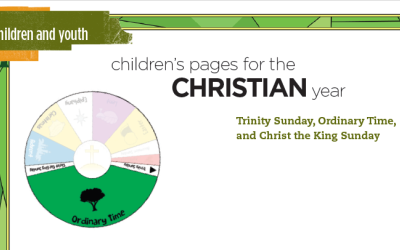
Trinity Sunday While there aren’t any big celebrations during Ordinary Time, there are some special days. The first Sunday in Ordinary Time is Trinity Sunday. Instead of the usual Ordinary Time green, churches on Trinity Sunday will often use white to represent God. “Trinity” is the word used to describe the mystery that God the Father, God the Son (Jesus), and God the Holy Spirit are all one God—three different persons in the one person of God. Is that confusing? That’s because it is a mystery. We cannot really understand how amazing and complex our God is, so we worship with wonder and awe. This God of mystery invites us to ask questions and to look for ways to grow in knowledge and understanding of God, such as going to worship or reading the Bible. We can delight in the fact that our God is beyond anything we can even imagine and rejoice in awe and wonder that God is so big that, no matter how old we grow, there will always be more for us to learn about God. Trinity Shield The Trinity Shield is a Christian symbol that helps us understand what it means to worship one God in three persons. What colors would you use to represent each of the persons of the Trinity? Color the shield with those colors. Ordinary Time Ordinary Time is, well, ordinary. There are no big holidays or special celebrations. But have you ever thought about how most of Jesus’ life was ordinary time? He spent so many days of his life doing the normal things that you and I do—things like eating, sleeping, learning, playing, cleaning, working, and resting. Ordinary Time is good news for us because it means that our everyday lives matter to God. God is with us always, and there is nothing in our lives that the Holy Spirit cannot use to make us more like Jesus. Ordinary Time’s color is green to show us that we are growing, just as plants do, as we live out our faith in the small moments of our lives. That is also why some churches call this time “growing season.” Living Your Faith During Ordinary Time we are reminded that we need to live out our faith by becoming more and more like Jesus. Draw a picture of what it looks like for you to live the faith in your life at home, at school, with your friends and your family, with people who are like you, and with people who are different from you. Share this picture with someone. Ask them what living the faith looks like in their life. Christ the King Sunday Christ the King Sunday is the last Sunday of Ordinary Time. The color for Christ the King Sunday is white because it is a time to celebrate Jesus being King over all the world. We have many kings, presidents, and rulers in our world, but none is as powerful, perfect, or loving as Jesus—they’re not even close! Song of Praise There are lots of songs full of praise for Jesus the King—songs that remind us that Jesus reigns and has a crown. Can you think of any? Even though the book of Psalms in the Bible was written before Jesus was born, the writers looked forward to the day when there would be a perfect King. Psalm 93 is one example. Can you write your own song or poem about Jesus, the only true and good King of the whole world? If you can’t think of a whole song, just write some words that describe Jesus as King. Will you share what you’ve written with someone? Bonus: Do You Remember? Christ the King is the very last day of the Christian year. Do you remember what season the Christian year begins with? You can find the answer on the Christian year wheel.

Read The Article

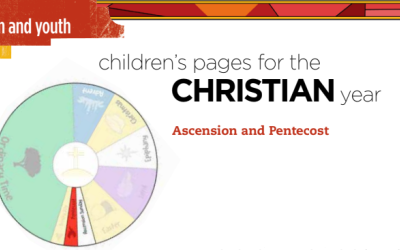
Ascension Day On the fortieth day of Easter, Jesus went up into heaven; he ascended from the earth. If you count the forty days starting with Easter Sunday, Ascension Day falls on a Thursday, though many churches observe it on the Sunday before or after. Do you ever wonder where Jesus is now? What is he doing? Why can’t we see him the way his disciples could? Ascension Day reminds us that Jesus is on the throne in heaven, praying for each one of us. Not only that, but whenever we hear the story of Jesus being raised up to be with God in heaven, we are reminded that one day we too will be raised to new life and live with God forever. I wonder what that will be like! The Ascension and Me Read Acts 1:6–11 or the Ascension Day story from a children’s Bible and then draw the part of the story that you would like to think more about. You could also respond to the story by writing a message to God. Pentecost When Jesus ascended into heaven, he promised to send the Holy Spirit to be our helper. The Holy Spirit helps us to believe in God, to share the good news of the gospel through our words and actions, and to remember the truths that are in the Bible. Pentecost, which we celebrate fifty days after Easter, is the day when all those who believed in Jesus received the gift of the Holy Spirit for the first time. Prayer Labyrinth This is a prayer labyrinth. It is a way for you to use your body to pray. Begin at the white path on the bottom of the flame and move your finger or a toothpick slowly along the path until it ends. When you get to the middle, take a deep breath and then turn back the way you came, moving your finger slowly along the path until you exit the flame. Ready to pray? As you move toward the end of the path, talk to God. What do you want to say to God? When you get to the middle, take a deep breath in and out, continuing to talk to God until you are done. As you move your finger back to the beginning, listen for what God is saying to you. Take another deep breath in and out and thank God for sending the Holy Spirit. Repeat as often as you would like. Fruits of the Spirit Have you heard of the “fruit of the Spirit” before? These are holy characteristics we will see growing in our lives if the Holy Spirit lives in us, but they are not things we can work hard to make happen on our own. Read Galatians 5:22–23. Can you name all nine fruits of the spirit and write them on the tree’s fruit? Fruits of the Spirit and Me What fruit would you like to ask the Holy Spirit for? Write it on the apple.

Read The Article

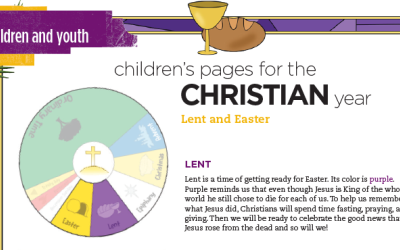
 LentLent is a time of getting ready for Easter. Its color is purple. Purple reminds us that even though Jesus is King of the whole world he still chose to die for each of us. To help us remember what Jesus did, Christians will spend time fasting, praying, and giving. Then we will be ready to celebrate the good news that Jesus rose from the dead and so will we!Lenten PracticesFastingFasting means giving something up. Is there something in your life that you want to stop, give up, or walk away from to help make more room in your life for Jesus? Some people choose to give up sweet treats or TV shows—not because these things are bad, but because giving them up reminds us that Jesus is the only thing we really need.GivingCan you name all the things that God has given you? The biggest gift we’ve received is Jesus dying to save us. That’s why in Lent we pray and ask the Holy Spirit to help us to be generous with the things God has given us. Can you think of something you could give on Easter Sunday to celebrate God’s gifts to you?PrayerDuring Lent, we are encouraged to spend more time in prayer. There are many different ways we can pray and talk with God. Here are a few:Prayer Walk—As you walk, say thanks for the beauty and goodness you see and pray for places where God’s help is needed.Prayer Art—Create some art while you talk to God.Prayer Writing—Write your prayer down as a letter to God or as a poem or song.Listening Prayer—Read a Bible verse and then ask God what God would like to say to you about it. Wait quietly. What would you like to say to God?EasterDid you know Easter isn’t just one day, but fifty days? It’s six weeks of Sundays plus all the days in between. The color of Easter is white or gold. During this time, we celebrate Jesus’ life with his friends after he arose, the fact that Jesus is still with us now, and that Jesus’ resurrection has made everything new.“Alleluia, Christ is risen! The Lord is risen indeed! Alleluia!”This is called an Easter acclamation. It’s a shout of praise that Jesus is no longer dead. Many churches will say this phrase all through Easter. What does your church do to celebrate that Jesus is alive?The Emmaus Road Easter CalendarDo you ever wonder what else happened on the day Jesus rose from the dead? He took a long walk. I wonder if his muscles felt tight from three days of lying in that tomb. I wonder if it felt good for him to get up and stretch his legs. What do you wonder about? Sometime on Easter Sunday, or the week after, read the story of Jesus’ Easter walk to Emmaus in Luke 24:13-35. What were Jesus’ disciples wondering about? What do you think Jesus was teaching them? Can you use Legos, clay or draw a picture about what you think Jesus may have said? There is one passage and one activity for each week of Easter.Easter 1 John 20:1–18 or Mark 16:1–8Activity: Read this week’s Scripture passage and make a piece of art inspired by Jesus’ resurrection. Send it to someone you know who could be encouraged by the reminder that Jesus is alive!Easter 2 John 20:19–31Activity: John says he wrote his gospel so that we would believe that Jesus is the Savior. Make a video of yourself celebrating something Jesus has done in your life. Share it with someone you know.Easter 3 Luke 24:36–48Activity: Think of people you know who may feel worried or afraid for different reasons. Each day, pray that they will know Jesus’ peace with them in the midst of hard or scary things. Think about calling them or emailing them to let you know you prayed for them.Easter 4 John 10:11–18Activity: Memorize John 10:14–15. How does it make you feel to know that Jesus is the good shepherd? What does that remind you of?Easter 5 John 15:1–8Activity: Go outside and look at a tree or plant that is growing. Think about how the plant takes in water from the roots, and the leaves, flowers, or fruit grow because they are connected to the stem, branches, or trunk. I wonder what it means to be connected to Jesus. Write or draw what you think.Easter 6 John 15:9–17Activity: In this passage, Jesus calls us his friends. I wonder how it feels to know that you are one of Jesus’ friends. Write, draw, or make something in response to the knowledge that Jesus loves you and calls you his friend. Whom would you like to share that with?

Read The Article
Advent Christmas Epiphany Children

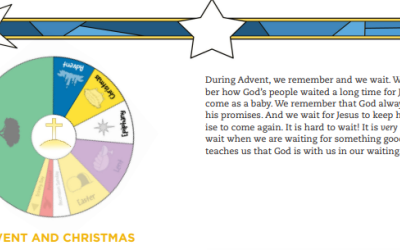
I remember celebrating only five holidays in church as a child: Christmas Eve, Christmas Day, Easter, Mother’s Day, and Father’s Day. Then in college I attended a church that followed the Christian calendar, and I was astonished by how many holy-days I had never heard of even though I grew up in the church. I also learned that Mother’s Day and Father’s Day were not actually part of the Christian calendar! As a person who has a soft spot for traditions and warm memories, I instantly found myself enthralled with the Christian year. But the more I learn about it, the more I understand that it isn’t about those traditions or memories but rather is a complete reordering of the way we live our lives. As God’s people, we mark time by the birth, life, death, resurrection, and ascension of Jesus—the events we believe have forever changed this world.As both a children’s minister and a parent, it’s important to me that I do what I can to share this gift with children, to help them understand the colors, seasons, and celebrations of the gathered people of God as something more than precious traditions and warm memories. I want my children to grow up marking time by the holy events that changed history and seeing their lives as a part of God’s big story. So much of what children learn is absorbed through experience, and there is no substitute for participating in rich, meaningful experiences of worship around the Christian year with your church community and at home. This series of children’s pages is designed to supplement the rich, lived experiences of children, to provide language that children, parents, and church leaders can use to talk about those experiences, and to help children begin to see and live into the deep beauty of the story of the Bible.Each children’s page provides a visual Christian calendar to help children place the current season in the cycle of the Christian year. Each page also contains a brief explanation of the season and activities designed to help your child go deeper into what the seasons are all about. Children could use these pages during worship, at home with children and parents working through and talking about them together, or in a special class for children about the seasons of the Christian year. Perhaps children could share what they have learned with your congregation—there are many adults who could benefit from hearing these truths in the voice of a child! However you use these pages, I pray they will be a blessing to the children in your church community as they journey with Jesus.Free DownloadYou can download and make as many copies as you desire if you are a Reformed Worship subscriber. All others should email info@ReformedWorship.org for permission. https://tinyurl.com/y6s4btfjMore to ComeLook for additional pages in the next three issues of Reformed Worship that will cover the seasons and special celebrations of Lent, Easter, Ascension, Pentecost, Trinity Sunday, and Ordinary Time.Advent and ChristmasWhat is the Christian calendar?The Christian calendar is how Christians keep track of days, weeks, months, and years. It is a way for God’s people to keep track of time and to remember the story of Jesus all year round. The Christian calendar is full of special days and seasons that point us to Jesus. Our world has been changed by Jesus’ life. The Christian calendar helps us to live as people who are a part of God’s story, to walk in the light of Jesus Christ all year long.What is Advent?Advent is the beginning of the Christian year. It is the time to get ready for the wonder of Christmas. The color for Advent is sometimes blue and sometimes purple. These colors tell us that we should slow down and pay attention.During Advent, we remember and we wait. We remember how God’s people waited a long time for Jesus to come as a baby. We remember that God always keeps his promises. And we wait for Jesus to keep his promise to come again. It is hard to wait! It is very hard to wait when we are waiting for something good. Advent teaches us that God is with us in our waiting.Color the Advent WreathAn Advent wreath helps us wait for Jesus during Advent. Maybe you have seen an Advent wreath in the worship space of your church. Maybe you have one in your home. Each week, as we get closer to Christmas, the light gets brighter and brighter as more candles are lit. Pay attention to each candle as it is lit. Can you figure out what each one means?Have you ever had to wait a long time for something?Have you ever had to wait a long time for something?Draw a picture of yourself waiting for something very special.Draw a picture of what it was like when the waiting was finally over.What is Christmas?At Christmas, we celebrate Jesus’ birth. The color of Christmas is white or gold because it is a time for joy and parties. You have probably heard the story of Christmas many times. Christmas is a wonderful gift because it is the beginning of the best part of God’s story. When Jesus came as a little baby, the whole world changed, and it will never be the same again. This is why we celebrate with special songs and services. This is why we give gifts to one another—because in Jesus, we have been given life with God. It’s the only gift we’ll ever need!The Twelve Days of ChristmasWe celebrate on Christmas Day, but Christmas is also a season that lasts for twelve days! Each day during the season of Christmas, read a Scripture passage and color a star to remember to celebrate all season long!Isaiah 9:2–7Titus 2:11–14Isaiah 52:7–10Titus 3:4–7Psalm 98:4–8Philippians 2:5–11Hebrews 1:1–4John 1:1–5Galatians 4:4–7Psalm 148:9–13John 1:12Revelation 21:3–5What is Epiphany?Epiphany is a word that means Oh, I get it! It is also the name of one of the first Sundays of the new year, when we celebrate the Magi, the astronomers that followed a star to find Jesus. Some churches talk about the season of Epiphany, which goes all the way until the beginning of Lent. The color of Epiphany is white because it is a celebration. We all are invited to come and see Jesus, learn about him, and tell others too! Then we all get to say “Oh, I get it!” That is a reason to celebrate!Many people in the Bible knew Jesus but didn’t really know he was God until he rose from the dead. I wonder if you ever have a hard time remembering who Jesus is. We all need the Holy Spirit to show us who Jesus is. We need the Holy Spirit to help us say, “Oh, I get it!”Help the Magi find JesusInstructions: Can you trace the path from the wise men to Mary, Joseph, and the young Jesus?Reformed Worship grants permission to subscribers only when using the children’s pages to reprint and reproduce for noncommercial use for worship purposes. Proper credit must be given at least once on the reprinted material as listed here “From Reformed Worship 137 © 2020 Worship Ministries of the Christian Reformed Church. Used by permission.” If you are not a subscriber, please seek permission at info@reformedworship.org.

Read The Article