

Please wait while we generate your results...
“We can sing our faith for all to hear, but it has to start with the pastoral musician. When we establish a culture of singing our faith with intentionality and discernment led by the Holy Spirit and study, others will begin to trust our message and meet us in praise of God in the context of Christ’s sacrifice. We will sing authentically to God in the presence of our fellow brothers and sisters for all to hear, resonate with, learn from, and remember why it is we became Christians in the first place.”
—Adán Fernández, “Developing a Culture of Singing,” © September 2017, ReformedWorship.org, CC BY-NC-SA 4.0.

This candle lighting originally appeared in the Advent series "Amazing Love: An Advent Series Based on Hosea."Lighting the Advent Wreath—Week 1Child: Why do we light the first Advent candle?Parent: We light one candle today because this candle represents our time of waiting for the coming Savior. This first candle reminds us of the light of hope that the prophets promised to us in the Old Testament. Each Sunday in Advent we will light one more candle as the promise unfolds.Child: Who will bring this light of hope to the world?Parent: Jesus is coming! The promise of the prophets is coming true. Jesus, the light of the world, has come to earth and will come again.Lighting the Advent Wreath—Week 2Child: Why do we light this second Advent candle?Parent: We light two candles today because the second candle points to the peace that God gave to us through Jesus.Child: Why do we light one more candle each Sunday in Advent?Parent: Because Jesus is coming again. Because light gradually pushes out darkness. Jesus, the light of the world has come to earth and will come again.Lighting the Advent Wreath—Week 3Child: What does this third Advent candle mean?Parent: We light three candles today because the third candle means love, which God gave to us through Jesus. Jesus’ birth and the coming of God’s love was first told to Mary and has since been spread through all the world. We too must share Jesus’ love with each other.Child: Why do we light one more candle each Sunday in Advent?Parent: Because Jesus is coming again. Because as light gradually pushes out darkness, love gradually pushes out hate. Jesus, the light of the world has come to earth and will come again.Lighting the Advent Wreath—Week 4Child: Why do we light four candles today?Parent: We light four candles today because it is the shortest, darkest time of the year. We need more light today than ever.Child: I remember too that Jesus is the light of the world.Parent: Every candle we light reminds us that the light of Jesus pushes darkness away from our livesAdvent Candle Song“Light One Candle”(st. 1) Sleeth Note: This song is best used by adding one stanza each week and adapting the music where needed to end appropriately.
This is part of the worship series, "Amazing Love—An Advent Series Based on Hosea"Series Introduction Advent 1 | Advent 2 | Advent 3 | Advent 4Fourth Sunday in AdventFlourish Like GrainScriptureHosea 14; John 12:23–26Song Suggestions for Week Four“My Soul in Stillness Waits” Haugen“Change My Heart, O God” Espinosa“Savior of the Nations, Come,” Luther “Breathe on Me, Breath of God” Hatch “O Christians, Haste” Thomson“To God Be the Glory” Mills Call to Worship From Scripture: Psalm 96In Song: “Humble Thyself in the Sight of the Lord” HudsonLighting the Advent WreathChild: Why do we light four candles today?Parent: We light four candles today because today is the shortest, darkest day of the year. We need more light today than ever.Child: I remember too that Jesus is the light of the world.Parent: Every candle we light reminds us that the light of Jesus pushes darkness away from our lives and God’s world.Advent Candle Song“Light One Candle”(st. 1–4) Sleeth Sermon Helps: “Flourish Like Grain”The final Advent sermon before the Christmas celebration is based on the surprisingly joyful and hopeful chapter 14. Replete with images of growth and blossoming, this passage must surely have seemed unrealistic during Assyria’s great threat to Israel’s territory and sovereignty. And, in fact, Israel did succumb to Assyria’s conquest. So then, where were hope and joy?This passage reminds God’s people not to place hope in human might as Israel had done by trying alliances with Egypt, even with Assyria itself. (Psalm 146 would surely be a fitting reference somewhere in this service, perhaps as a reading immediately following the sermon.) Instead, God promises to change the definition of prosperity and security. Love and forgiveness will replace superiority and power politics.Two images from the Scripture passages can be used in this sermon for vivid communication of Christian truth. From Hosea 14 comes the image of “dew to Israel.” In that arid land, the dew would at rare times be so heavy that it would provide enough moisture for growth. That is, int he most unlikely place and time, God’s love, blessing, and power can take root and flourish. Yet the second image from John 12 of the seed dying turns human attention to Christ—who flourished by dying, who turned human power upside down.Thus in Advent and at Christmas, which is the time of God’s “coming down,” God’s people also must look forward to Good Friday, to the death of God’s Son and Seed, and to Jesus’ resurrection. Jesus sacrificed himself—but in dying brought new life. God’s people can sacrifice themselves by bringing hope and life to hopeless refugees, by waiting for wayward children. Or, to return to the guiding image of Hosea, a closing example can be made of a spouse sacrificing herself or himself, waiting beyond human endurance for the other to return. Revised Common LectionaryYear B: Advent—Fourth Sunday of Advent
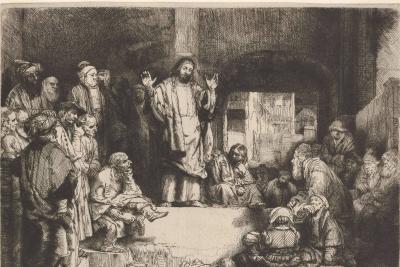
This is part of the worship series, "God in Three Persons"Series Introduction Week 1 | Week 2 | Week 3 | Week 4 Trinity SundayThe Triune GodScriptureJohn 16, 17Sermon-Building IdeasHave you ever found yourself in this position? You are surrounded by a catechism class of eager eighth-graders. In an attempt to teach the concept of the Trinity, you quote the creedal statement: “So the Father is God, the Son is God, and the Holy Spirit is God; but there are not three Gods, but one God.” Invariably you are confronted with the puzzled faces of teens who secretly wonder if you are mathematically challenged. To regain their confidence and understanding, you try a few analogies. You might compare the Trinity to water (three forms as vapor, liquid, ice, yet one substance) or the flags of many nations (three colors, one flag) or the triangle (three separate sides, yet one geometric figure).Naturally we try to grasp the concept of the Trinity mentally so we can understand God’s nature. Yet in the Bible this God, who wants to be known by us, never really seeks to explain that triune nature. God is simply there. The greater priority is that we know God experientially and love him with mind, heart, and body. This biblical truth was not lost on Rembrandt. Although we are unable to see the Father with the physical eye, God is actively among us through the visible Christ by the insightful work of the invisible Holy Spirit. The triune God is revealed throughout the Bible, and his presence and work is interwoven through the daily living of our faith.Jesus’ prayer conveys the intricacy involved in the relationship of the three persons of the Trinity and the believers’ close attachment. John frequently uses the term abide in to express this proximity. The prayer indicates that serious indwelling is going on. The Father is in the Son, the Son is in the Father, believers are in the Father and the Son, and the Son and Father are in the believer(s). All this happens because of the subversive yet essential work of the Holy Spirit, (cf. John 14:26). The bonds are so complex as to be inseparable, yet all parties retain their own distinctive identity. Simultaneously, identity is defined through relationship to each other.Attempting to analyze these complex interrelationships leads us into mystery. Exhort God’s people to worship and celebrate the triune God as they witness the signs of his presence. Like a panoramic view and surround sound, the Trinity is all around, revealed in the Word and in our worship:in Genesis 1:1-3 and John 1:1-18; Genesis 1:26-27 and Genesis 2:18-25; Isaiah 61 and Luke 4:14-21; Luke 1:26-38; Mark 1:9-11; 2 Corinthians 13:14in the letters written to the seven churches (Rev. 1:9-3:22)in the blessing that comes from God via a pastor’s benedictionin hymns like “Holy, Holy, Holy,” “Of the Father’s Love Begotten,” “Father, I Adore You,” “Now Thank We All Our God”in our unison confession of the Apostles’ and Nicene creedsin the call that invites us to respond to the Great Commissionin our celebration of the Lord’s Supperin the Word proclaimedin the opportunity to witness a baptismin our seeking to live as baptized peopleInvite the community to participate in trinitarian life—more proclaiming, less explaining.We engage in the triune nature of God in the unity and diversity of the faith community: in Spirit-inspired praise to the Father for the love shown in Jesus ; in a handshake or a hug of a beloved sister or brother in Christ; in the fellowship of a potluck lunch in the church basement. Or how about on the basketball court or in a game of pick-up hockey? Where else does the trinitarian nature of God reveal itself? All around, in the mundane yet supernatural ministry and life of God’s people.Do we have the faith-eyes to see the triune God among us? Some of us still may have a tough time trying to see that three-dimensional image in the magic-eye picture. Good thing our lives don’t depend on it. Our lives do depend on eyes to picture ourselves seated with the crowd in Rembrandt’s etching, compelled by the Holy Spirit to receive the Word of the Father’s love through the voice and hands of Jesus. Sung PrayerHoly God, we praise your Name;Lord of all we bow before you.Saints on earth your rule acclaim;all in heaven above adore you.Infinite your vast domain;everlasting is your reign.Holy Father, holy Son,Holy Spirit, three we name you,Though in essence only one;undivided God, we claim youand, adoring, bend the kneewhile we own the mystery.—Te Deum, 4th cent.; vers. Ignaz Franz; c.1774; tr. Clarence A. Walworth, 1853, alt. public domain. PrayerTriune God, Father, Son, and Holy Spirit, you know the futility of our fumbling attempts to comprehend you. Time and again we are left exhausted by our finite minds’ endeavor to grasp your infinite Being. We are humbled and thankful you have revealed so much of yourself to us: a Father who creates and provides, who reaches out in electing love and embraces us. A Son who shares in our humanity, who died and rose that we may reign with him. A Spirit who opens our minds and hearts, who brings us into trinitarian truth. Lead us to own this mystery. Teach us to live the Trinity. Amen.SongsMost hymnals include songs on the Trinity as a separate section and/or in a listing in the topical index. Choose a trinitarian hymn for the opening hymn, as a response to the sermon, and as a doxology. Consider introducing a doxology that will be sung throughout the summer months. Here are some suggestions:“Holy God, We Praise Your Name” Unknown“Come, Thou Almighty King” Anonymous (stanzas 1-3 at the beginning of the service; stanza 4 as a doxology)“Father, We Love You” Adkins “Abide with Us, Our Savior" Stegmann Revised Common LectionaryYear C: Season after Pentecost—Trinity Sunday

Connect
Reformed Worship Resources in Your Inbox
Sign up for the newsletter to receive the latest Reformed Worship resources and other news.
