Resources by Bethany Besteman

The Lord is My Shepherd Reiffer

This is part of the worship series, "Psalm 23"Series Introduction Week 1 | Week 2 | Week 3 | Week 4 | Week 5Week 6 | Week 7 | Week 8 | Week 9 | Week 10Week 11 | Week 12Week 2Green Pastures and Still Waters “He makes me to lie down in green pastures;He leads me beside the still waters” (Psalm 23:2, NKJV).Weekly EmailWhat are the green pastures and still waters in your life that God has blessed you with? What blessings bring you peace and rest? Do you have a favorite corner of the couch that you curl up on? Is there a neighborhood coffee shop you feel at home in? Is there a friend who calms you down every time you are in their presence? Praise and thank God for these green pastures and quiet waters. If this verse doesn’t feel true for you this week—if life feels filled with deserts and rough seas—maybe spend some time remembering what God has done for you in the past and allow that to comfort you in the present moment. Sermon Ephesians 1:3–14, “Blessings”Sermon notes by Rev. Stan Mast are available from the Center for Excellence in Preaching.Children’s MessageLast week we talked about God the shepherd, and we mentioned a few different ways God is like a shepherd: God corrects us when we sin, God guides us, and God is all around us when we need him or when we feel sad or lonely. This week we are focusing on a different way that God is like a shepherd. Today’s verse tells us that God “makes me to lie down in green pastures” and “leads me beside the still waters.” Green pastures are places where there is soft green grass and where the water is quiet. [Spend time wondering together, asking questions such as the following.]I wonder what it would be like to lie down in a green pasture—to lie down on soft, green grass. Do you have any ideas about what that would be like? What about lying beside quiet waters? I wonder what that would be like. Have you ever lain down by a small stream? I wonder what quiet water sounds like. Would you like to go somewhere that had green grass and quiet waters?  Where are some places you don’t want to go? Today we are going to be talking about how God brings us to good places like green pastures and quiet waters—places that are safe and comforting. I wonder what some of the safe and comforting places in your life are. How might we thank God for the safe and comforting places in our life? I wonder what we could do right now in our time of worship to praise God for the good things God gives us. [If one of the children says “pray” or “sing a song,” use that to transition into the next part of the service.] Song Suggestions“God Is So Good”  Makai“Ten Thousand Reasons” Redman“Savior, Like a Shepherd Lead Us” ThruppPrompts for Reflection During the WeekPoem: Make an acrostic poem. Write a word or words from the verse vertically on a piece of paper and, for each letter, name a blessing that begins with that letter. Faith Practice: CelebratingArtwork: Take a piece of paper and draw a stream down the center of it lengthwise. On one side of the stream write down ways God has blessed your body; on the other side of the stream write down ways that God has blessed your mind. In the stream itself write down ways that God has blessed your soul. You can make this more creative by using green and blue pencils or pens to write or by making the lists on green construction paper with a blue stream cut out and glued in the center. Faith Practice: RememberingActivity: Find time this week to go for a walk with a notebook and pen near a stream or by a field. Find a place to sit. Breathe in while saying to yourself, “He makes me to lie down in green pastures.” Breathe out while saying to yourself, “He leads me beside the still waters.” Repeat for a few minutes, and then sit in stillness, inviting the Holy Spirit to speak to your heart. After listening, you can spend some time journaling, either recording what God says to you or writing a letter back to God after you’ve listened to him. Faith Practice: ListeningRevised Common LectionaryPsalm 23Years A, B, C: Easter—Fourth Sunday of EasterYear A: Season after Pentecost—Proper 23 (28)Year B: Season after Pentecost—Proper 11 (16)Ephesians 1Year B: Season after Pentecost—Proper 10 (15)

Read The Article
The Lord is My Shepherd Reiffer

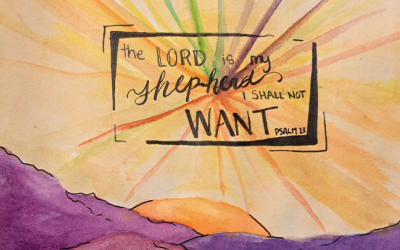
This is part of the worship series, "Psalm 23"Series Introduction Week 1 | Week 2 | Week 3 | Week 4 | Week 5 Week 6 | Week 7 | Week 8 | Week 9 | Week 10Week 11 | Week 12Week 1 God’s Work in Ordinary Time“The Lord is my shepherd;I shall not want” (Psalm 23:1, NKJV).Weekly EmailAfter Pentecost, the long season of the church known as Ordinary Time begins. The mountaintop experiences of the liturgical calendar are past, and the church enters into the everyday to experience God’s sanctifying work amid the ordinary. Ordinary Time corresponds at least in part with summertime, a season in which school finishes, travel happens, graduations are celebrated, and transitions are anticipated. If this is a time of change in your daily schedule, celebrating Ordinary Time can offer stability and grounding. Ordinary Time is a good time to return to well-loved and well-known Scripture—passages so well ingrained in us that we don’t remember when we memorized them, as if we’ve always known them. Psalm 23 is one such passage, and its first verse is one of the best known verses in all of Scripture: “The Lord is my shepherd; I shall not want.” What needs do you see met in your everyday life? Imagine your daily routine as a pasture you are being guided through. How does your shepherd care for you as you wake up? As you make coffee? Get the kids dressed? Get to work? Run errands? Make dinner? Get ready for bed? In the ordinary moments of your day, remember that God is your shepherd and that God takes care of you.Sermon Luke 15:1–10, “What’s So Great About a Shepherd?” Sermon notes by Rev. Chelsey Harmon are available from the Center for Excellence in Preaching.Children’s Message [Display or project a picture of a shepherd so that all the children can see it. If you choose, distribute small cards of the image and the blessing found below for the children to take home. You can also print more for congregants to pick up on their way out of the worship space.][Spend time wondering together using questions like these.]Does any of you have a special name that only your family calls you? Or do you sometimes shorten your name a little and just use a part of it? Some people have lots of names. In the Bible, God has lots of names. Can you think of some of God’s names?There is one name for God that we are going to be thinking about a lot this summer: shepherd. What does a shepherd do? I wonder why sometimes the Bible says that God is our shepherd? How is God like a shepherd? [Possible answers: he protects us; he watches over us; he helps us do the right thing.] Yes, and that’s why sometimes we call God our shepherd. This summer we are going to be thinking a lot about how God is our shepherd because we are going to be thinking about Psalm 23. The first verse of Psalm 23 says, “The Lord is my shepherd; I shall not want.” Another version of this verse says “ God, my shepherd! I don’t need a thing” (Psalm 23:1, MSG). Of course we still need some things, like food and water, but the psalm writer is telling us that we can trust God always to be with us and care for us. Isn’t that incredible? God—the Creator of the whole universe!—loves and cares for each of us, and because God takes care of us we can trust God with everything.When you pray to God you can call him God, Shepherd, or [one of the other names the children came up with]. Different names remind us of different things about God. When we pray to God and call him “Shepherd,” we are saying that God is someone we can trust. God is there for us, protects us, and is always with us even if we don’t see him. Let’s pray to our shepherd God now. [The children’s message can end here, or you can continue with the text below if you want to make use of the optional handout.]Optional Handout[Ahead of the service prepare a handout with a picture or line drawing of a Shepherd and the blessing found below. Make extra copies for older children and adults to pick up at the end of the service. A sample handout can be found in the resource section below.]As I was thinking about this name for God, I was reminded of a blessing sometimes given at the end of the worship service. I put it on these cards with a picture of a shepherd, and I’m going to give one to each of you so that you can read it or have a grown up read it to you every day this week. Listen to what it says: God goes before you to lead you, God goes behind you to protect you, God goes beneath you to support you, God goes beside you to befriend you. Do not be afraid. May the blessing of God the Father, Son, and Holy Spirit be upon you.Do not be afraid. Go in peace to love and serve the Lord. Amen.—Source unknownI hope that you will take this home with you and remember that God is always with you. You don’t have to be afraid about the future because God’s already there. You don’t have to be sad about what happened in the past because God is in the past as well. You don’t have to worry about the present because God is with you today too. I hope that helps you as much as it helps me.Song Suggestions“The King of Love My Shepherd Is” Baker“He’s Got the Whole World in His Hands” AnonymousPrompts for Reflection During the WeekJournaling: Make a list of all the ways a shepherd meets the needs of a sheep. Then extend the metaphor: what might God be doing in your life like a shepherd does in a sheep’s life? For example, a shepherd makes sure that a sheep receives food; in what ways does God make sure you are fed, both physically and spiritually? Faith Practice: GratitudeSensory: Using an old egg carton, start a sensory journey through the psalm. Each week, put something small into one of the egg holders that reminds you of that week’s verse. For example, perhaps this week you put a cotton ball in the first spot to give you a sensory memory for the idea of being a sheep in God’s flock. By the end of the twelve weeks you will have developed sensory memories associated with Psalm 23. This prompt will work well with young children who are just beginning to memorize Scripture, but it may also be a meaningful way for someone who has already memorized this psalm to experience it with more than just our eyes or our ears. Think of some creative ways to decorate your egg carton to reflect Psalm 23. Weekly Devotions: Spend time this week with the many different passages of Scripture that consider the metaphor of God as a shepherd, especially Isaiah 40, Ezekiel 34, Luke 15, and John 10. How do these passages shed light on the Psalm 23 meditation on God as our shepherd? Which passages use the metaphor to show God’s gentle and caring side? Which passages use the metaphor of shepherd to show God’s protective and defending side? Faith Practice: Engaging ScriptureRevised Common LectionaryPsalm 23Years A, B, C: Easter—Fourth Sunday of EasterYear A: Season after Pentecost—Proper 23 (28)Year B: Season after Pentecost—Proper 11 (16)Luke 15Year C: Season after Pentecost—Proper 19 (24)

Read The Article

  We are living stones who sing. Like stones that would have sung to fill the silence,we ring out: “How lovely are the feet of our good-news-bearing King!”Like Jacob’s pillow we declare: “Lay your head here and see visions of angels.”We are living stones who sing in the house of God.There are other stones,stones along the road:they mark the journey, they point to the sky. There also are stones in the valley; they say, “Trouble was here— here are the rocks we threw down to bludgeon our sins, to raze death’s fortress,to remove trouble from our midst.” But we—we are the living stoneswho have left the valley behind,who have been built up into altars on which is offereda sacrifice of praise,of self,of all. And here the body and the bloodare rededicated and shared,and they bind together the living stonesas we sing,as we sing,as we sing. 

Read The Article

The Word was told to hush the rowdy crowd, their off-key songs of praise that followed himand mingled with the rock dust raised by tramping      feet, percussive sandals slapping dirt so that to breathe was to inhale hosanna.       With a distant look he said, “Into the silence (should they cease), the rocks themselves would rouse, would raise the cry.” Hyperbole, as he was known to use, the rabbi never       one to pass a teaching moment by, but—more than merely figurative speech—did Jesus, saying so, evoke the rocksthat spoke along the path of Israel?Did he remember then a pillow turned to pillar where the angels had passed by, the tablets etched by God’s own hand that cried the law to rocky-hearted folks, the Jordan’s       boulders pried from under priests then piled twelve high, the slate slab Samuel declareda monument to Yahweh’s aid in war?When human voices faded, still the raised-up boulders stood as words without a word.They spoke, they testified, and, yes, they sangabout the deeds of God—a river-splitting,       heaven-dwelling, law-imparting God. Perhaps, as well, the Word remembered thenthe bloodied uncut stones of altars raised for sacrifice, which told the story of sin’s cost in every bright-red drip that droppedinto the cracks and pooled in crevices,persistent lullaby of life through death.If that grand choir of stones sang out to himamid procession’s brief cacophony,did Jesus hear as well the soloist’s deep breath and smile to know there was a stone aboutto offer rumbled, rolling gloria? About to start the final movement ofthe opera by crying out to allthe grief-choked world in endless echo: Love’sredeeming work, “He is no longer here!” 

Read The Article
Crown of thorns with bowl of water and pitcher

This week’s sermon text, John 20:1-18, has a profound yet simple testimony: “I have seen the Lord!” Where do we see the Lord today? When the Lord reveals himself to us, through scripture, creation, words of people, books, music, etc, we should also declare, “I have seen the Lord!” Other readings from the lectionary for today remind us that we are called to give account to the hope that we have. Easter equips us with both the words and actions to give such an account. 

Read The Article
Crown of thorns with bowl of water and pitcher

This week began with the joyful sounds of “Hosanna!” but now the crowds cry “crucify.” Jesus was the ultimate servant, giving his life for the sake of the world. While the price to follow Christ might not be as high for us today, Christ made it clear that following him will cost each of us something.  As Christ said, “Whoever wants to be my disciple must deny themselves and take up their cross daily and follow me. For whoever wants to save their life will lose it, but whoever loses their life for me will save it” (Luke 9: 23-24).

Read The Article
Crown of thorns with bowl of water and pitcher

Can you think of a situation in which explaining what to do wasn’t effective, so you needed to show the person how to do it? Jesus reverses this pattern: He starts by showing, then spends some time explaining. In the gospel of John, much of his final time of teaching the disciples has to do with love—his love for them, his hope that they will continue to love him, and his command that they love each other. But he begins all his teaching with a vivid demonstration of love: He washes his disciples’ feet. This act is set in the middle of John’s account of Judas’s betrayal. Jesus’ love is not dependent on his disciples’ behavior. It is offered in advance of and with full knowledge of all their coming cowardice, denials, and betrayals. And this act ends with a clear application: Show this same humble, servant-like love to each other.

Read The Article
Crown of thorns with bowl of water and pitcher

It is worth noting that in Luke’s account of the triumphal entry there is no mention of the Palms; instead Luke highlights the laying down of the coats, a sign of reverence and subservience. Little did Christ’s followers understand of what true service to God requires: Nothing short of our whole lives, not merely our cloak. Yet, though they did not grasp the deep significance of the pageantry unfolding in front of them, they played a significant part. The message of the angels proclaimed in Luke 2:14 —“Glory to God in the highest heaven, and on earth peace to those on whom his favor rests” —has now been taken up by Christ’s disciples, “‘Blessed is the king who comes in the name of the Lord!’ ‘Peace in heaven and glory in the highest!’” (Luke 19:38). As Christ’s disciples in the world today, we need to continue that refrain or else the stones will cry out in our place.

Read The Article