This is part of the worship series,
"In the Beginning Was the Word”
Series Introduction
Advent 1 | Advent 2 | Advent 3 | Advent 4
Introduction
In the article by Lester Ruth "Why Not "Move" Advent to November?", he suggests a calendar for celebrating Advent early, perhaps in November, for the purpose of spending more time during December on the rich doctrines of the Incarnation of Jesus Christ. Roger Eernisse took a similar approach in this four-week Advent series based on the opening verses, or prologue, to the gospel of John. Each week unpacks different aspects of the meaning of the Incarnation. Norma deWaal Malefyt prepared the music resources for this series; she was the Resource Development Specialist of Congregational Song for the Calvin Institute of Christian Worship.
What is the purpose of Advent if not to prepare for Christmas? The usual idea is that Advent is preparation for the birth of Jesus. But that can be confusing, since “Advent is not a season of Christian make-believe during which Church people pretend that they are back in the Before-Christ centuries, and hopefully awaiting and powerfully pleading for the Messiah to come,” as Patrick Cowley writes in Advent: Its Liturgical Significance (Morehouse-Barlow, p. 9). Instead, during Advent, the church remembers (looking back) that Christ did come and now prays (looking forward) for the complete accomplishment of the redemptive work of Christ. “The purpose of the Advent season,” Cowley writes, “is to rouse once again in the Church people the loving anticipation of the end, and to bid them to be prepared for it” (p. 43).
The End of the Story
In other words, Advent is a season of the church that is about the end of the story, not a time of preparation for the beginning of it. Advent is celebrated rightly by focusing on the second coming of Christ, not the first. This is a season of eschatology, not nativity.
The goal for this series is for the people of God to learn again the true significance of Advent so that they might grow in their understanding of the doctrine of the Incarnation and its implications for Advent and for the life of believers at all times.
How are we to accomplish that goal? Let me start with an analogy of the way many of us read a book. To begin, we might scan the jacket or flap to get an idea of what it is about. Next we might be tempted to peek at the end to see how it comes out. At which point we might decide we don’t have to bother reading it, since we know all there is to know. Wrong! While we may have some vague idea of the plot and some sense of the ending, we have missed the development of the characters, the significant subplots and ideas that thread their way through the overall story, and therefore the fullness of what the author intended.
So it is with our celebration of Advent. We find the central theme of our faith in Easter and the resurrection, the climax of the story. But to really appreciate the ending, to get the fullness of what the author, in this case God himself, wants us to discover about the Incarnation, we need to start at the beginning and follow the character development and subplots: the coming, birth, life, suffering, and death of Jesus Christ. Advent is the place to begin to understand the end of the story.
The Incarnation
Thus, “as ‘Alleluia’ is the triumphant theme song of Easter, so ‘Come’ is the watch-word or clarion call of Advent” (Cowley, p. 39). Whose coming are we awaiting? The Lord, the eternal Word, he who became flesh, the incarnate one. This makes the prologue of John’s gospel a perfect tool to celebrate this season—in it we can touch all the character development and subplots of Advent contained in the doctrine of the Incarnation.
Brian Hebbethwaite, in The Incarnation, suggests that the significance of the Incarnation can be spelled out in five headings: (a) revelation and personal knowledge of God; (b) trinitarian belief; (c) the cross as God’s own subjection to pain and suffering and death or atonement; (d) Christ as a living presence, with whom we have communion today; and (e) Christ as the means through which we shall finally be united with the Father. If in our worship for Advent we can proclaim that message, we will have properly celebrated the season. If in Advent, by a study of incarnational Christology, we can develop the character of Christ and understand the themes of his mission, then we are truly ready to look toward both Easter and his second coming with joy. And that is the true purpose of Advent.
This series is based on the prologue to the gospel of John as presented by Raymond Brown in the Anchor Bible Series: “An early Christian hymn, . . . which has been adapted to serve as an overture to the Gospel narrative of the career of the incarnate Word.”
Come, let us sing an Advent hymn.
Series Image
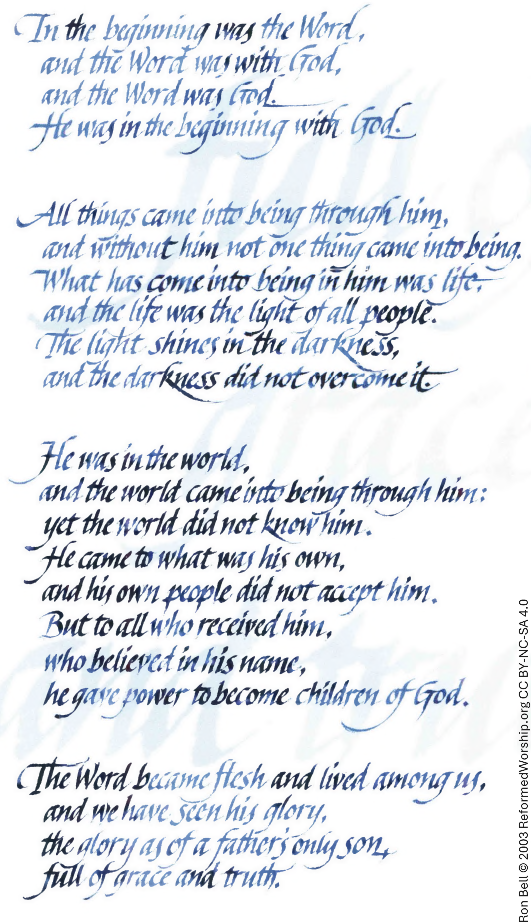
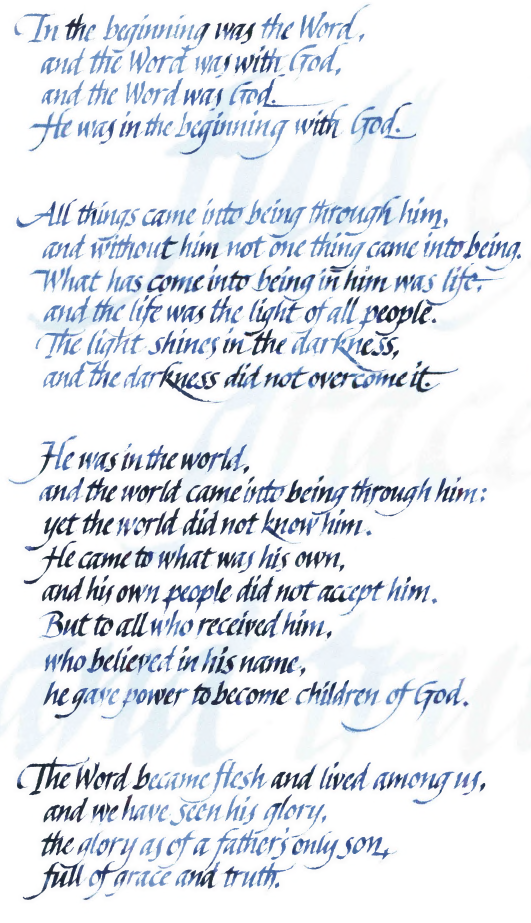
The image for this series can be found below in the resource section. It can be used by Reformed Worship readers for non-commercial purposes with the following copyright line: Ron Bell © 2003 ReformedWorship.org CC BY-NC-SA 4.0.
Series Outline
| Theme | Scripture | |
| Week 1 | The Word with God | Old Testament: Genesis 1:1–2 Epistle: Revelation 19:11–16 Gospel: John 1:1–2 |
| Week 2 | The Word and Creation | Old Testament: Isaiah 40:18–26 Epistle: Colossians 1:15–17 Gospel: John 1:3–5 |
| Week 3 | The Word in the World | Old Testament: Malachi 3:13–18 Epistle: Acts 7:51–53 (New Living Translation) Gospel: John 1:10–12 |
| Week 4 | Incarnate Savior of the World Who Is Coming Again |
Old Testament: Exodus 34:6–7 Epistle: Revelation 21:1–7 Gospel: John 1:14–16 |