This is part of the worship series,
"God in Three Persons"
Series Introduction
Week 1 | Week 2 | Week 3 | Week 4
Sunday Before Ascension sunday
God the Father
Scripture
John 16:25–28; John 17:1–3, 20–21; Psalm 104; Psalm 139
Confession of Faith
God formed sky, land, and sea;
stars above, moon and sun,
making a world of color, beauty, and variety—
a fitting home for plants and animals, and us—
a place to work and play,
worship and wonder,
love and laugh.
God rested
and gave us rest.
In the beginning
everything was very good.
—“Our World Belongs to God,” para 9. © 2008, Christian Reformed Church in North America, Grand Rapids MI. www.crcna.org.
Sermon-Building Ideas
Aaron, our seven-year-old son, needed to visit the allergist for testing due to a perennial sniffy nose. On arriving home he informed me that the problem was dust. My wife elaborated, explaining that the actual culprit was not the dust but dust mites living on the dust—literally thousands of microscopic bugs living on each dust particle. I was bemused at something so tiny causing such a problem. Just imagine—we have whole colonies of dust mites living right in our nostrils!
Creation is an endless source of inspiration. Psalm 104 reveals an awe-struck worshiper proclaiming God’s handiwork and praising God’s provision for all of creation. Nature exclaims a God of wildly creative imagination and incredible power—the Creator of everything from minuscule to mighty, mundane to mysterious. Consider time and eternity, the Milky Way, the boom of a thunderclap, the way of a man with a woman, the human hand, the complex kidney, the color blue, the scent of an Easter lily, the taste of ripe raspberries, the humor in a Jan Steen painting, the hearty wail of a child, the breath of life . . . it’s endless. If your sanctuary is equipped with slide projector and screen, you may want to collect nature slides and create a slide presentation accompanied with instrumental music or a soloist singing a song in celebration of the Creator.
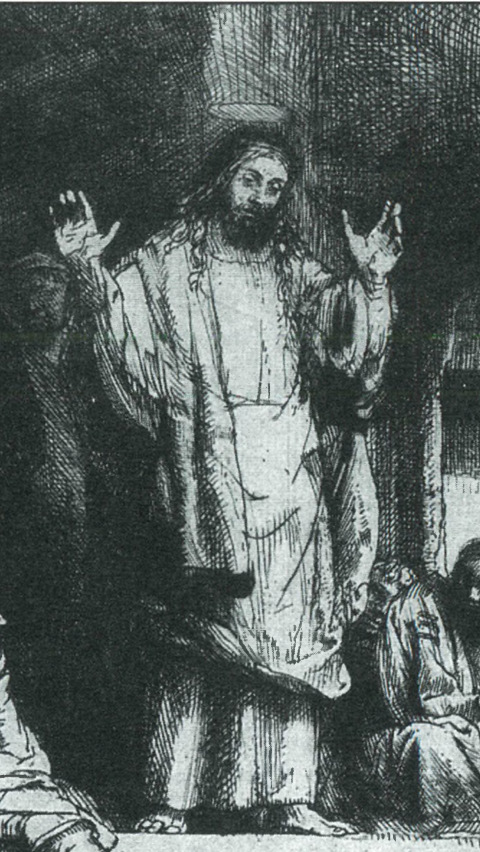
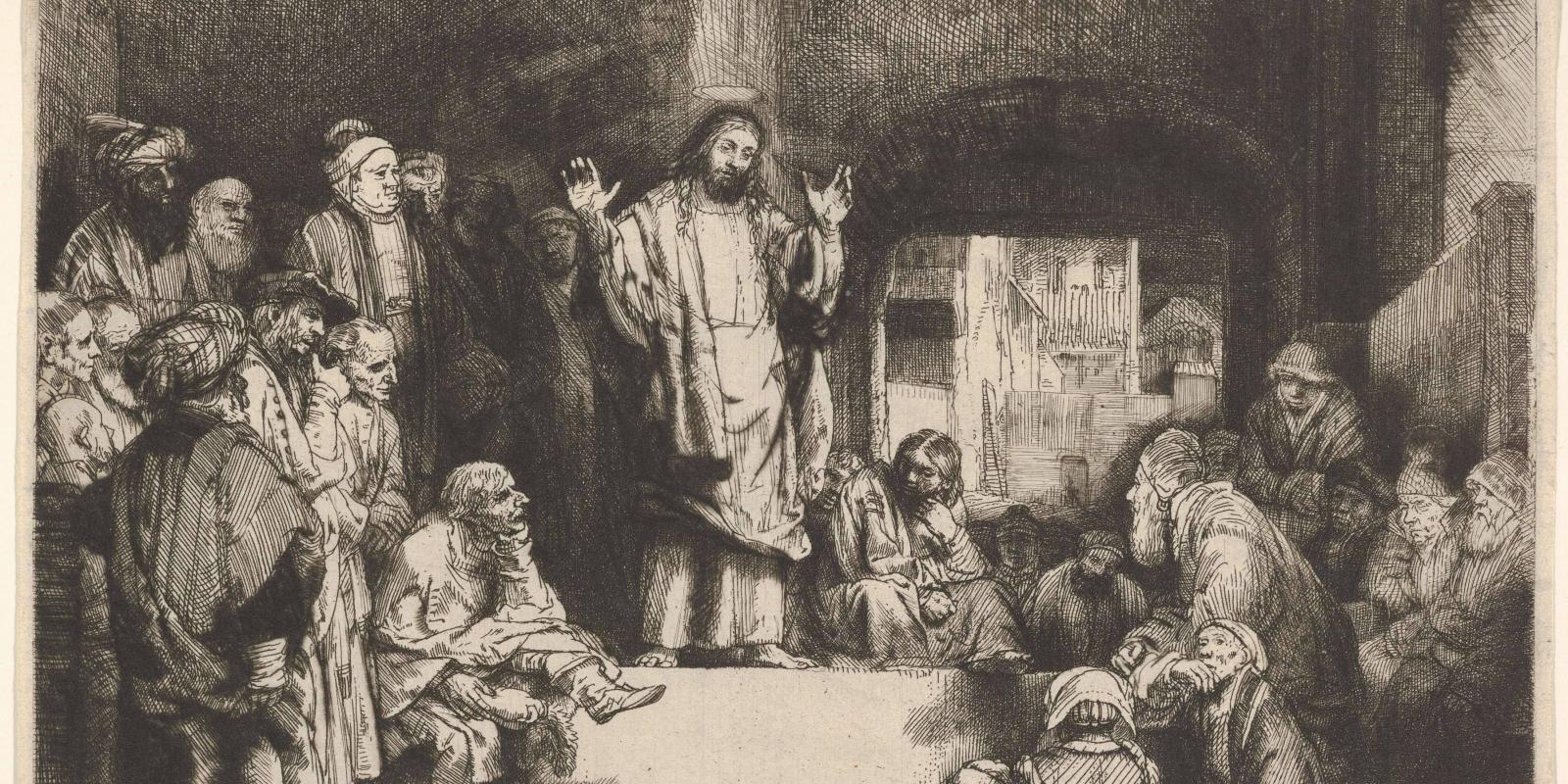
Unlike artists such as Michelangelo and William Blake, who, gifted as they were, helped give us the false impression that God is like a majestic grand-father with a flowing white beard and piercing eyes, Rembrandt never attempted to depict a visible image of God the Father. For the artist, the Bible revealed the Father as invisible Spirit, and the Father would remain so, as far as Rembrandt was concerned. Where is the Father portrayed in this etching? The artist’s work is more subdued than a theophanic shaking of thresholds and terrifying flutter of seraphs’ wings. The subtle stream of light above the head of Jesus tells us that an unseen force is at work in this scene. Jesus’ presence inextricably includes the invisible Father, as John’s gospel emphasizes. The large, significant hands of Jesus are prominently stretched over the gathered group, drawing the viewer to contemplate the providential hand of God. Perhaps the artist had, in his mind’s eye, the image of pastors with arms stretched before a congregation, pronouncing the blessing of the triune God. Each Sunday in church we receive the word of blessing through the voice of a pastor. In what ways have you witnessed the Father’s care in the past week?
Jesus prays that those who come to believe in him will know the intimate heart of the Father, whom we may call “Abba.” (John 17:26) The heart of the first person of the Trinity can be declared in one profound word: love. God is love (1 John 4:16). In The Return of the Prodigal Son, Henri Nouwen wrote about the Father image of God: “Here is the God I want to believe in: a Father who, from the beginning of creation, has stretched out his arms in merciful blessing, never forcing himself on anyone, but always waiting; never letting his arms drop in despair, but always hoping that his children will return so that he can speak words of love to them and let his tired arms rest on their shoulders.”
The Father patiently trusts that his magnetic love will pull his children home. Psalm 139 illustrates this inseparable bond our Maker has established. God formed us in secret and has knit us together. We cannot hide from him. We’re designed to live in our Father’s embrace. Nineteenth-century poet George Herbert expressed this article of faith in a poem, “The Pulley”:
When God at first made man,
Having a glass of blessings standing by,
“Let us,” said he, “pour on him all we can.
Let the world’s riches, which dispersèd lie,
Contract into a span.”
So strength first made a way;
Then beauty flowed, then wisdom, honor, pleasure.
When almost all was out, God made a stay,
Perceiving that, alone of all his treasure,
Rest in the bottom lay.
“For if I should,” said he,
“Bestow this jewel also on my creature,
He would adore my gifts instead of me,
And rest in Nature, not the God of Nature;
So both should losers be.
“Yet let him keep the rest,
But keep them with repining restlessness;
Let him be rich and weary, that at least,
If goodness lead him not, yet weariness
May toss him to my breast.”
—George Herbert, "The Pulley," Public Domain
Prayer
O Gracious and Holy Father,
Give us wisdom to perceive you,
intelligence to understand you,
diligence to seek you,
patience to wait for you,
eyes to see you,
a heart to meditate on you,
and a life to proclaim you,
through the power of the Spirit of Jesus Christ our Lord.
—St. Benedict, 480–547, public domain.
Songs
“This Is My Father’s World” Babcock
“Earth and All Stars” Brokering
Your Spirit, O LORD, Makes Life to Abound Unknown
Response to the Assurance of Pardon
“Glory Be to the Father”/“Gloria Patri” Anonymous
Revised Common Lectionary
Years A, B, C: Easter—Seventh Sunday of Easter