This originally appeared as part of the article "Singing the Sovereignty of Christ Over Creation" where you will find additional reflections and other congregational song suggestions on similar themes.
“Let Justice Flow”
Words (refrain based on Amos 5:24) and Music (LET JUSTICE FLOW irregular): Douglas Romanow © 1994 Douglas Romanow & Citizens for Public Justice
Music and Words are available in the hymnals Lift Up Your Hearts #295, Community of Christ Sings #286, Voices Together #791, and in the print issue Reformed Worship 112 p. 17. Reprints permitted with a CCLI license or by contacting Douglas Romanow at doug@douglasromanow.com.
|
Audio file
|
Audio file
|
Background
This driving stanza/chorus song with a contemporary feel was written as a theme song for the Canadian lobbying organization Citizens for Public Justice. Based in the capital, Ottawa, and comprising some 1,500 individuals, participating churches, and religious orders, this organization describes itself as “inspired by faith to work for justice.” Their stated goal is to work toward a better Canada in which no one lives in poverty, where care for the earth is a way of life, where refugees are treated fairly, and where the rights of Aboriginal people are respected. Through research and analysis, publishing, and public dialogue, they work to keep public justice front and center in policy debates. This song, written by Douglas Romanow—an accomplished Canadian songwriter, producer, and member of the Christian Reformed Church—articulates some of these motivating concerns. It echoes Amos 5 in calling on justice to flow down like a river to the mouths of the hungry, to the streets of the homeless, and through the courts of our nation.
Performance Suggestions
Where text is the most important concern of Shirley Erena Murray’s “Lament for the Earth,” rhythm is the motivating feature of “Let Justice Flow.” The chorus in particular should be sung with a sense of drive and pulse, like you might sing along to a Top 40 song on the radio.
The melody line could be brought out by trumpet, saxophone, or one or more violins. The style lends itself to a rhythm-section accompaniment style, with a driving piano rounded out by electric or acoustic guitar, drums, and bass. A drum kit would be
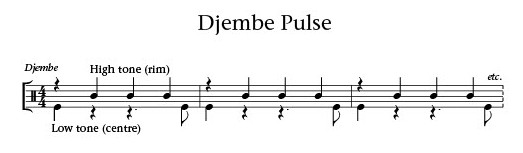
appropriate with this song; if none is available but you want to evoke the spirit of this sound, consider splitting it up among various hand percussion. The djembe can provide a basic pulse in the manner of a bass drum, whether simple or with improvised inner-beat embellishments.
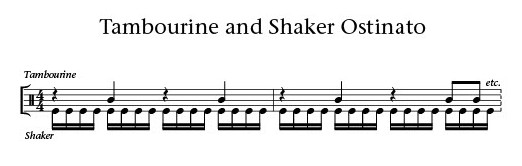
The higher kit sounds can be created by another player combining the sound of crisp high shakers (such as egg shakers) on the sixteenth-note divisions with tambourine attacks on beats 2 and 4. This is done by playing the shakers with your dominant hand while holding the tambourine in the other hand; the attacks on 2 and 4 are done by whacking the edge of the tambourine with the back or side of the shaker-playing hand.
Audio file
|
Audio file
|
Consider varying the accompaniment's texture to create variety across the singing of the song. You could employ the full band only on the chorus, then pull back to piano or rhythm section for the stanzas.
The chorus following the final stanza is a chance for some improvisatory play with your congregation; consider repeating the final chorus several times as the spirit is captured by the gathered singers. Vary the repetitions, and consider throwing in an extra a cappella chorus with percussion only. You might have the congregation sing throughout, or distribute the stanzas among soloists; consider also varying the congregational texture by having women sing stanza 1, men sing stanza 2, and all sing stanza 3. To conclude the song, you might like to turn the final line of the chorus (m. 8-9) into a repeated “tag,” repeating it two or three times as the singing comes to a close. An instrumental rendition of the chorus makes an effective introduction.
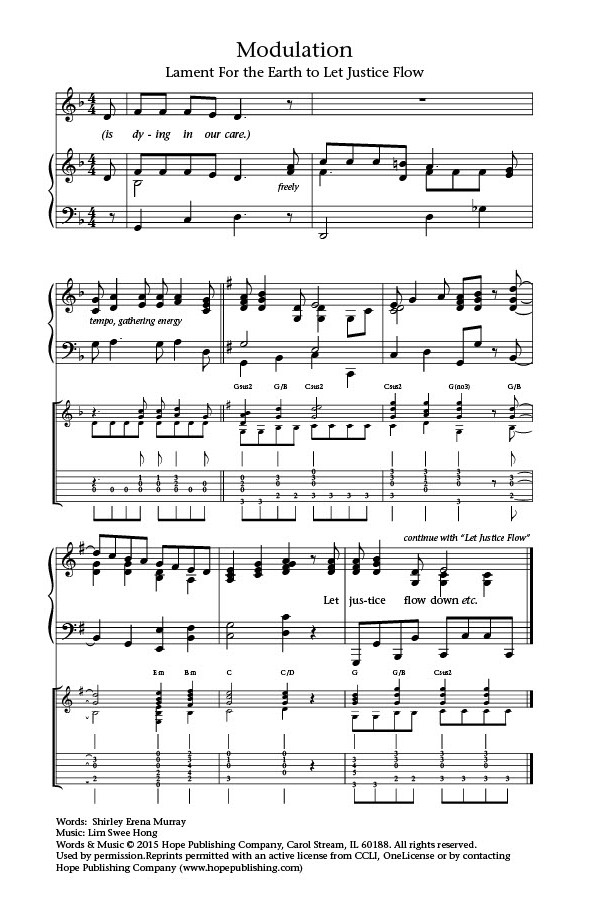
“Let Justice Flow” would be well-placed as a sung response to the prophetic Amos reading (Amos 5:1-24), or to the Beatitudes (Matt. 5:1-12). To give this pairing a touch of dramatic flow, consider underpinning the concluding phrases of the reading with the instrumental introduction, then rolling on without a break to the singing of the song. In a worship service whose themes focus on social justice and stewardship of the earth, consider pairing this song in a suite with Shirley Erena Murray’s “Lament for the Earth,” with “Let Justice Flow” serving as a conclusive call to action following the more plaintive introspection of Murray’s “Lament.” A realization is included below for a segue from the modal D minor of “Lament for the Earth” into the energetic G major of “Let Justice Flow Down.”