This is part of the worship series,
"Psalm 23"
Series Introduction
Week 1 | Week 2 | Week 3 | Week 4 | Week 5
Week 6 | Week 7 | Week 8 | Week 9 | Week 10
Week 11 | Week 12
Week 6
God’s Presence
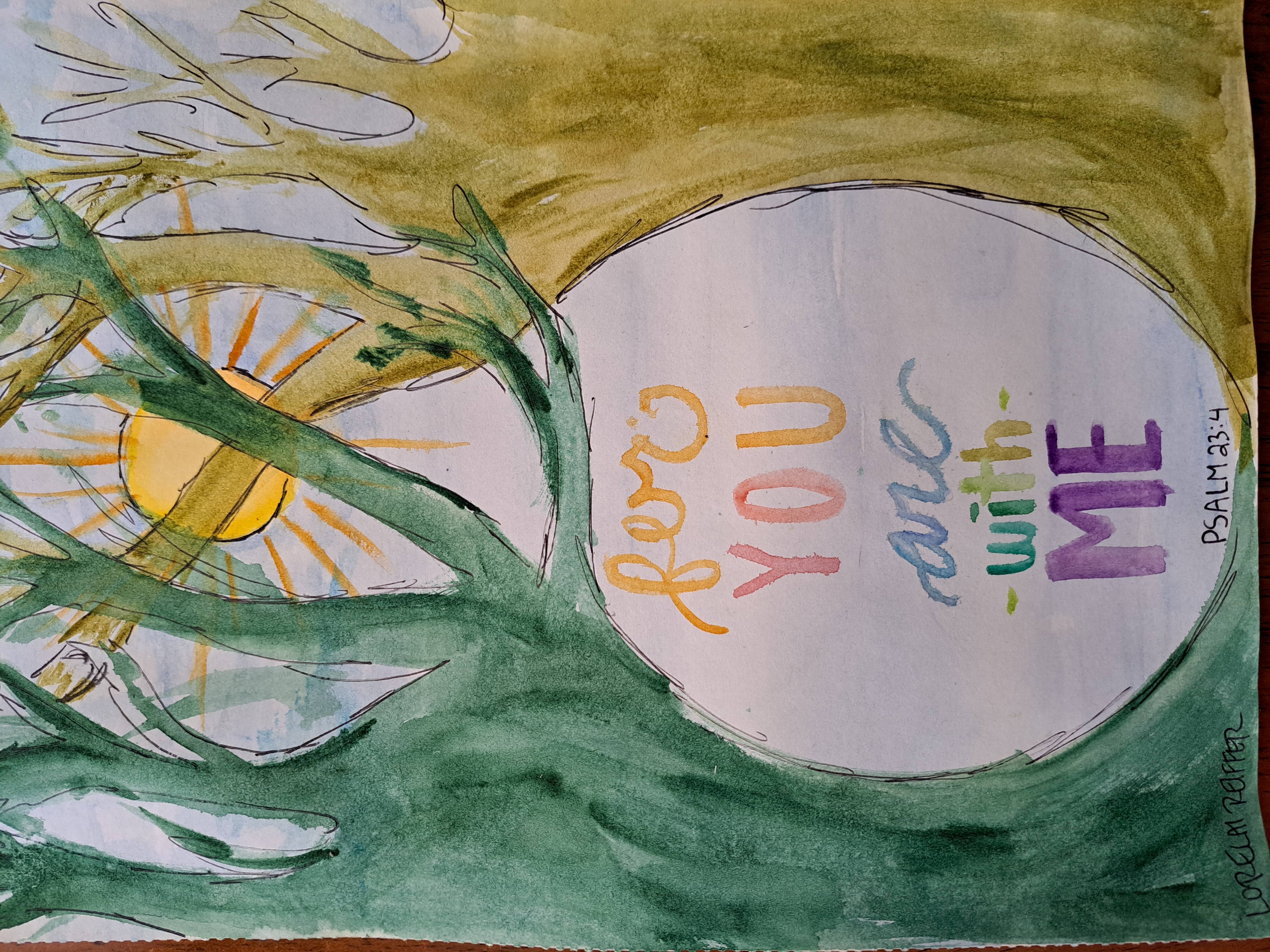
“For you are with me” (Psalm 23:4b, NKJV).
Weekly Email
The Good Shepherd’s companionship is the reason the sheep fears no evil despite being surrounded by the shadows of death. Can you remember a time in your life when you had to do something alone and you desperately wished you had someone there with you? A class presentation? A difficult conversation? Caring for a sick child or elderly parent? What about a time when you did have someone there beside you, and it made a difficult task easier to face? That is what this sheep experiences: comfort and assurance, the unclenching of the shoulders and the letting go of a breath you didn’t know you were holding, simply because you suddenly realize you are not alone. How does knowing that your Good Shepherd is with you change how you go into the difficult tasks of this week?
Sermon
Isaiah 43:1–7, "I Will Be With You"
Sermon notes by Rev. Scott Hoezee are available from the Center for Excellence in Preaching.
Prayer of Confession
[The children’s message this week functioned as the assurance of pardon following this prayer of confession.]
Last Sunday we talked about walking through the valley of the shadow of death. Many of us have walked or continue to walk through deep, dark valleys. God wants us to come as we are, to offer our hearts and our voices in prayer no matter what. Please pray with me:
Great is your faithfulness, O God.
We know this to be true
because you have proven yourself faithful to us
time and time again.
But even though we see and proclaim your faithfulness,
sometimes you feel very far off.
We often wonder if you will be faithful once again
or if you’ve forgotten us.
Sometimes we foolishly pray, expecting you to do what we want,
not what you want for your world and for us, your children.
Forgive us, God. Teach us to pray
“Your will be done.”
Walk with us through the deepest of valleys,
and once again show yourself to be faithful and good,
for you are with us. Amen.
Children’s Message
Assurance of Pardon: [After the prayer of confession, invite the children to come forward for the children’s message.]
In the prayer we just prayed, we admitted to God that we sometimes have a hard time waiting for God to answer our prayers or that we sometimes don’t really feel like God is listening to us. Do you have a hard time waiting? What are some things it is really hard for you to wait for? [Possible answers: Christmas, birthdays, summertime.] Sometimes we don’t always get what we want even when we wait for it for a long time, and this can make us sad. But does that mean that God doesn’t love us? [No.] In fact, we know not only that God does love us, but that God stays with us even when we are waiting and wishing for things to be different. Psalm 23:4 says, “You are with me.”
God doesn’t promise that life is going to be easy or that we will always get what we want, but God does promise that when things are difficult, we know God is there with us, loving us, guiding us, and giving us the courage we need to face whatever comes.
[The children’s message can end here, but if you want to use the optional handout you can continue with the text below.]

Optional handout
I have something for you to remind you of this wonderful truth. I’ve cut out these yellow felt figures that look as if they are holding hands, and I’ve written “Jesus” on one of them. I want you to write your name on the other one. You can take these with you. Maybe you can put yours on your desk at school, or you can ask your parents to put them on the fridge, on the bathroom mirror, or somewhere else you’ll see them every day and remember that no matter what, you are never alone.
And as we remember that God is always with us, in both the good and in the bad times, hopefully that will make us want to thank and praise God, so let’s sing a song doing just that.
Song Suggestions
“Great Is Thy Faithfulness” Chisholm
“Nothing to Fear” Zach Assad, and Wardell
“Blessed Be Your Name” Redman
Prompts for Reflection
Journaling Prompt: There are only five words in this week’s verse, so spend some time thinking deeply about each word and then journaling or free-writing your thoughts. Faith Practice: Engaging Scripture
Some prompts to get you going:
For—Here a synonym for “because,” this word links back to the previous statement “I will fear no evil.” Why does God’s presence cause us to fear no evil?
You—This is the first time the psalmist talks directly to God and not just about God. How does talking about God lead us to talking to God?
Are—God is . . . There are so many things we can put after that statement, but spend a moment reflecting on the fact that God is. What does that mean for you?
With—Here, God is with—not against, not behind, not above. While those other words might be true of God in other contexts, why is it especially comforting to know he is “with”?
Me—Who are you in relationship with God? Do you derive fearlessness from his presence?
Music Prompt: Listen to “Nothing to Fear,” Zach, Assad, and Wardell which uses language borrowed from this psalm but puts the words in God’s mouth instead of the sheep’s or psalmist’s mouth. When the words are spoken as a promise rather than as a declaration of faith, do you think about them differently?
Poem and/or Art Prompt: The five words of this week’s verse don’t carry a vivid image, so make one. What is God’s presence like? Write a list poem by starting with the line “God’s presence is . . .” or “God with me is . . .” and then writing a list of metaphors for God’s presence (a cup of hot cocoa on a cold winter day, a glass of lemonade on a hot one, etc.). This is also a good group activity. Each person in turn can come up with a metaphor until you are happy with your list. Use this as a springboard for a prayer of thanksgiving to the God who is with you. If inspired, choose one of the metaphors you just came up with to illustrate. Faith practice: Gratitude
Revised Common Lectionary
Psalm 23
Years A, B, C: Easter—Fourth Sunday of Easter
Year A: Season after Pentecost—Proper 23 (28)
Year B: Season after Pentecost—Proper 11 (16)
Isaiah 43
Year C: Epiphany—Baptism of the Lord