This is part of the Advent and Christmas worship series
"Remembering the Future"
Series Introduction
Advent 1 | Advent 2 | Advent 3 | Advent 4
Christmas
Christmas Day
Service Elements
Gospel Reading
Luke 2:15–20
Call to Worship
The people walking in darkness
have seen a great light.
Here in the valley of the shadow of death,
a light has dawned.
For unto us a child is born,
unto us a son is given.
On this glad Christmas Day we hail him,
our God and King!
Praise to you,
our Wonderful Counselor,
Mighty God,
Everlasting Father,
and Prince of Peace.
—based on Isaiah 9 NIV
Let us worship God.
For he lives and reigns forever and ever.
In the Name of the Child,
his Father,
his Spirit of Holiness,
grace to you and abiding peace
through the gospel of good news,
which is for all the people,
proclaimed and celebrated by us this holy day.
Amen.
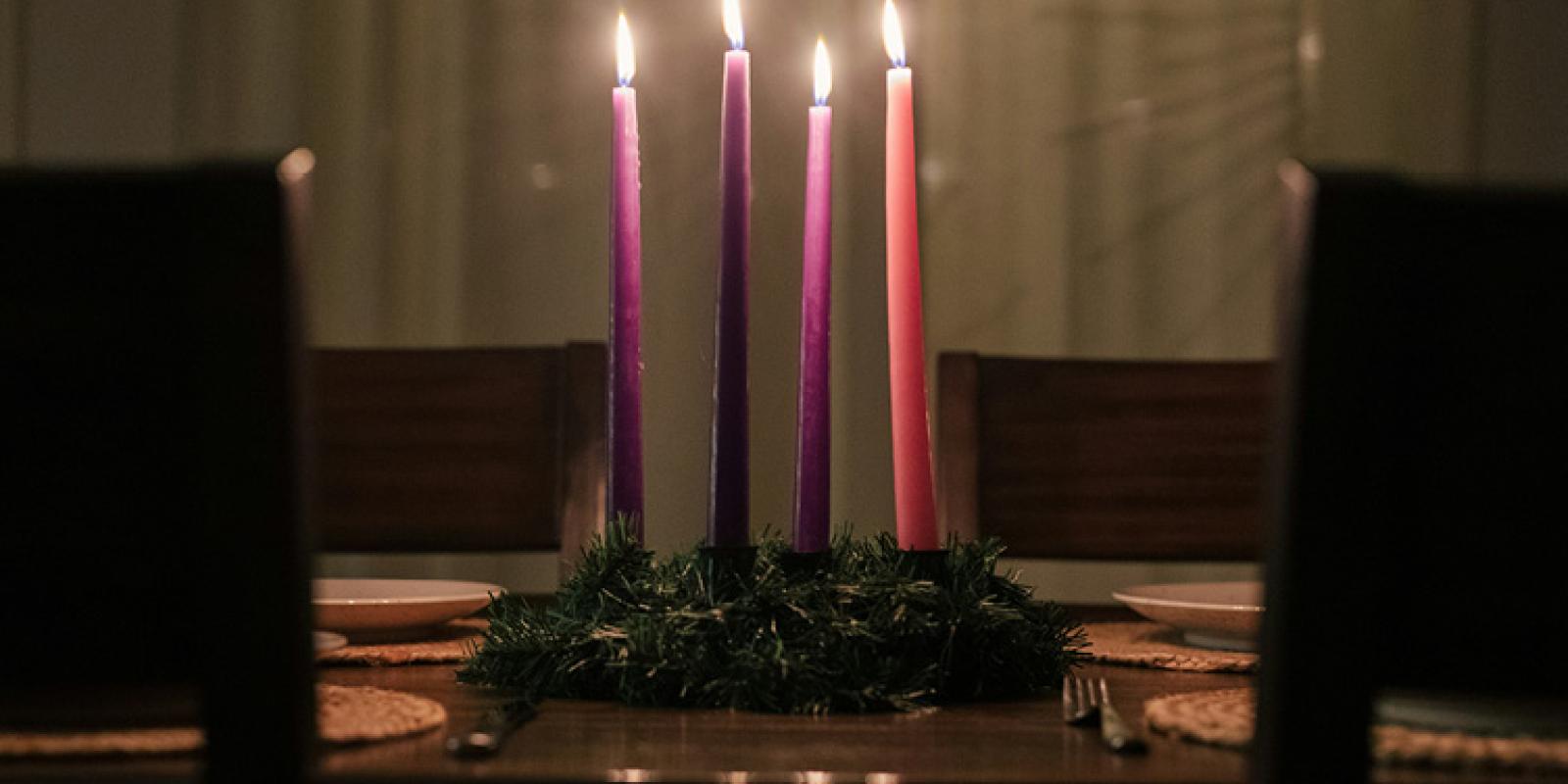
Advent Wreath Suggestions Reading
Reading
Today we light the Christ candle because today Jesus, the Light of the World, is born. As this candle burns in the center of the wreath, we re- member that Jesus brings us hope, joy, love, and peace, now and forever. We remember that Jesus is coming again some day and will bring us to his kingdom to enjoy all these good things forever.
Prayer
Dear God,
thank you for sending your Son, Jesus,
to our world.
We need him so much.
Fill us with Jesus,
now and every day.
Help other people
to be able to see Jesus in us.
Amen.
Sermon Sketch
Luke 2 is a busy chapter. Luke famously opens with a snapshot of the world in motion. With a stroke of his pen the Caesar managed to make the world jump. Everyone was on the move, on the road, away from home. Small wonder that even a dinky town like Bethlehem found its every lodging place with a No Vacancy sign swinging from the front porch.
But the hectic pace of Luke 2 is not restricted to Caesar’s doings. Eventually the hosts of heaven are also shown to be in full cry. The most serene image you get in Luke 2 is that of the shepherds drowsing in the fields. But that did not last long. The skies of that quiet night ripped open to reveal scores of fiercely bright angels, piercing the nighttime silence with their exuberant singing. This display unleashes still more activity as the shepherds im- mediately scurry off to Bethlehem.
Yet in the middle of this hubbub comes verse 19: “But Mary treasured up all these things and pondered them in her heart.” It is an odd insertion, arresting the action. Having had a lot to say in Luke 1, Mary does not say a word in this famous Christmas narrative. Instead she sits in silence with a furrowed brow.
Yet maybe we've never envisioned verse 19 as involving a furrowed brow of contemplation. Maybe the way we’ve mostly imagined this scene is of the holy virgin Mary with a look of utter calm and enraptured joy on her face. Certainly that is the primary way we’ve seen Mary depicted in art. But what if that were not the case? After all, it is possible to translate verse 19, “But Mary clutched at these things and tried to make sense of them in her heart.”
Suppose that the picture we have of Mary in verse 19 is one of reflective confusion. Keep in mind that she is a very young girl who has been the recipient of a flurry of surprising events and revelations the last nine months. In Luke 1 Gabriel greeted Mary like royalty. The archangel of almighty God all but bowed down before her to announce the arrival of something cosmic. But then, in the months that followed, perhaps Mary had occasion to wonder about all that as she endured a succession of morning sickness, stiff muscles, and clothes that would not fit. On top of all that, right about the time she was about as uncomfortable as she could get, Caesar ordered her to hit the road. We always picture Mary riding on a donkey, though the Bible nowhere mentions that. It’s possible, given the poverty of Mary and Joseph, that they did not own such an animal—that Mary had to walk mile after mile.
About the time Mary probably started to wonder just how much God was looking out for her after all, she arrived in Bethlehem, only to be shunted into a barn. The trauma of it all, not to mention the jostling of the journey, made Mary go into labor in that stable. This is not the way Mary had pictured things. Gabriel had not mentioned this!
Exhausted from the ordeal of childbirth and still bunking with the cows and goats, Mary’s mind had taken in about as much disconnected, disconcerting data as was possible. So she scooped up these events and guarded them in her heart as she tried to piece them together. It was all a puzzle. The verb we usually translate as “pondered” literally means “to throw together.” Mary tossed these divergent things into the hopper of her heart in hopes that eventually she would be able to figure it out. But for the time being events surely did not add up.
So what is Luke 2:19 doing in this text? Perhaps just this: sometimes in the Christian life the right posture to strike is one of thoughtful reflection. Maybe what Luke is trying to tell us is that the gospel is deeply mysterious, apparently incongruous, and worthy of serious reflection. The unalloyed joy of the shepherds is a good response, just as are our own busy celebrations during December. These are glad tidings of great joy.
But these are also serious matters of utterly surprising shapes and forms. And so while angels danced and shepherds sang, while cattle lowed and guiding stars twinkled, while townsfolk marveled and Joseph fretted, Mary sat silently and tried to make sense of it all. How well she succeeded that night or in the years to come we don’t know. But at least she recognized that the birth of the one whom the angels had called Savior and Lord had something—and just maybe had everything—to do with the world’s jagged, confusing edges. That’s why he came. Surely this is a truth to treasure, ponder, and proclaim.
Music Suggestions
Organ Music
- “Three Preludes on ‘Vom Himmel hoch’” by Ernst Pepping, Kleines Orgelbuch (B. Schott’s Söhne 3735, 1968)
- “Chorale Partita on ‘From Heaven Above to Earth I Come’” by Paul Manz (MorningStar MSM-10-120, 1993)
- “Von Himmel hoch da komm’ ich her” by Johann Pachelbel, Church Organist’s Golden Treasury, Volume 3 (Ditson 79006-183, 1951)
- “Divinium Mysterium” by Gerald Kemner, Fantasies on Nine Familiar Hymn Tunes (Augsburg 11-5919, 1990)
- “Of the Father’s Love Begotten” by Wilbur Held, Six Carol Settings (Concordia 97-4985, 1970)
Hymn Suggestions
- “Joy to the World, the Lord Has Come” Watts
- “O Come, All Ye Faithful” Wade
- “Emmanuel” McGee
- “Glory, Glory, Glory”
- “From Heaven Above to Earth I Come” Luther
- “Of the Father’s Love Begotten” Prudentius
Revised Common Lectionary
Year C: Christmas—Nativity of the Lord