
Resources by David Koll

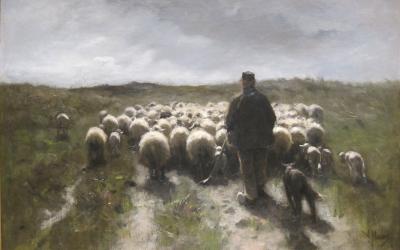
Shepherd_and_Sheep'_by_Anton_Mauve

This is part of the worship series"The Lord, Our Shepherd"Introduction Lent 1 | Lent 2 | Lent 3 | Lent 4 | Lent 5 Palm Sunday | Maundy Thursday | EasterHome DevotionsSECOND SUNDAY IN LENTHe makes me lie down in green pastures, he leads me beside quiet waters, he restores my soul. ScriptureIsaiah 49:8–12; Matthew 6:24–34Sermon“Greener Pastures”Sermon IdeasIt was easy to work into the message by recognizing that we are predisposed to wanting what is green—and it’s always greener on the other side of the fence. We’re always searching. God is the only one who will truly satisfy; God is our green “pasture” (Jeremiah 50:7). Our problem is that we are color blind. We go after artificially green pastures: money, sex, self-fulfillment. The idea of walking beside “quiet waters” and finding “green pastures” is, indeed, attractive, and it’s a frequent biblical theme. Only in seeking God are our souls truly satisfied and restored. The challenge is to learn to tune in to God’s voice, which is constantly calling us to claim God’s compassion and favor (Isaiah 49:8–12).Song Suggestions“As the Deer” Nystrom“Go Now in Peace” Sleeth“Like a River Glorious” Havergal“Spirit Song” Wimber“Wait for the Lord” TaizéLitany of ConfessionReader 1: Israel is a scattered flock that lions have chased away. —Jeremiah 50:17Reader 2: My people have been lost sheep; their shepherds have led them astray and caused them to roam on the mountains.—Jeremiah 50:6People: We all, like sheep, have gone astray. —Isaiah. 53:6Reader 1: Suppose one of you has a hundred sheep and loses one of them. Does he not leave the ninety-nine in the open country and go after the lost sheep until he finds it? —Luke 15:4Reader 2: When he saw the crowds, he had compassion on them, because they were harassed and helpless, like sheep without a shepherd. —Matthew 9:36People: We all, like sheep, have gone astray, each of us has turned to his own way. —Isaiah. 53:6Reader 1: He himself bore our sins in his body on the tree, so that we might die to sins and live for righteousness; by his wounds we have been healed. —1 Peter 2:24Reader 2: For you were like sheep going astray, but now you have returned to the Shepherd and Overseer of your souls. —1 Peter 2:25People: We all, like sheep, have gone astray, each of us has turned to his own way, and the Lord has laid on him the iniquity of us all. —Isaiah 53:6Wednesday "Strolling With the Shepherd" ServiceReflective Music“He Leadeth Me” GilmoreGathering LitanyOur Shepherd leads us and gathers us today to worship:Led into green pasturesand beside quiet waters,We come to worship.Led out of wantand into restoration,We come to worship.Led by righteous pathsand for the sake of our God’s good name,We come to worship.Led through dark valleys of death’s shadowand out of our fears,We come to worship.Led towards the house of the Lordand secure in our shepherd’s presence,We come to worship.—Bethany Besteman © 2025 ReformedWorship.org, CC BY-NC-SA 4.0. Used by permission.Opening Hymn“Come, Thou Long Expected Jesus” WesleyScripture Readings:First Reading: Psalm 103:1–5 This is the Word of the Lord. Thanks be to God![A moment of silent reflection] Second Reading: Isaiah 49:18–23 This is the Word of the Lord. Thanks be to God![A moment of silent reflection] Third Reading: 2 Peter 1:16–19 This is the Word of the Lord. Thanks be to God![A moment of silent reflection] Hymn of Response“What Wondrous Love” AnonA Time of ReflectionWhat have you been learning so far this lent season? What has God been saying to you?What do we need to pray about tonight?A Time of PrayerParting ScripturePhilippians 3:20–4:1Closing Song“God Be With You Till We Meet Again” RankinRevised Common LectionaryYear A: Lent—Fourth Sunday in Lent
Read The Article
Shepherd_and_Sheep'_by_Anton_Mauve

This is part of the worship series"The Lord, Our Shepherd"Introduction Lent 1 | Lent 2 | Lent 3 | Lent 4 | Lent 5 Palm Sunday | Maundy Thursday | EasterHome DevotionsFIRST SUNDAY IN LENTThe Lord is my shepherd, I shall not be in want.Sunday MorningScripturePhilippians 4:10–19; Matthew 6:25–34Sermon“What do you want?”Sermon IdeasThe message began by referring to a humorous article that described America’s snack habits and made personality inferences based on the snack preference. I went on to speak about the difference between needs and wants, and God’s promise to give us true wealth, that is, “the glorious riches of Christ.”The message concluded with Psalm 73:25: “Earth has nothing I desire besides you.”Song Suggestions“I Offer My Life” Cloninger, Moen“More Precious than Silver” Maranatha! Music“Psalm 23” SNC 181“Seek Ye First” LaffertyLitany of Confession for all WeeksThis litany, based on Isaiah 53, can be used for each of the services in this Psalm 23 Lenten series.Reader 1: Israel is a scattered flock that lions have chased away. —Jeremiah 50:17Reader 2: My people have been lost sheep; their shepherds have led them astray and caused them to roam on the mountains.—Jeremiah 50:6People: We all, like sheep, have gone astray. —Isaiah. 53:6Reader 1: Suppose one of you has a hundred sheep and loses one of them. Does he not leave the ninety-nine in the open country and go after the lost sheep until he finds it? —Luke 15:4Reader 2: When he saw the crowds, he had compassion on them, because they were harassed and helpless, like sheep without a shepherd. —Matthew 9:36People: We all, like sheep, have gone astray, each of us has turned to his own way. —Isaiah. 53:6Reader 1: He himself bore our sins in his body on the tree, so that we might die to sins and live for righteousness; by his wounds we have been healed. —1 Peter 2:24Reader 2: For you were like sheep going astray, but now you have returned to the Shepherd and Overseer of your souls. —1 Peter 2:25People: We all, like sheep, have gone astray, each of us has turned to his own way, and the Lord has laid on him the iniquity of us all. —Isaiah 53:6Wednesday "Strolling With the Shepherd" ServiceOpening Hymn"The Lord's My Shepherd" 1650 Scottish PsalterGathering Litany:From Bethlehem to Nazareth, from Jordan to Jericho, from Bethany to Jerusalem, from then to now,Come, Lord Jesus.To heal the sick, to mend the broken-hearted,to comfort the disturbed, to disturb the comfortable,to cleanse the temple, to liberate faith from convention, Come, Lord Jesus.To carry the cross, to lead the way,to shoulder the sin of the world and take it away, Come, Lord Jesus.Today, to this place, to us, Come, Lord Jesus.—Source unknownScripture ReadingHebrews 12:18–29Sung Response“Holy. Holy, Holy” HeberScripture ReadingI John 2: 15–17Litany of Response:When the advertisements offer us everything, if we only have the money;and you offer everything if only we do without,Lord, help us to say “no” to the world and “yes” to you. When the easier way to succeed means we lose our integrity, but the harder waymeans we lose our pride,Lord, help us to say “no” to the world and “yes” to you. When society wants us to conform and be nice, and you want us to rebel and be real,Lord, help us to say “no” to the worldand “yes” to you. When our friends don't respect what we count as important,but you call us to persist and overcome, Lord, help us to say “no” to the world and “yes” to you. When we feel alone and forsaken by youand are tempted to forsake you in turn,but you have promised your enduring presence even when we don’t feel it,Lord, help us to say “no” to our doubtsand “yes” to you. When we have come to a crossroads and we don't know where to turn,but you call us to walk in faith with you, Lord, help us to say “no” to our doubtsand “yes” to you. Jesus Christ, the Son of God, who has been preached among youis not one who is “yes” and “no.”He is God’s “yes”—For it is he who is the “yes” to all God’s promises. —David Koll © 2002 ReformedWorship.org CC BY-NC-SA 4.0Scripture1 Corinthians 1:26–31 A Time of ReflectionWhat Has God been teaching you about desires? What are some of the “yes” statements God has made to you?For whom should we pray tonight?A Time of PrayerScriptureMatthew 6:32–33Closing Song“Seek Ye First” LaffertyRevised Common LectionaryYears A, B, C: Holy Week—Tuesday of Holy WeekYear A: Lent—Fourth Sunday in Lent

Read The Article

It was an audacious statement: “I know every one of the psalms by heart.” How could this be true? I knew there were 150 psalms, and I had read each of them a number of times. Yet I couldn’t possibly “know” all 150 by heart! A few favorites, maybe. But all of them?I wasn’t of a mind to challenge the veracity of the person I was talking to. This was my dear friend Bastiaan. I had been his pastor for more than ten years, and he had been alive for nearly ninety years. Anyone who knew Bastiaan would say that he was good for an entertaining story, but he wouldn’t lie about his faith walk.Both Bastiaan and I grew up in a denomination with Dutch Reformed roots. He was born and raised in the Netherlands and immigrated to a new life in California in his thirties, after World War II. I was born and raised in western Michigan in the Christian Reformed Church. I found my way to California as a pastor in the 1990s and became friends with Bastiaan and his wife, Marie. It would be hard to find a more delightful elderly couple, and my pastoral duties enabled me to visit them regularly.I asked Bastiaan, “How did you get to know all 150 psalms?” I confessed my amazement at his claim. He told me of growing up in a family that had the habit of singing a psalm at the dinner table every day. Combined with an active engagement in a church that sang only the psalms, these precious words were imprinted in his heart. We talked about how the psalms nurture us, comfort us, express our frustrations, embolden our confidence, and bring us into God’s presence. We wondered together whether we might sing the psalms in heaven. Bastiaan spoke with a tear in his eye and a familiar smile as he testified that although his eyesight was fading and he could no longer read, the psalter in his heart remained vivid, active, and cherished.Bastiaan’s testimony touched and challenged me. He was “owned” by the psalms even as he “owned” them. Although the true owner was his faithful Father, yet the cherished psalter provided a set of tunes and texts that had become part of his very being.In my own life, I have encountered God and grown in my faith through the psalms. Indeed, like Bastiaan, the psalms have been forming my life from my youth. In preschool at church, there were psalms and psalm verses that we committed to memory. These included Psalm 23, Psalm 100, and the opening words of Psalm 46. As I grew through elementary school, the list of familiar psalm verses was both reinforced and broadened. In a Christian school setting, they became imprinted on my heart. I recognized that my faith formation in church was heavy and rich with the psalms. The first church songbook I encountered had a red cover with a gold-lettered title: the Psalter Hymnal. This red book was replaced in my elementary school years with a new book with a blue cover with the same title, this time in silver. These books had a carefully selected set of psalm-based songs supplemented by other songs that I came to know as “hymns,” with texts for various occasions. The blue book was later replaced by a new one, now with a gray cover but still having the familiar title: Psalter Hymnal.Back in my college years I attended an InterVarsity conference in Urbana, Illinois. One of the keynote speakers was Billy Graham. During a Q&A session, Graham was asked to describe his devotional life. He said he read five psalms every day. With 150 psalms, he was able to read the entire psalter each month. I was impressed enough to still remember the comment more than fifty years later, but at the time such a task felt impossible for me. I tried for a while but didn’t succeed.In my early years of ministry I was given A Long Obedience in the Same Direction, a book by Eugene Peterson. It’s a series of meditations on each of the fifteen Psalms of Ascent (120–134)—songs sung by the Israelites as they traveled to Jerusalem for religious festivals. Peterson describes them as songs of the pilgrim and demonstrates their relevance to modern Christians. I assume it was the Spirit of God that started to pick away at my resistance to owning (and being owned by) the psalms.  How to Encourage Being “Owned” by the Psalms• Write a sermon series on Psalms.• Choose a psalm of the month. Use it each week in worship and encourage the congregation to memorize it.• Include a psalm in every worship service, using it where it fits best.• Hold an adult Sunday school class where you learn to sing a new or old psalm each week.• Have a workshop on art journaling through Psalms.• Gather writers and word lovers to versify a few psalms so your congregation can “own” them in a very personal way.• Search ReformedWorship.org for resources for using the psalms in worship.So often in pastoral care, in personal devotional life, and in corporate worship, it is the psalms that quickly come to mind. They are indeed tools from God. They speak what the heart needs to speak. They root us in a story that is ours—even though we might not immediately recognize it as such. Long ago I discovered that memorizing words was easier for me if the words were tied to a tune. As I reflected on my intimate and animated conversation with Bastiaan, I was primed for the challenge that came to my heart: get to know the psalms better. Own them, and be owned by them.Thus convicted, I started making space in my life to carefully read each psalm and to select a single verse from each that I would seek to commit to memory. Recognizing the power of marrying tunes and texts, I started a research project in which I listed all the songs available to me for each of the 150 psalms, making use of the three Psalter Hymnals I had on my shelf. By the time this project was in full gear, I added two new books to my shelf: Psalms for All Seasons and Lift Up Your Hearts. They became valued tools for me as I sought to select a single song to learn for each of the 150 psalms.My project started giving me more energy than it took. I became better acquainted with the text of each of the 150 psalms. In matching text to tune, I tried to ensure the words included my memorized key verses from each of the 150 psalms. In some cases, this meant composing a song verse that fit the selected tune.The result is a one-of-a-kind psalter. My personal psalter includes tunes from a variety of centuries and texts to match each tune. I’m happy to share my worksheets with others as a place to start. Creating your own version would be more than worthwhile for anyone who wants to “own” these precious texts or imprint them onto one’s heart.My devotional life now includes regularly singing each psalm. I’m not yet to the point where I could make the profession made by my dear friend, Bastiaan. He’s singing the psalms in heaven now. Where to Start1. Focus on the 15 Psalms of Ascent (120–134)2. Focus on the Christmas psalms (89, 96, 97, 98, 147, and 148  are a good place to start. Also consider Christmas carols whose words are based on these Psalms.) 4. Focus on “The Final Five” (146–150 offer a wonderful finale to the psalter)5. Make your personal “top ten” booklet of favorite psalms.

Read The Article

William Willimon. Nashville: Abingdon Press, 2002. 386 pp. $17.00. Willimon’s announced task is to describe the theology and practice of ordained Christian ministry. His provocative book begins with an analysis of ordination and a description of images of the pastor that are common in contemporary culture. Chapter by chapter, he then describes and reflects on the biblical images of the pastor as priest, preacher, counselor, teacher, evangelist, prophet, and leader.

Read The Article

Each year we try to include a fresh and biblical celebration of Pentecost in our worship. When one member of the planning team offered the idea of using clear glass cylinders with floating candles, our imagination shifted into active gear. These candles could help create the aura suggested by Acts 2, where “tongues of fire” seemed to float around the room.

Read The Article

A reading of Acts 2:1-6 and John 3:16 in a variety of languages The following reading for Pentecost is a very simple way to present the international celebration implicit in the day. It requires the use of several candles to be placed on a display table. Two readers present the first six verses from Acts 2, lighting a candle at the place where the text mentions the tongues of fire. Then, at the cue of Acts 2:6, various languages are used to present the essence of the gospel as described in John 3:16.

Read The Article