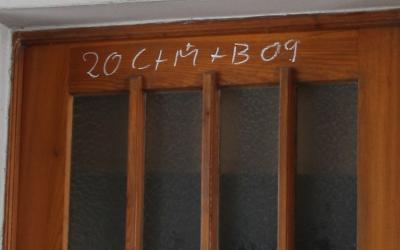
I was “today years old” when I learned about the chalking of the doors, and I’m eager to add it to my collection of practices that help connect communal worship with home life and worship. Such practices deepen faith and help us live with a greater awareness of Christ’s presence and the call to be a light in this world.To help those who, like me, may be unfamiliar with the chalking of doors, an explanation is provided. I suggest introducing the concept in a church newsletter or social media post, then using the Epiphany service to further draw the connection between Epiphany and this practice. Also included below is a liturgy that can be downloaded and handed out for congregants to take home and use.Chalking of the DoorsThe practice of the “chalking of the doors” seems to have begun in Eastern Europe or areas of Slavic origin toward the end of the Middle Ages. In Exodus we read about how the Israelites painted blood on their doorframes to protect them from the angel of death, who killed the firstborn sons of all the Egyptians. In Deuteronomy, the Israelites are told to remember the works of the Lord, to teach them to their children, to talk about them, and to “write them on the doorframes of your houses and on your gates” (Deuteronomy 6:9; 11:20). There is a two-fold purpose in marking one’s doorframe during Epiphany: to protect and bless those within the home by inviting Christ into it, and to bear testimony to the household’s trust in God. These two themes of blessing and bearing witness fit well with the message of Epiphany. The Magi responded to a sign, a visible symbol, with faith and action. They came, bearing gifts, to worship the Christ-child, and they left blessed. Though Scripture doesn’t say if they told others about their experience, it’s hard to imagine them returning home without testifying to all that they had witnessed.For us today, the act of chalking the door can be both a reminder of Christ’s presence with us as well as a countercultural testimony to all who pass by or enter our homes that Christ is Lord of our lives. In fact, in some places in Eastern Europe when the Soviet government was trying to stamp out Christianity, the act of chalking the doors became a protest as well as a faith statement.Chalking the doors is most often done on the feast of Epiphany, January 6 (the twelfth day of Christmas), but it would be equally meaningful any time in theEpiphany season, especially toward the beginning of the year. Chalk is used because it reminds us of our fragility—that we are dust. It is also simple, accessible, and not permanent, for what is written is not magical, but rather a tool for writing God’s truths on our hearts and searing them in our mind. Of course, painting a wooden sign with the symbol or writing it on a paper would also be fine.In the year 2022, the sign written on the doorframe is 20+C+M+B+22. The outer numbers are the year. The + symbols represent the cross and could be written as such. The C, M, and B carry two meanings: It could refer to the names traditionally given to the Magi—Caspar, Melchior, and Balthasar—but there were likely many more than three magi who visited the Holy Family. Better, it reflects the Latin phrase Christus mansionem benedicat—“May Christ bless this dwelling.”When chalking the door, you may choose to spend time wondering about what it would be like if Jesus were physically present in the house. How would Christ’s presence affect how we interact with each other in our words, work, or play? How would Christ’s presence affect how we respond to both invited and unexpected guests on our doorsteps? Write the symbols on the doorframe to remind each other of Christ’s spiritual presence, and offer your own prayer asking Christ to bless the home (or office, or classroom, or hospital room) and all who enter it.For a stronger connection to communal worship, you could encourage your congregants to use the liturgy that follows the Epiphany service below.An Epiphany ServicePreludeBegin this service with notes of joy.Call to Worship[This call to worship should not be read. While there is a script here, much of it could be ad-libbed.]Voice 1 [with great enthusiasm]: Everyone,Christ has been born, the light has come.So join me in celebration!Voice 2 [with consternation]:Celebrate? Celebrate?Have you not heard the news?Where have you been living?[Add the troubling news of the day.]Evil and death are everywhere.There is no hope.Voice 3 [with a gently correcting tone]:Don’t you see it,that light that is growing?The good that is happening right around you?Christ has been born. The Spirit is all around us!Voice 1: Open your eyes and look around you!People are gathered here to worship.The Spirit is at work here.The Spirit is at work around the world.Voice 3:You should see the gifts that areflowing out of God’s people,a testimony that indeed the light has come!There is hope!Voice 1:One day there will be no more evil,no more grief, no more fear.We have hope!Voice 3:So come, join all God’s people in proclaimingthe praise of the Lord!All Voices:“Arise, shine, for your light has come,and the glory of the LORD rises upon you.” —Rev. Joyce Borger, based on Isaiah 60:1–6 © 2021 ReformedWorship.org, CC BY-NC-SA 4.0.Opening Medley“Arise, Shine, for Your Light Is Come” Glass“Glory Hallelujah” Schoolmeester (English/Spanish)or“Jesus Shall Reign / Psalm 72” Watts God’s GreetingThus says God, the LORD,who created the heavens and stretched them out,who spread out the earth and what comes from it,who gives breath to the people on itand spirit to those who walk in it:“I am the LORD; I have called you in righteousness;I will take you by the hand and keep you;I will give you as a covenant for the people,a light for the nations,to open the eyes that are blind,to bring out the prisoners from the dungeon,from the prison those who sit in darkness.I am the LORD; that is my name;my glory I give to no other,nor my praise to carved idols.—Isaiah 42:5–8 ESVSong of Praise “O Come, All Ye Faithful” Wadeor“O Come Let Us Adore Him” Maverick City Music Prayer of ConfessionWe’ve come today to give praise to our God, to continue to celebrate the gift of God’s Son, the light of the world. We want to give God all the praise and glory, but do we? God may be worthy of it all, but do we give God our all? God has blessed us, but what have we given in return? Sung Refrain: “Come, Light, Light of God” The Sisters of the Community of Grandchamp, Switzerland Eternal Light,shine into our hearts;Eternal Goodness,deliver us from evil;Eternal Power,be our support;Eternal Wisdom,scatter the darkness of our ignorance;Eternal Compassion,have mercy upon us;that with all our heart and mindand soul and strengthwe may seek your faceand be brought by your infinite mercyto your holy presence;through Jesus Christ our Light. Amen.—Alcuin of Tours (8th century)., P.D. alt. Sung Refrain: “Come, Light, Light of God” The Sisters of the Community of Grandchamp, Switzerland Words of Assurance 1 John 1:5–7Sung Refrain: “Come, Light, Light of God” The Sisters of the Community of Grandchamp, Switzerland Prayer for IlluminationGod of light and life,open our eyes as well as our ears,so that we may not only hear your Word preached todaybut then see your Word lived out in our lives and in your world,through Christ, our Lord, the light of the world.Amen. —The Worship Sourcebook F.3.1.2Scripture ReadingMatthew 2:1–12Sermon: Signs, Gifts, and TestimonySermon NotesBegin by writing the symbol for chalking the door (for 2022 it is 20+C+M+B+22) with chalk on a wooden cross or another piece of wood. Share that you saw this and are wondering what it could possibly mean. Invite the congregation (especially younger congregants) to wonder with you. What do they think the plus signs are?Chances are that, unless chalking the doors is a familiar practice in your community, the sign will remain a mystery. Wonder together about whom you might ask to help solve the mystery. If you thought this message, this sign, was really important, how far would you travel to find the answer? How much would you be willing to give up, to sacrifice?Talk about how the Magi in the Scripture passage found a sign in the sky: a star. Somehow they knew it was important—it meant a king had been born—but they couldn’t solve the whole puzzle. (You could wonder how many Magi there were. We used to think there were three Magi because there were three gifts named in the story, but now we know that they probably traveled in a large group. Still, people talk about three Magi, traditionally named Caspar, Melchior, and Balthasar. Could that be a clue to the C, M, and B on our sign?)The Magi sought help from the wisest and most powerful people they could find, but they were no help. The wisest people in the story turn out to be the Magi themselves, who, though foreigners and powerless, because of their faithfulness and humility met the king of the whole universe. The Magi saw the Light when those with power, wealth, and access to information did not. The Magi saw the Light, and they worshiped Christ, the Savior of the world, who died on the cross to save us. (Cross . . . could that be another clue? Are the + signs meant to remind us of the cross?)Explain how “Epiphany” means “manifestation” or “revealing.” God revealed himself not to the king and his wise men, as we would expect, but to people outside the ruling Roman Empire and even outside the Jewish community Jesus was born into. Not only that, but God revealed himself through nature: God used the star to communicate. Everyone could see it, but only the Magi were paying attention. They were open and receptive.God also calls us today (another part of the puzzle!) to have our eyes open to what he is doing in the world, and God invites us to join in that work. We don’t need to have power, influence, wealth, or lots of knowledge. We need only a willing heart. Christ is present through the Spirit and desires to bless us so that we might bless others.Mention the Latin phrase Christus mansionem benedicat, meaning “May Christ bless this dwelling.” This is the true meaning of the C M B on the sign. Share the purpose and meaning behind chalking the doors.Conclude by wondering what stories the Magi told about their journey and what stories or testimonies we might share about ours. Hopefully our eyes will be open to see God along the way. Sermon Response[Invite people who would like to chalk their doors to pick up chalk and a copy of the liturgy found below in the resource section, or provide other directions that fit your context.]Sung Response Prayers of the PeopleOffering Traditionally on Epiphany an offering is taken for benevolence or missions.Sending and BlessingAs we leave this service of worship,let us go as the Magi left the infant Jesus,rejoicing on our way that we have seen the living Lord,ready to return to our daily life and work,spreading the good news of Jesus, the light of the world.Receive now these words of promise and blessingfrom our Lord Jesus Christ:Remember, “I am with you always, to the end of the age.”“Peace I leave with you; my peace I give to you.Do not let your hearts be troubled.Do not be afraid.I am the light of the world.Whoever follows me will never walk in darknessbut will have the light of life.”Amen. —from Matthew 28:20; John 14:27; The Worship Sourcebook F.9.4 alt.Closing SongChoose one of the following or another of your choice:“Glory Hallelujah” Schoolmeesters (reprise)“Hear Our Praises” Morgan, LUYH 302, SSS 414“Jesus, the Light of the World” Wesley, Elderkin, LUYH 100Pastoral ConsiderationsAs you introduce the practice of chalking the doors to your congregation you may need to be pastorally sensitive to certain demographics in your congregation and offer some options. For those who live outside, in shelters, or in their cars, offer to pray a blessing prayer wherever they most often sleep at night. For those who live alone, ask an elder to offer to lead the liturgy or encourage those individuals to invite others over for the blessing or to include their small group. For those living in college dorms, hospitals, or other institutions, pray for Christ to be present in the room and get permission to write on the doorframe of the room. Again, there is nothing magical about writing the symbol or placing it on the door or doorframe, but it is a tool to represent the reality of Christ’s presence and an opportunity to worship and bear witness to Christ’s lordship.