This is part of the worship series
"Picture Jesus"
Introduction
Lent 1 | Lent 2 | Lent 3 | Lent 4 | Lent 5
Palm Sunday | Good Friday | Easter
Good Friday
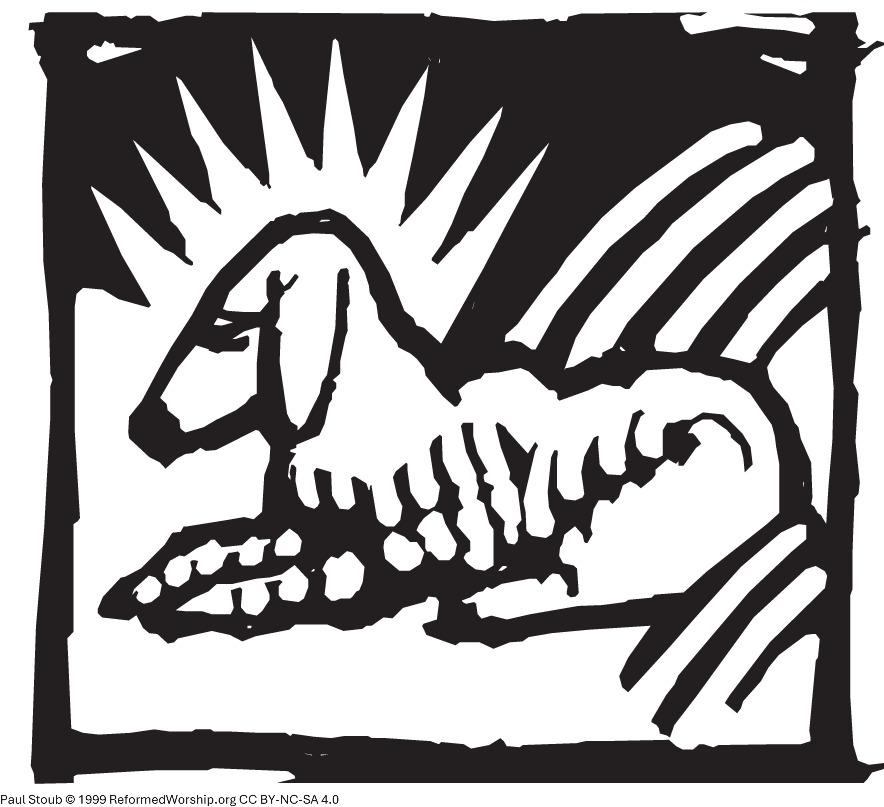
The Lamb
The Word
Scripture
Isaiah 52:13–53:12; Hebrews 4:14–15; 5:7–9
Text
John 1:29; 10:11, 14–18
Sermon Notes
To gain a deeper understanding of the lamb metaphor, we made a number of visits. We first visited Jerusalem at Passover time and found it a very noisy place. Not only were crowds of pilgrims in town milling around in the temple courts, but large numbers of animals were being slaughtered for the sacrifices that the people had come to make.
Stepping back into history gave us the opportunity to visit a Hebrew home and join their celebration of the traditional Hebrew Passover feast. We saw the mother preparing for the celebration, the father leading the family around the table, and the child answering a critical question: “What does this ceremony mean to you?” (Ex. 12:26). That set the stage for the father’s explanation of slavery in Egypt, the plagues, the Passover lamb with blood on the doorposts of the house, and God’s great deliverance.
Next we visited the other side of the Jordan River where John the Baptist was gathering followers, when suddenly he pointed to Jesus and declared, “Look, the Lamb of God, who takes away the sin of the world” (John 1:29).
Together we stood at Calvary, witnessing the people’s cruelty toward Jesus, the intensity of his suffering, his willingness to endure it, and the sacrifice it involved. In his crucifixion, Jesus was serving as the sacrificial lamb of God.
Our final visit involved the scene in the temple on the Day of Atonement. After the sacrifices had been made, the priests laid their hands on the scapegoat and sent him out into the wilderness, carrying the sins of the people.
These visits, all of which reinforced the idea of sacrifice, prepared us to approach the Lord’s table.
Congregational Songs:
“O Sacred Head, Now Wounded” Gerhardt et al.
“O Christ the Lamb of God” Dei et al.
“Ah, Holy Jesus, How Have You Offended” Heermann et al.
“When I Survey the Wondrous Cross” Watts and Mason
“Just As I Am, Without One Plea” Elliott and Bradbury
“There Is a Redeemer” Green
“What Wondrous Love” Anon.
“Now Behold the Lamb” Franklin
Choral Suggestions
“Christ We Do All Adore Thee,” Theodore Dubois (the final movement from Seven Last Words; also found in The Covenant Hymnal 297)
“Surely He Has Borne Our Griefs,” Paul Laubengayer (Morningstar MSM-50-3025, SATB anthem with C instrument)
“Heavy,” Russell Nagy (High Street JH552, SATB anthem)
Instrumental Suggestions
“Passacaglia in C Minor,” J. S. Bach
“O Sacred Head, Now Wounded,” Michael Burkhardt (Five Lenten Hymn Improvisations; herzlich tut mich verlangen; Morningstar MSM-10-309)
Communion Meditation Music
“Beneath the Cross of Jesus,” David Cherwien (Lamb of God; st. christopher; Morningstar MSM-10-302)
“Just as I Am,” Dale Wood (Wood Works Book 2; woodworth; SMP KK400)
Liturgy Note
- Our Good Friday evening worship is usually a Tenebrae service with a series of readings, songs, and diminishing light. The service moves to a quiet and reflective participation in the Lord’s Supper, and concludes in the dark with the tolling of the bell seven times to represent the fullness of Christ’s suffering for us.
- The Burkhardt, Cherwien, and Wood selections were played by organ with the melody lines played by solo instrument. We used flute, oboe, and bassoon on the different pieces.
Revised Common Lectionary
Year B: Holy Week—Good Friday