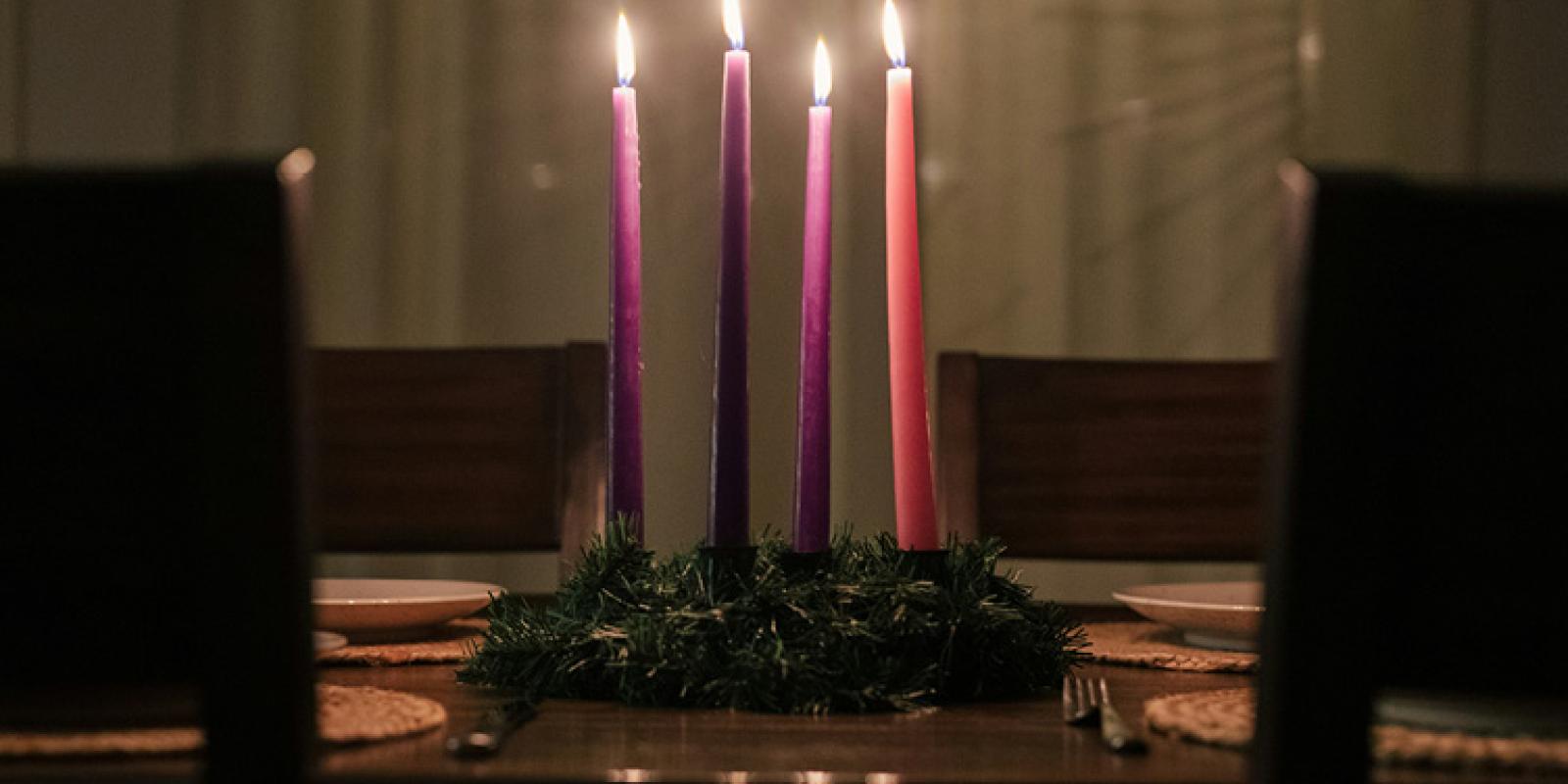
This is part of the Advent and Christmas worship series
"Remembering the Future"
Series Introduction
Advent 1 | Advent 2 | Advent 3 | Advent 4
Christmas
First Sunday in Advent
Service Elements
Gospel Reading
Luke 21:25–36
Call to Worship
The mighty God summons the earth
from the rising of the sun to the place where it sets.
Our God comes and will not be silent.
God calls, and we respond to his love.
The heavens declare God’s righteousness.
We tell out God’s glories!
Offer up to God your thanksgiving.
And our God will hear us,
save us, and stay with us forever.
The Lord be with you.
And also with you.
As we enter this season of Advent,
may the love of God the Father,
the grace of Jesus the Son,
and the fellowship of the Holy Spirit
be and abide with us all.
—based on Psalm 50
Amen!
Advent Wreath
Up to three children could participate in the Advent Wreath liturgy each week: one to light the candle, one to do a reading, and one to lead in a closing prayer.
Song
“People in Darkness Are Looking for Light”Carlson
Each week the children’s choir can open the service singing stanzas of this song. On this first Sunday in Advent sing only stanza 2 before the Advent Wreath is lit (sing an additional stanza each successive Sunday in Advent).
Reading
Today we light the candle of hope as we anticipate the coming of Jesus, who is our hope now and forever. We read from 1 Peter 1:3: “Praise be to the God and Father of our Lord Jesus Christ! In his great mercy he has given us new birth into a living hope.”
Prayer
Dear God,
as we light this candle and begin this new Advent season,
shine the light of your hope into our hearts and world.
Amen.
Sermon Sketch
In 1999, as the new millennium approached, much of the world was filled with apocalyptic speculations. What would the year 2000 bring? The much-touted Y2K computer glitch, not to mention predictions of terrorist activities, led some to hunker down last New Year’s Eve in basement bunkers surrounded by sacks of flour, cans of Spam, and loaded rifles. Even within the church there were some who proclaimed that all such events were possible harbingers of Christ’s return.
And then . . . nothing happened. Zip. The only Y2K glitches were humorous incidents like the man who brought back a video, only to be charged $10,000 for returning it 100 years late! But that was it. The lights stayed on; no one went to war; Jesus did not put in an appearance. Eschatology once again became what it had traditionally been—namely, a part of theology that rarely occupies the forefront of believers’ minds.
But has anything really changed? Does anyone know any more or any less now about the final ringing down of history’s curtain than they knew in 1999? For that matter, can preachers capture people’s attention with talk of the end times as easily as they could then?
Whatever the specific state of mind in which the world, or a congregation, finds itself, the lectionary reading for the first Sunday in Advent forces Christians to bend their thoughts not toward the serene manger in Bethlehem but to a set of images that is anything but “calm and bright.” Advent begins by recalling the finite nature of reality as we know it.
These days many people are aware of the sometimes-grim things science tells us about our universe. In the 1990s, twenty-one fragments of the comet Shoemaker-Levy hit Jupiter and ripped astonishingly huge holes into Jupiter’s atmosphere—some of those holes were larger than the entire planet Earth! If even one such meteor were to impact our planet, the likelihood of global catastrophe and loss of life in the billions would be very high. And scientists say there are lots of meteors out there.
But there are also other indicators of entropy and decay. The sun only has so much fuel and will one day burn out. Granted, it’s got about five billion years of life left to it, but it is finite! And so is the entire universe. It will either keep on expanding until it flattens out or, like a rubber band, it will snap back and collapse in on itself. If all of this seems faraway and unreal, we are altogether too aware that we human beings have, for half a century now, held in our twitchy hands weapons that could destroy all life on this planet many times over.
As theologian and physicist John Polkinghorne says, when we look squarely at the things science shows us about our decaying universe, the vital question theology must answer is this: In the end, will all be well? Will I, my children, my future descendants be OK? Science has no answer to that. Only faith can see such cosmic indicators of decay and still say, “Lift up your heads, for your redemption is drawing near.”
Why begin Advent this way? Because there’s precious little sense in doing much celebrating in the next four weeks if the birth of that little one in Bethlehem cannot somehow take account of the “death and decay in all around we see.” As we wish one another the season’s good cheer and say our “Merry Christmas” greetings, we do so knowing that Somebody’s coming. Even if the worst happens and heaven and earth pass away, the Word of the One who is the Alpha and the Omega will never pass away, and that Word is resurrection life! Believe that message and you will have more than sufficient cause to celebrate Christmas, the Advent of the Christ, with great joy, childlike hope, and lasting peace.
Music Suggestions
Organ Music
- “The King Shall Come” by Michael Burkhardt, Five Advent Hymn Improvisations (MorningStar MSM-10-004, 1991)
- “The King Shall Come When Morning Dawns” by David Johnson, Preludes and Postludes, Volume 2 (Augsburg 11-9319, 1973)
- Partita on “Freu dich sehr, O meine Seele” by Johann Pachelbel, Selected Organ Works, Volume 4 (Kalmus 3763, reprinted by Belwin Mills)
- Prelude on “Freu dich sehr” by Raymond H. Haan, Seasonal Preludes on Five Hymn-tunes for Organ (AMSI OR-14, 1991)
Psalm and Hymn Suggestions
- Psalm 25: “To You, O Lord, I Lift My Soul”Pishner
- “The King Shall Come When Morning Dawns”Brownlie
- “Comfort, Comfort Now My People” Winkworth
- “Come, Thou Long-Expected Jesus”Wesley
- “My Lord! What a Morning”Hustard
Children’s Music (for Children’s Choirs or Congregational Singing)
- “Come, Lord Jesus”Landry A choir may sing stanzas 1, 2, 4, 3 (in that order) with a soloist or duet of choristers singing the opening line of each stanza and the entire choir singing the refrain.
Choral Suggestions
- “Advent Processional” by John Ferguson (Augsburg 11-10448)
- “Come, Lord Jesus, We Are Waiting” by Dorothy Christopherson (CGA-592) Advent readings are included with this music.
Revised Common Lectionary
Year C: Advent—First Sunday of Advent