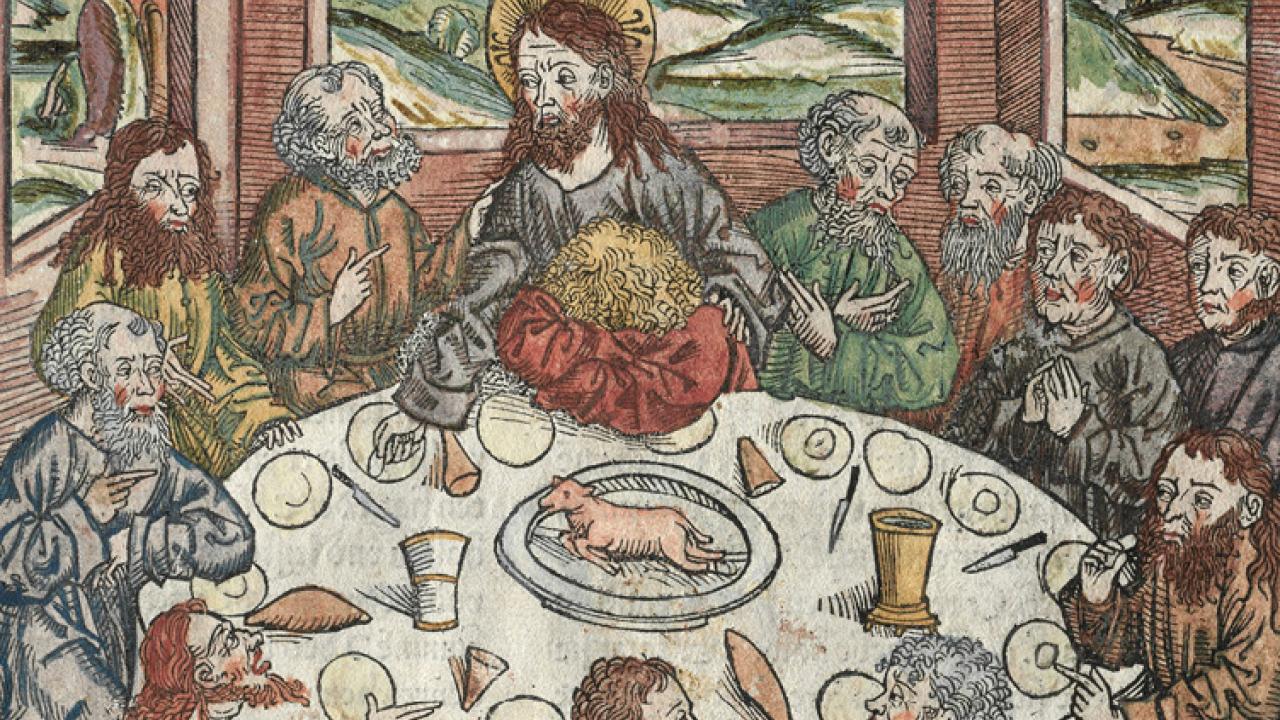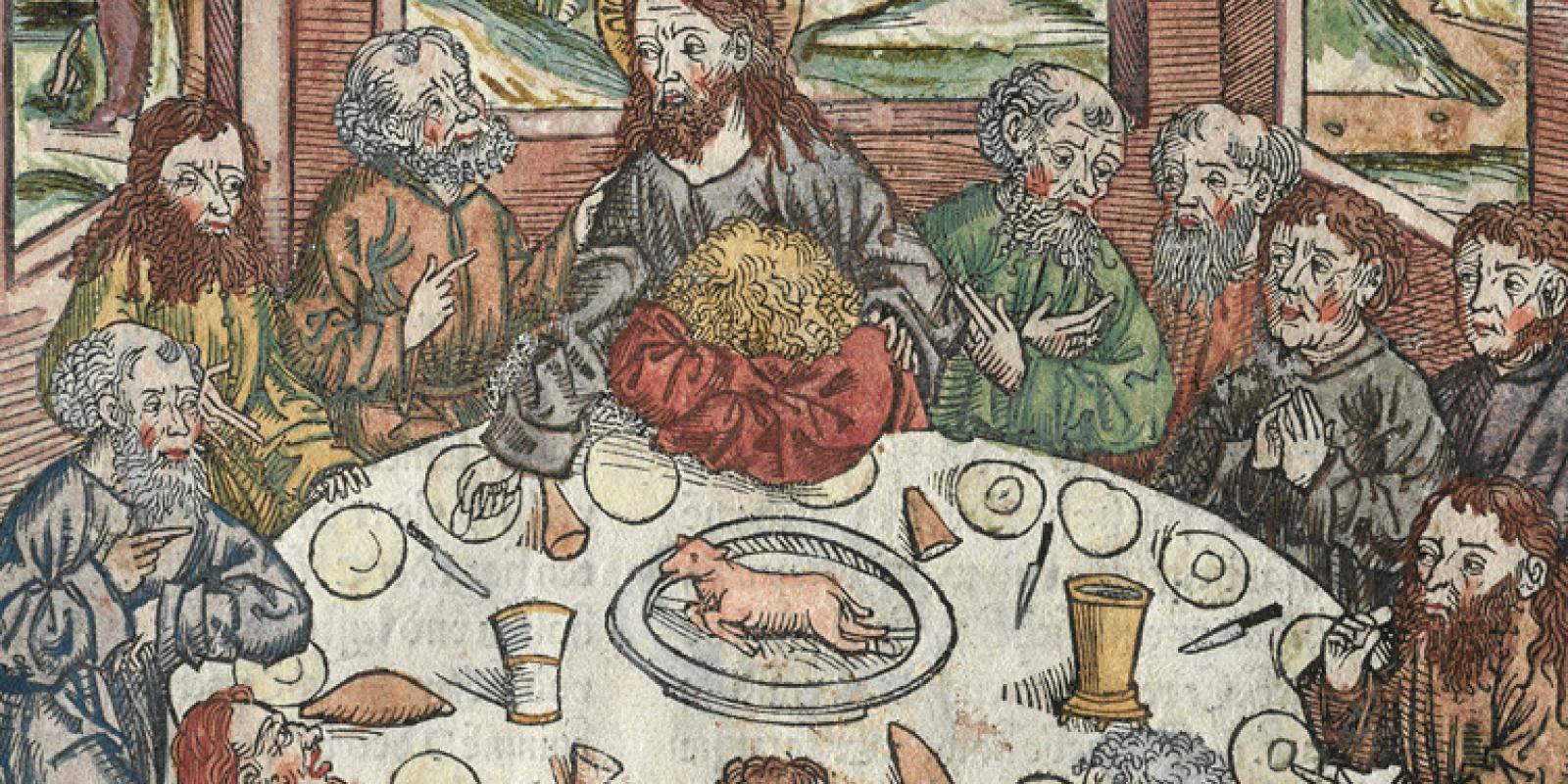
The school gym where I worship is normally bright and bustling before a service. On this Thursday night, however, it is dim and quiet, dozens of small candles providing the only light. In place of the usual rows of chairs there are rows of tables, snaking back and forth to form a single continuous line. At the head table a prominent array of thirteen candles symbolizes Christ and his disciples, whose last supper together this Maundy Thursday service will commemorate.
The service begins with readings and responses from Scripture, recalling our Lord's suffering for his people. One by one the candles representing the disciples are extinguished, a reminder that those who break bread with Christ in the upper room will soon betray and abandon him. Between readings, as we sing successive stanzas of "O Sacred Head, Now Wounded," the words of this familiar Passion hymn come alive in the beautiful and moving gestures of the accompanying liturgical dance.
Standing at the head table, the pastor leads us in a brief meditation, after which a family from the congregation brings forward wine and unleavened bread, and everyone joins in the church's ancient prayer of thanksgiving: "Lift up your hearts… Let us give thanks to the Lord our God…" By now only one candle, the Christ candle, continues to burn; the liturgist slowly raises it above the table, a flickering image of Easter hope on the eve of Good Friday. Exchanging a sign of Christ's peace with one another, we share the bread and wine. We sing a final hymn, and then the dancers solemnly remove the communion ware and take away the Christ candle. Everyone departs silently, in darkness, remembering the suffering Servant who left the upper room for the darkness of Gethsemane and the agonies of the cross.
"Thursday of the Lord's Supper"
For many churches in the Reformed tradition, Maundy Thursday services, like the one described above, may be a fairly recent innovation. We've always celebrated Easter together. And most of our churches and communities have gathered to remember Christ's death on Good Friday. But Maundy Thursday is something new to most of us.
Not so in the wider Christian community. The celebration of Maundy Thursday goes back at least to the fourth century, when pilgrims on their way to Jerusalem are known to have marked the Last Supper and other events of passion week with special services at holy sites. As the idea of such passion week celebrations spread to other areas, various local rites and customs were incorporated into the Maundy Thursday celebration. Doubtless the best-known of these customs is foot washing, an old monastic exercise inspired by Christ's example in the upper room and associated with the "new commandment" of love recorded in John 14 (hence the familiar name Maundy Thursday, "maundy" being an English corruption, via French, of the Latin mandatum: "commandment").
Various traditions know the day by different names: Holy Thursday, Great Thursday, Green Thursday. In the Middle Ages Christians officially called the day the "Thursday of the Lord's Supper," and this ancient designation is still the most descriptive. The central focus of Maundy Thursday worship has always been the upper room, where Jesus on the night of his arrest, sat at the table with his disciples and instituted a solemn memorial of his new covenant through the broken bread and shared cup of his supper.
Focus on Passover?
Maundy Thursday, therefore, ranks among the richest and most complex of the Christian celebrations. As the climax of the old Passover tradition, the Last Supper recalls the exodus and other past signs of God's covenant faithfulness. As a prelude to the Easter drama, the service not only anticipates Geth-semane and Golgotha but also looks beyond them in expectation to the empty tomb and the great heavenly banquet of the Lamb (cf. Matt. 26:29). The church's challenge on Maundy Thursday is to give adequate liturgical expression to this extraordinary richness of biblical content.
An obvious point of departure is the connection between Passover and the Lord's Supper. Although scholars (and the gospels themselves) disagree over whether the meal in the upper room was a formal Passover celebration, no one would deny that the Last Supper, with all its emphasis on covenant, deliverance, and Christ as the new Paschal Lamb, can only be understood in terms of the Passover. Hence, some churches favor observing Maundy Thursday by means of a "Christian" seder.
Such a service raises a number of pastoral and theological problems, however, not least of which is the possibility of giving offense to our Jewish neighbors (see, for example, "Should Christians Eat the Seder Meal?"). But although we may not want to adopt the seder meal as our own, there is no reason why we should refrain from reflecting something of the spirit of the Passover in our commemoration of the Last Supper.
The seder is a table liturgy, and the experiences of table fellowship ought to permeate Maundy Thursday worship. Where facilities permit, the service can actually be held at tables, with or without an accompanying "love feast." Even where the service is held in a sanctuary, worshipers should be given some sense of gathering around a table: for example, the communion table could be centrally located, and the entire service— preaching included—conducted from it.
In the spirit of Passover, accounts of God's redemptive acts should figure prominently in Maundy Thursday worship. However solemn the service may be, the note of blessing and thanksgiving so typical of Jewish table prayers should also be present, especially during communion. This service is not a time for lengthy, didactic forms; better to use one of the newer communion liturgies, most of which draw on ancient Christian (and hence Jewish) models.
Symbols of Celebration
A table celebration can often be enriched by judicious use of traditional symbols or rituals. Here much will depend on local circumstances—such as whether a congregation observes Maundy Thursday instead of, or in addition to, Good Friday.
Foot washing
In many churches foot washing continues to be a Maundy Thursday institution. As an expressive response to the Word and to Christ's call for mutual charity, this ceremony has both historical precedent and the enthusiasm of some liturgical experts to commend it. Worship planners should not, however, consider this ritual a necessity. To the uninitiated the symbolism of foot washing might seem obscure and the actual experience more awkward than inspiring.
Other symbolic actions would surely do as well—and might be preferable to any self-conscious attempt to "modernize" foot washing itself (by shining shoes, for example). A simple but effective alternative would be a congregational offertory procession, possibly featuring gifts of food for a local relief ministry. Such a procession could also include the communion elements, thereby underscoring the connection between our giving and Christ's self-giving, memorialized in the sacrament.
Tenebrae
Another ancient and increasingly popular tradition is the service of tenebrae— especially effective as a Maundy Thursday service in those churches that hold no separate Good Friday service. The service usually involves Scripture reading, song, and the gradual extinguishing of candles. As the candles go out, we are reminded that those who break bread with Christ in the upper room will soon abandon him in the hour of his greatest suffering. (The extinguishing of the candles and the resulting darkness can also refer to other shadows of Christ's passion. See "Tenebrae,".)
Tenebrae normally ends with the extinguishing of the final candle, symbolizing Christ's death. When the service is held on Maundy Thursday, however, the Christ candle might continue to burn; it might even be elevated briefly at an appropriate point in the service. This small sign of hope in the darkness, an anticipation of the resurrection, can have considerable symbolic force. It is also theologically important, coming as it does in the context of the Lord's Supper, which never commemorates Christ's death apart from his triumph over death.
Stripping the Altar
The intrinsic unity of the whole Easter period can be underscored by a variant of the old practice known as "stripping the altar." At the end of the service, before worshipers leave, members silently collect and remove all communion utensils, banners, table coverings, and other decorations (including the Christ candle, if used), leaving the worship area totally bare as a token of Christ's abandonment and humiliation. On Sunday the process is reversed; the first Easter service begins with an unfurling of banners and the dressing of the table with festive coverings, flowers, and other symbols of the resurrection.
Whatever the specific means employed in celebrating the Maundy Thursday service, the watchword should be simplicity— a simplicity of celebration that respects, and so enhances, the intrinsic power and richness of the great event we are privileged to commemorate.