

Resources by Kathryn Ritsema Roelofs

The Lord is My Shepherd Reiffer

This is part of the worship series, "Psalm 23"Series Introduction Week 1 | Week 2 | Week 3 | Week 4 | Week 5 Week 6 | Week 7 | Week 8 | Week 9 | Week 10Week 11 | Week 12Week 8 God’s Invitation to the Feast“You prepare a table before me in the presence of my enemies” (Psalm 23:5a, NKJV). Weekly EmailThis verse changes the metaphor of the psalm. No longer is the psalmist comparing himself to a sheep and God to a shepherd. Now the psalmist is a guest in the home of a gracious host. The guest comes to the host feeling unworthy or embattled, surrounded by enemies, by people who think or act poorly towards the guest. Perhaps the guest has been snubbed at other feasts. But not here, not by this host. This host loves the guest so much that he honors that guest in front of the very people who have hurt or rejected the guest. “Here, there is a feast for you,” the host says; “Here, you belong.” No matter where you face rejection or obstacles this week, remember that you are always welcome at the table of our God.SermonMatthew 22:1–14 "Invitation to a Banquet"Sermon notes by Rev. Chelsey Harmon are available from the Center for Excellence in Preaching.Children’s MessageLet’s remember together all the things Psalm 23 has helped us celebrate. We’ve rested in green pastures and enjoyed quiet waters. We’ve gotten to walk down paths of righteousness, and we’ve been comforted in death-shadowed valleys. We’ve been guided and protected by God’s rod and staff. Wow, this psalm has really helped us see what God has done for us when we think about God as a shepherd! But do you remember waaaaay back to when we talked about the first verse of this psalm and said there were lots of different names for God? Well, the psalm doesn’t just talk about God as a shepherd. It also talks about the ways God is like someone throwing a party. Psalm 24:5 says, “You prepare a table before me.”  Think about the best, most delicious meal you have ever eaten. Now imagine that times ten or a hundred or infinity. That’s what God’s party food is like! Now imagine that you were at a party where you felt like the other people didn’t like you very much. Maybe you don’t feel good enough to be at this party, or maybe you worry about what other people think of you. But the host looks you in the eyes and says, “You are my guest. You belong here. I’m throwing this party for you, and we are going to celebrate together.” As we go through the rest of this psalm, keep that idea of an incredible celebration in mind and remember how happy we can all be that we are invited.Song Suggestions“All Creatures of Our God and King”  Draper and St. Francis of Assisi“We Will Extol You, God and King” Scheer“My Shepherd Will Supply My Need” Watts“Soon and Very Soon” CrouchPrompts for ReflectionJournaling Prompt: Before the communion elements are distributed, the pastor often says, “These are the gifts of God for the people of God.” Just as Jesus gave us the sacrament of holy communion, so the host in this psalm gives a meal to the guest. Spend some time this week reflecting and journaling on the theme of God preparing meals for God’s people. Where in the Old Testament does God provide food? What about in the New Testament? Why is a feast such a good metaphor for what God gives us? Faith Practice: Engaging Scripture Activity Prompt: Consider volunteering this week at a food pantry or food bank. When you serve people in this way you are helping to prepare physical tables for members of your wider community. As you serve, ask God to make this physical blessing a spiritual one too. Consider how you can be a gracious host in imitation of our God, blessing those who may have faced much rejection and many obstacles. Faith Practice: ServiceActivity Prompt: Throw a party—big or small, multi-course or one-pot, themed or casual. Gather people together and share food and fellowship. As you prepare for and enjoy the time with friends and/or family, reflect on the ways God hosts us in the everyday, at the Lord’s Supper, and also in the eternal celebration we look forward to. Faith Practice: Hospitality.Listening Activity: Listening is hard in a world that moves so fast and is full of obligations. Listening is similar to making time for a family meal when fast food might be much easier. Spend time this week at the table of our God. Sit down somewhere with few distractions. Set the timer on your phone for five or ten minutes, then commit to not looking at your phone during that time. Listen. What does your host want to tell you? What message of welcome in a world of rejection does he have for you? If you find your mind wandering, repeat the phrase “He prepares a table before me” to refocus and recenter your mind on God. Faith Practice: ListeningRevised Common LectionaryPsalm 23Years A, B, C: Easter—Fourth Sunday of EasterYear A: Season after Pentecost—Proper 23 (28)Year B: Season after Pentecost—Proper 11 (16)Psalm 119Year A: Season after Pentecost—Proper 23 (28) 

Read The Article
The Lord is My Shepherd Reiffer

This is part of the worship series, "Psalm 23"Series Introduction Week 1 | Week 2 | Week 3 | Week 4 | Week 5 Week 6 | Week 7 | Week 8 | Week 9 | Week 10Week 11 | Week 12Week 7 The Shepherd’s Tools“Your rod and Your staff, they comfort me” (Psalm 23:4c, NKJV).Weekly EmailThe sheep is comforted not only by the shepherd’s presence, but also by the instruments of his profession. These are the tools the shepherd uses to guide the sheep, fend off attacks, and make paths. What tools does God use to accomplish God’s will that bring you comfort? God can use any part of this created world as a tool to accomplish God’s will, but when you look back on your life, what do you see God working through? Daily devotions? Christian fellowship? Worship services? Parents and/or Christian mentors? Sunsets or the view from a mountaintop? Isn’t it wonderful that the comfort and assurance of God’s presence can come to us through things, events, people, and places that surround us every day?SermonPsalm 119: 105–112, 129–136 "Your Decrees are Wonderful"Sermon notes by Rev. Scott Hoezee are available from the Center for Excellence in Preaching.Children’s MessageI’m going to start this message by playing some sounds for you. Listen to the sound and then tell me what message that sound is telling you: [siren] [baby crying] [doorbell]. Aren’t our ears incredible? Even without words, you knew what those sounds were saying. I wonder how we can listen to God? Does God show up in your bedroom and tell you to get up in the morning? Does God appear at your elbow and remind you not to lie? Does God give you a hug and tell you he loves you? Not in a way we can see or touch, but we still say that God is there when we wake up, God’s there when we are tempted, God’s there when we need comfort. So what helps us hear God when we need him? [Possible answers: Bible, parents, conscience/Holy Spirit speaking in our hearts.]Our verse this week from Psalm 23 says, “Your rod and your staff, they comfort me.” A rod and a staff are the tools a shepherd needs to guide and protect his sheep. The sheep looks to those tools to see what the shepherd is doing. This is just like we are listening to the Bible, our pastor, teachers, and parents—and to the Holy Spirit speaking to us in our hearts to hear what God wants and what God is doing. So when you think about the rod and the staff bringing the sheep comfort, think about what you see in your life that shows God is there taking care of you and helping you listen to God.Song Suggestions“Speak, O Lord” Getty and Townend“Open Your Ears, O Faithful People” JabuschPrompts for Reflection Activity Prompt: Find or make a walking stick and take a walk. When is the stick most helpful? When you are on a paved path or when you are off-road? When you are on level ground or when you are going uphill? When would you be tempted to throw the walking stick away? When are you glad you have it? How is this a good metaphor for the things God puts in our life to help us (the Bible, church, parents, etc.)?Journaling Prompt: Some commentaries discuss how the rod and staff would have two different purposes for a shepherd. The staff would be something to lean on and would be used to guide the sheep. The rod would be used as a weapon to defend the sheep. These are things God does for us: God gives us comfort, gives us direction/guidance, and protects us. Spend some time journaling. When/how does God comfort you? When/how does God give you direction? When/how has God protected you? Faith Practice: RememberingFamily Activity: Make “rods” and “staffs” from popsicle sticks. Alone or in a group, think about what you can do when you need God’s comfort, guidance, or protection. How can we listen to God when we need to hear him? Take ten or more popsicle sticks, separate them into two piles, and find a way to differentiate them using markers or stickers or paint. On “staff” popsicle sticks, write things you can do when you need comfort or guidance. (Is there a particular verse of Scripture that helps? Do you need to take a walk outside? Smell a flower?) On “rod” popsicle sticks, write things you can do when you feel like you need God’s protection (e.g., get a parent’s hug, talk to a friend, remember a verse from Scripture). Put the “rods” and “staffs” in a jar to keep on the kitchen counter, dining room table, or anywhere that is easily accessible to everyone in the house. When you realize you need to listen to God, the rods and staffs can help you. Faith Practice: Listening. Revised Common LectionaryPsalm 23Years A, B, C: Easter—Fourth Sunday of EasterYear A: Season after Pentecost—Proper 23 (28)Year B: Season after Pentecost—Proper 11 (16)Psalm 119Year A: Season after Pentecost—Proper 12 (17)

Read The Article
The Lord is My Shepherd Reiffer

This is part of the worship series, "Psalm 23"Series Introduction Week 1 | Week 2 | Week 3 | Week 4 | Week 5 Week 6 | Week 7 | Week 8 | Week 9 | Week 10Week 11 | Week 12Week 6God’s Presence “For you are with me” (Psalm 23:4b, NKJV). Weekly EmailThe Good Shepherd’s companionship is the reason the sheep fears no evil despite being surrounded by the shadows of death. Can you remember a time in your life when you had to do something alone and you desperately wished you had someone there with you? A class presentation? A difficult conversation? Caring for a sick child or elderly parent? What about a time when you did have someone there beside you, and it made a difficult task easier to face? That is what this sheep experiences: comfort and assurance, the unclenching of the shoulders and the letting go of a breath you didn’t know you were holding, simply because you suddenly realize you are not alone. How does knowing that your Good Shepherd is with you change how you go into the difficult tasks of this week?SermonIsaiah 43:1–7, "I Will Be With You"Sermon notes by Rev. Scott Hoezee are available from the Center for Excellence in Preaching.Prayer of Confession[The children’s message this week functioned as the assurance of pardon following this prayer of confession.]Last Sunday we talked about walking through the valley of the shadow of death. Many of us have walked or continue to walk through deep, dark valleys. God wants us to come as we are, to offer our hearts and our voices in prayer no matter what. Please pray with me:Great is your faithfulness, O God. We know this to be true because you have proven yourself faithful to us time and time again. But even though we see and proclaim your faithfulness, sometimes you feel very far off. We often wonder if you will be faithful once again or if you’ve forgotten us. Sometimes we foolishly pray, expecting you to do what we want, not what you want for your world and for us, your children. Forgive us, God. Teach us to pray “Your will be done.” Walk with us through the deepest of valleys, and once again show yourself to be faithful and good, for you are with us. Amen.Children’s MessageAssurance of Pardon: [After the prayer of confession, invite the children to come forward for the children’s message.] In the prayer we just prayed, we admitted to God that we sometimes have a hard time waiting for God to answer our prayers or that we sometimes don’t really feel like God is listening to us. Do you have a hard time waiting? What are some things it is really hard for you to wait for? [Possible answers: Christmas, birthdays, summertime.] Sometimes we don’t always get what we want even when we wait for it for a long time, and this can make us sad. But does that mean that God doesn’t love us? [No.] In fact, we know not only that God does love us, but that God stays with us even when we are waiting and wishing for things to be different. Psalm 23:4 says, “You are with me.” God doesn’t promise that life is going to be easy or that we will always get what we want, but God does promise that when things are difficult, we know God is there with us, loving us, guiding us, and giving us the courage we need to face whatever comes. [The children’s message can end here, but if you want to use the optional handout you can continue with the text below.] Optional handoutI have something for you to remind you of this wonderful truth. I’ve cut out these yellow felt figures that look as if they are holding hands, and I’ve written “Jesus” on one of them. I want you to write your name on the other one. You can take these with you. Maybe you can put yours on your desk at school, or you can ask your parents to put them on the fridge, on the bathroom mirror, or somewhere else you’ll see them every day and remember that no matter what, you are never alone.And as we remember that God is always with us, in both the good and in the bad times, hopefully that will make us want to thank and praise God, so let’s sing a song doing just that.Song Suggestions“Great Is Thy Faithfulness” Chisholm“Nothing to Fear” Zach Assad, and Wardell“Blessed Be Your Name” RedmanPrompts for ReflectionJournaling Prompt: There are only five words in this week’s verse, so spend some time thinking deeply about each word and then journaling or free-writing your thoughts. Faith Practice: Engaging ScriptureSome prompts to get you going:For—Here a synonym for “because,” this word links back to the previous statement “I will fear no evil.” Why does God’s presence cause us to fear no evil?You—This is the first time the psalmist talks directly to God and not just about God. How does talking about God lead us to talking to God?Are—God is . . . There are so many things we can put after that statement, but spend a moment reflecting on the fact that God is. What does that mean for you?With—Here, God is with—not against, not behind, not above. While those other words might be true of God in other contexts, why is it especially comforting to know he is “with”?Me—Who are you in relationship with God? Do you derive fearlessness from his presence?Music Prompt: Listen to “Nothing to Fear,” Zach, Assad, and Wardell which uses language borrowed from this psalm but puts the words in God’s mouth instead of the sheep’s or psalmist’s mouth. When the words are spoken as a promise rather than as a declaration of faith, do you think about them differently? Poem and/or Art Prompt: The five words of this week’s verse don’t carry a vivid image, so make one. What is God’s presence like? Write a list poem by starting with the line “God’s presence is . . .” or “God with me is . . .” and then writing a list of metaphors for God’s presence (a cup of hot cocoa on a cold winter day, a glass of lemonade on a hot one, etc.). This is also a good group activity. Each person in turn can come up with a metaphor until you are happy with your list. Use this as a springboard for a prayer of thanksgiving to the God who is with you. If inspired, choose one of the metaphors you just came up with to illustrate. Faith practice: GratitudeRevised Common LectionaryPsalm 23Years A, B, C: Easter—Fourth Sunday of EasterYear A: Season after Pentecost—Proper 23 (28)Year B: Season after Pentecost—Proper 11 (16)Isaiah 43Year C: Epiphany—Baptism of the Lord

Read The Article
The Lord is My Shepherd Reiffer

This is part of the worship series, "Psalm 23"Series Introduction Week 1 | Week 2 | Week 3 | Week 4 | Week 5 Week 6 | Week 7 | Week 8 | Week 9 | Week 10Week 11 | Week 12Week 5Shadow of Death “Yea, though I walk through the valley of the shadow of death,I will fear no evil” (Psalm 23:4a, NKJV). Weekly EmailSo far Psalm 23 has described us being led to green pastures, still waters, and paths of righteousness. Now the psalmist imagines a more sinister road: a shadowy valley where the threat of death lurks behind boulders. The sheep and shepherd walk a path that reminds the sheep how close life and death are. How does the shadow of death appear in your life? Are there broken relationships, physical ailments, withered hopes, or livelihood insecurities? The sheep in this verse remarkably faces the shadow of death and says, “I will fear no evil.” How does your shepherd give you the courage to look at the shadows around you and say the same?Sermon Psalm 23, “Everyone Needs a Shepherd” Sermon notes by Rev. Scott Hoezee are available from the Center for Excellence in Preaching.Children’s Message[Spend time wondering together, asking questions and reflecting.] Do you remember where God, our shepherd, leads us? “The Lord is my shepherd; I shall not want. He makes me to lie down in . . . [green pastures]; He leads me beside . . . [the still waters].” Do you remember wondering what it was like to lie down in green pastures and lie beside quiet waters? Then we talked about how God leads us on paths of righteousness. That just means that God teaches us how we are to treat the world around us and everything and everyone within it. But now the Bible teaches us that God leads us in scary places too. It says, “Yea, though I walk through the valley of the shadow of death, I will fear no evil” (Psalm 23:4a).I wonder what the valley of the shadow of death is like? It sounds like a scary place, doesn’t it? Are there places that scare you? The Bible is saying that even if we are in the scariest place ever we don’t need to be afraid. Why do you think that is? [Because God is with us.] We don’t have to fear because God is there! Next week we will think some more about how wonderful it is that God is always with us. Song Suggestions“Don’t Be Afraid” Bell“Abide With Me” Lyte“Precious Lord, Take My Hand” DorseyPrayer of Lament [The following prayer is interspersed with singing portions of  “My Soul in Stillness Waits” Haugen.]Throughout this prayer, after I pray the words “We wait and hope for you to banish these shadows,” we will sing together the chorus to “My Soul in Stillness Waits.” We will end the prayer with the first verse and chorus together. Even though we know we don’t need to fear the shadows of death, that doesn’t mean we have to ignore them or pretend they don’t exist. Let’s come to God this morning, lamenting the shadows and praying for the light. Please pray with me. Creator God, out of the darkness you spoke, and there was light; you banished the first shadows with the power of your Word. But humanity rejected partnership with the Light in favor of the shadows. We see the way shadows now darken your good creation: polluted waters, decimated forests, species extinction, and unbalanced ecosystems. Lord, we lament these shadows, and we confess our part in them. Show us how to care for your creation so we can be bringers of light. We wait and hope for you to banish these shadows.For you, O Lord, my soul in stillness waits; truly my hope is in you. God, ruler of all the world, we trust in your sovereignty over the nations, but we lament the shadows of death that loom large in wars, oppression, terrorism, and corruption across the world. We pray in faith and hope for an end to these shadows, and we beg that the light of truth, justice, and peace would shine among the nations of our world. We wait and hope for you to banish these shadows.For you, O Lord, my soul in stillness waits; truly my hope is in you. King of kings and Lord of lords, we look closer to home and see shadows here too. We lament the shadow of partisanship that divides much of this nation and seems increasingly bitter. We pray for the men and women we elect to be guided by your light so they might promote the flourishing of all life. We wait and hope for you to banish these shadows.For you, O Lord, my soul in stillness waits; truly my hope is in you. Holy Spirit, our guide and comforter, whose coming heralded the dawn of the church, be with your church now. The same shadow of partisanship that affects our government has crept into your church in North America, dividing communities. Shadows of abuse, theological disunity, and idolatry creep into our sanctuaries. We beg you to bring your church into the light so it can be the light it is meant to be to a shadowed and dying world. We wait and hope for you to banish these shadows. For you, O Lord, my soul in stillness waits; truly my hope is in you. Father God, who cares for his children as only loving parents could, here in this space there are people walking through the valley of the shadow of death. Shadows of illness, broken relationships, bereavement, isolation, exhaustion, and despair threaten us. We lament these shadows in this room today. We pray against them and ask for your light. We wait and hope for you to banish these shadows.For you, O Lord, my soul in stillness waits; truly my hope is in you. God of light, in whose light we see light, bring us to the end of the valley of the shadow of death and into the radiance of your glory. Amen.For you, O Lord, my soul in stillness waits; truly my hope is in you.“My Soul in Stillness Waits”(st. 1) Haugen—Bethany Besteman © 2022 ReformedWorship.org, CC BY-NC-SA 4.0.Prompts for ReflectionMusic: Listen to the hymn “Abide with Me,” which uses much of the same symbolism as Psalm 23:4. Each hymn verse goes deeper into the dark of night before the final verse, which brings us to the dawn. Reflect, journal, and pray about the ideas the hymn considers. What does it mean for God to abide with us? How does God's presence help you deal with people letting  you down? With change? With pain? With sorrow? Spend time in prayer, in the abiding presence of God. Faith Practice: Prayer Artwork/Activity: Make a memento mori (Latin for “remember you have to die”). Sometimes, when life is going great and we aren’t walking through any shadowed valleys, we have a hard time remembering that we are dependent on God for everything. The early Christian practice called memento mori, in which one meditated on death or kept a visual reminder of it, helped combat this forgetfulness. The point of the memento mori is not to become constantly focused on your own death or keep you from being happy with life. The point is to remember that God holds both your life and your death in his hand, and for that reason you don’t need to fear. Symbols for death included a skull, an hourglass, or wilted flowers. You can do some art journaling and choose one of these symbols to draw. Or you can buy or pick some flowers and hang them upside down to dry. Once they’ve dried you can put them in a vase without water somewhere you’ll regularly see them to remember we flourish like a flower of the field (Psalm 103:15). Faith Practice: RememberingRevised Common LectionaryPsalm 23Years A, B, C: Easter—Fourth Sunday of EasterYear A: Season after Pentecost—Proper 23 (28)Year B: Season after Pentecost—Proper 11 (16)

Read The Article
The Lord is My Shepherd Reiffer

This is part of the worship series, "Psalm 23"Series Introduction Week 1 | Week 2 | Week 3 | Week 4 | Week 5 Week 6 | Week 7 | Week 8 | Week 9 | Week 10Week 11 | Week 12Week 4The Way of Righteousness “He leads me in the paths of righteousnessFor His name’s sake” (Psalm 32:3b, NKJV).Weekly EmailGod leads us toward blessings, as we contemplated two weeks ago (green pastures, still waters), but God also leads us to live up to his moral and ethical standard: righteousness. What does it mean to walk in the way of righteousness? In the Bible, the idea of righteousness is almost always about being in right relationship with God and with our fellow humans. How is God helping you walk paths of right relationship this week? How is God helping you to be right with him? With your neighbor? Sermon Isaiah 5:1–7, John 15:1–17, “Justice and Righteousness” Sermon notes by Rev. Stan Mast are available from the Center for Excellence in Preaching.Children’s Message[Spend time wondering together, asking questions and reflecting on being right with God. If you used a toy with the children’s message last week, use the same toy this week.] Last week we talked about how God restores us. He fixes the things in us that are broken. Imagine that I let you use my toy and you broke it. You brought the broken toy to me and told me you were sorry. What should I say to you if you really are sorry? Should I say “I forgive you”? I should, shouldn’t I? Well, the cool thing is that I know how to fix the toy, so I restore it, and then I let you play with it again. This time you play really rough with my toy. You stomp on it and break it again. If you were me, what would you do? Should I let you play with my toy again even though you keep breaking it? What if I could teach you how to play with my toy without breaking it? If you knew how to play with it gently, should I let you play with my toy again? Could I trust you to play nicely with it? I wonder how you think you would feel knowing that I had fixed the toy, taught you how to play with it, and then gave it to you to play with. I wonder how you would feel if I let you play with all my toys even though you had broken some before. If it were me, I think I’d be pretty thankful, and I’d think you were a really good friend to trust me like that. And if I wanted to keep being your friend I’d want to keep playing with your toys in the right way, wouldn’t I? Did you know that God has given us this whole world to play with and have fun in, and God gave us lots and lots of people to love and be friends with? Sometimes we break God’s world, though. We leave our garbage around, for example, or we aren’t always kind to other people. What do you think we should say to God when we realize that we aren’t playing with God’s world the way he wants us to? We should probably say we’re sorry, shouldn’t we? I wonder what you think God would say to us if we told him we were sorry. God would forgive us, wouldn’t he? But God doesn’t just forgive us for all the bad things we do. God also teaches us how we should behave. That’s what we mean when we say God “leads me in the paths of righteousness for his name’s sake.” God shows us how we should live in this world—how we are to love God, creation, and all the people on earth. Is this easy to do? No, of course not; that is why we need God, our good shepherd, leading us. Even when we are thankful that God has forgiven us, we still are going to mess up. But God says he will keep helping us learn and get better at living how he wants us to, one step at a time.  Song Suggestions“I Will Rise” Reeves, et al.“The Lord, My Shepherd, Rules My Life” Idle “Lift Up Your Hearts unto the Lord” Prompts for ReflectionActivity with Scripture: Take a walk on a trail this week. As you walk, meditate on Psalm 23:3b or any of the following verses from Psalms that talk about the paths God leads us on and what helps us stay on them. Faith Practice: Engaging with Scripture“You will show me the path of life;In Your presence is fullness of joy;At Your right hand are pleasures forevermore” (Psalm 16:11, NIV).“You enlarged my path under me,So my feet did not slip” (Psalm 18:36, NIV).“All the paths of the Lord are mercy and truth,To such as keep His covenant and His testimonies” (Psalm 25:10, NIV).“Your word is a lamp to my feetAnd a light to my path” (Psalm 119:105, NIV)Artwork: Draw a path, either a bird’s-eye view or a path that recedes into the distance using a vanishing point. If this is the path of righteousness, what will you encounter along it? Wonder about what the journey into righteousness will look like. Draw or create a collage of things cut out from magazines of what you imagine you will find along the path of righteousness. They can be symbolic (a bird to represent the Holy Spirit, for example). Faith Practice: Wonder Journaling: Journal a timeline of your life as a progression along the path of righteousness. What events in the past has God used to grow you in righteousness? What is happening right now that shows God is leading you in the path of righteousness? What do you hope will happen in the future? Faith Practice: RememberingRevised Common LectionaryPsalm 23Years A, B, C: Easter—Fourth Sunday of EasterYear A: Season after Pentecost—Proper 23 (28)Year B: Season after Pentecost—Proper 11 (16)Isaiah 5Year A - Season after Pentecost - Proper 22 (27)Year C - Season after Pentecost - Proper 15 (20)

Read The Article
The Lord is My Shepherd Reiffer

This is part of the worship series, "Psalm 23"Series Introduction Week 1 | Week 2 | Week 3 | Week 4 | Week 5 Week 6 | Week 7 | Week 8 | Week 9 | Week 10Week 11 | Week 12Week 3Restoration “He restores my soul” (Psalm 23:3a, NKJV). Weekly EmailIf something must be restored, it is in a state of imperfection. The table that needs restoration has been scratched and stained; the garden that needs restoration is overgrown with weeds. Your soul is precious to God and worth the time, effort, and sacrifice its restoration requires. What scratches and stains is God lovingly undoing? What weeds is God lovingly removing? SermonLuke 7:11–17, “Restored” Sermon notes by Rev. Scott Hoezee are available from the Center for Excellence in Preaching.Children’s Message[Spend time wondering together, asking questions and reflecting on the idea of restoration.]In Psalm 23 we are reminded of this promise: God restores my soul. I wonder what “restores” means. Do any of you have any ideas? Have you ever brought a broken toy to a bigger person and asked them to fix it, and they gave it back to you all fixed? They restored your toy; they made something broken perfect again. Restored is another way to say “fixed.” [If you have a broken toy that is fixable, show them how it is broken; after you fix it, talk about how it is restored.]God promises that he will restore the whole world. When something is broken it doesn’t work right or maybe doesn’t look right. The Bible calls those problems “sin.” What are some things in the world that aren’t right, that are broken? I wonder what the world will look like when it is all fixed. God also promises that he will restore you and me. The Bible says that there are things in our lives that are not right, that are broken. The Bible calls those things “sins” too. I wonder what the world would look like if there wasn’t any sin in it, and people were filled with love for each other and creation. Would you like to live in a world like that? You know what’s awesome? God promises us that one day we will get to live in a world where nothing is broken, nothing ever breaks, and everyone is full of love. Isn’t that amazing? Song Suggestions“God, Be Merciful to Me” “Create in Me a Clean Heart, O God” GreenPrompts for Reflection During the WeekArtwork: Draw a picture of something that is beautiful or precious or deeply meaningful to you. Cover your picture with a piece of wax paper or parchment paper and secure it with a piece of tape so that you can lift the paper to reveal your original drawing beneath. On the top paper, trace or redraw the original image, but represent it as stained or broken or degraded in some way. If you want, write what in your soul is in most need of restoration on this top piece of paper (if you use wax paper, permanent markers may work best for this task, but be sure to let the ink dry so it doesn’t smear). Now, every time you lift the top paper you have an image of God’s restoring work. Allow this image to inspire you to be grateful for all that God has done in your life. Faith Practice: Gratitude  Activity: With family or friends, visit a park or trail and spend some time picking up trash (with all safety precautions observed). Think or talk about the ways our souls become littered and in need of God’s restoration work. By working to restore a small part of creation, you are joining in the work that God is doing, restoring the whole world. Faith Practice: Justice and MercyJournaling: In a journal entry, use your senses to explore the concept of restoration. What might restoration taste like? If you could touch restoration, what would it feel like? If you could hear it, what would it sound like? What does restoration look like? If it were a scent, what would it smell like? Faith Practice: WonderRevised Common LectionaryPsalm 23Years A, B, C: Easter—Fourth Sunday of EasterYear A: Season after Pentecost—Proper 23 (28)Year B: Season after Pentecost—Proper 11 (16)Luke 7Year C: Season after Pentecost—Proper 5 (10)

Read The Article
The Lord is My Shepherd Reiffer

This is part of the worship series, "Psalm 23"Series Introduction Week 1 | Week 2 | Week 3 | Week 4 | Week 5Week 6 | Week 7 | Week 8 | Week 9 | Week 10Week 11 | Week 12Week 2Green Pastures and Still Waters “He makes me to lie down in green pastures;He leads me beside the still waters” (Psalm 23:2, NKJV).Weekly EmailWhat are the green pastures and still waters in your life that God has blessed you with? What blessings bring you peace and rest? Do you have a favorite corner of the couch that you curl up on? Is there a neighborhood coffee shop you feel at home in? Is there a friend who calms you down every time you are in their presence? Praise and thank God for these green pastures and quiet waters. If this verse doesn’t feel true for you this week—if life feels filled with deserts and rough seas—maybe spend some time remembering what God has done for you in the past and allow that to comfort you in the present moment. Sermon Ephesians 1:3–14, “Blessings”Sermon notes by Rev. Stan Mast are available from the Center for Excellence in Preaching.Children’s MessageLast week we talked about God the shepherd, and we mentioned a few different ways God is like a shepherd: God corrects us when we sin, God guides us, and God is all around us when we need him or when we feel sad or lonely. This week we are focusing on a different way that God is like a shepherd. Today’s verse tells us that God “makes me to lie down in green pastures” and “leads me beside the still waters.” Green pastures are places where there is soft green grass and where the water is quiet. [Spend time wondering together, asking questions such as the following.]I wonder what it would be like to lie down in a green pasture—to lie down on soft, green grass. Do you have any ideas about what that would be like? What about lying beside quiet waters? I wonder what that would be like. Have you ever lain down by a small stream? I wonder what quiet water sounds like. Would you like to go somewhere that had green grass and quiet waters?  Where are some places you don’t want to go? Today we are going to be talking about how God brings us to good places like green pastures and quiet waters—places that are safe and comforting. I wonder what some of the safe and comforting places in your life are. How might we thank God for the safe and comforting places in our life? I wonder what we could do right now in our time of worship to praise God for the good things God gives us. [If one of the children says “pray” or “sing a song,” use that to transition into the next part of the service.] Song Suggestions“God Is So Good”  Makai“Ten Thousand Reasons” Redman“Savior, Like a Shepherd Lead Us” ThruppPrompts for Reflection During the WeekPoem: Make an acrostic poem. Write a word or words from the verse vertically on a piece of paper and, for each letter, name a blessing that begins with that letter. Faith Practice: CelebratingArtwork: Take a piece of paper and draw a stream down the center of it lengthwise. On one side of the stream write down ways God has blessed your body; on the other side of the stream write down ways that God has blessed your mind. In the stream itself write down ways that God has blessed your soul. You can make this more creative by using green and blue pencils or pens to write or by making the lists on green construction paper with a blue stream cut out and glued in the center. Faith Practice: RememberingActivity: Find time this week to go for a walk with a notebook and pen near a stream or by a field. Find a place to sit. Breathe in while saying to yourself, “He makes me to lie down in green pastures.” Breathe out while saying to yourself, “He leads me beside the still waters.” Repeat for a few minutes, and then sit in stillness, inviting the Holy Spirit to speak to your heart. After listening, you can spend some time journaling, either recording what God says to you or writing a letter back to God after you’ve listened to him. Faith Practice: ListeningRevised Common LectionaryPsalm 23Years A, B, C: Easter—Fourth Sunday of EasterYear A: Season after Pentecost—Proper 23 (28)Year B: Season after Pentecost—Proper 11 (16)Ephesians 1Year B: Season after Pentecost—Proper 10 (15)

Read The Article
The Lord is My Shepherd Reiffer

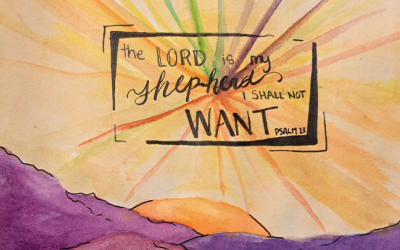
This is part of the worship series, "Psalm 23"Series Introduction Week 1 | Week 2 | Week 3 | Week 4 | Week 5 Week 6 | Week 7 | Week 8 | Week 9 | Week 10Week 11 | Week 12Week 1 God’s Work in Ordinary Time“The Lord is my shepherd;I shall not want” (Psalm 23:1, NKJV).Weekly EmailAfter Pentecost, the long season of the church known as Ordinary Time begins. The mountaintop experiences of the liturgical calendar are past, and the church enters into the everyday to experience God’s sanctifying work amid the ordinary. Ordinary Time corresponds at least in part with summertime, a season in which school finishes, travel happens, graduations are celebrated, and transitions are anticipated. If this is a time of change in your daily schedule, celebrating Ordinary Time can offer stability and grounding. Ordinary Time is a good time to return to well-loved and well-known Scripture—passages so well ingrained in us that we don’t remember when we memorized them, as if we’ve always known them. Psalm 23 is one such passage, and its first verse is one of the best known verses in all of Scripture: “The Lord is my shepherd; I shall not want.” What needs do you see met in your everyday life? Imagine your daily routine as a pasture you are being guided through. How does your shepherd care for you as you wake up? As you make coffee? Get the kids dressed? Get to work? Run errands? Make dinner? Get ready for bed? In the ordinary moments of your day, remember that God is your shepherd and that God takes care of you.Sermon Luke 15:1–10, “What’s So Great About a Shepherd?” Sermon notes by Rev. Chelsey Harmon are available from the Center for Excellence in Preaching.Children’s Message [Display or project a picture of a shepherd so that all the children can see it. If you choose, distribute small cards of the image and the blessing found below for the children to take home. You can also print more for congregants to pick up on their way out of the worship space.][Spend time wondering together using questions like these.]Does any of you have a special name that only your family calls you? Or do you sometimes shorten your name a little and just use a part of it? Some people have lots of names. In the Bible, God has lots of names. Can you think of some of God’s names?There is one name for God that we are going to be thinking about a lot this summer: shepherd. What does a shepherd do? I wonder why sometimes the Bible says that God is our shepherd? How is God like a shepherd? [Possible answers: he protects us; he watches over us; he helps us do the right thing.] Yes, and that’s why sometimes we call God our shepherd. This summer we are going to be thinking a lot about how God is our shepherd because we are going to be thinking about Psalm 23. The first verse of Psalm 23 says, “The Lord is my shepherd; I shall not want.” Another version of this verse says “ God, my shepherd! I don’t need a thing” (Psalm 23:1, MSG). Of course we still need some things, like food and water, but the psalm writer is telling us that we can trust God always to be with us and care for us. Isn’t that incredible? God—the Creator of the whole universe!—loves and cares for each of us, and because God takes care of us we can trust God with everything.When you pray to God you can call him God, Shepherd, or [one of the other names the children came up with]. Different names remind us of different things about God. When we pray to God and call him “Shepherd,” we are saying that God is someone we can trust. God is there for us, protects us, and is always with us even if we don’t see him. Let’s pray to our shepherd God now. [The children’s message can end here, or you can continue with the text below if you want to make use of the optional handout.]Optional Handout[Ahead of the service prepare a handout with a picture or line drawing of a Shepherd and the blessing found below. Make extra copies for older children and adults to pick up at the end of the service. A sample handout can be found in the resource section below.]As I was thinking about this name for God, I was reminded of a blessing sometimes given at the end of the worship service. I put it on these cards with a picture of a shepherd, and I’m going to give one to each of you so that you can read it or have a grown up read it to you every day this week. Listen to what it says: God goes before you to lead you, God goes behind you to protect you, God goes beneath you to support you, God goes beside you to befriend you. Do not be afraid. May the blessing of God the Father, Son, and Holy Spirit be upon you.Do not be afraid. Go in peace to love and serve the Lord. Amen.—Source unknownI hope that you will take this home with you and remember that God is always with you. You don’t have to be afraid about the future because God’s already there. You don’t have to be sad about what happened in the past because God is in the past as well. You don’t have to worry about the present because God is with you today too. I hope that helps you as much as it helps me.Song Suggestions“The King of Love My Shepherd Is” Baker“He’s Got the Whole World in His Hands” AnonymousPrompts for Reflection During the WeekJournaling: Make a list of all the ways a shepherd meets the needs of a sheep. Then extend the metaphor: what might God be doing in your life like a shepherd does in a sheep’s life? For example, a shepherd makes sure that a sheep receives food; in what ways does God make sure you are fed, both physically and spiritually? Faith Practice: GratitudeSensory: Using an old egg carton, start a sensory journey through the psalm. Each week, put something small into one of the egg holders that reminds you of that week’s verse. For example, perhaps this week you put a cotton ball in the first spot to give you a sensory memory for the idea of being a sheep in God’s flock. By the end of the twelve weeks you will have developed sensory memories associated with Psalm 23. This prompt will work well with young children who are just beginning to memorize Scripture, but it may also be a meaningful way for someone who has already memorized this psalm to experience it with more than just our eyes or our ears. Think of some creative ways to decorate your egg carton to reflect Psalm 23. Weekly Devotions: Spend time this week with the many different passages of Scripture that consider the metaphor of God as a shepherd, especially Isaiah 40, Ezekiel 34, Luke 15, and John 10. How do these passages shed light on the Psalm 23 meditation on God as our shepherd? Which passages use the metaphor to show God’s gentle and caring side? Which passages use the metaphor of shepherd to show God’s protective and defending side? Faith Practice: Engaging ScriptureRevised Common LectionaryPsalm 23Years A, B, C: Easter—Fourth Sunday of EasterYear A: Season after Pentecost—Proper 23 (28)Year B: Season after Pentecost—Proper 11 (16)Luke 15Year C: Season after Pentecost—Proper 19 (24)

Read The Article
Child Praying

The following originally appeared as part of "Rooted and Established in Love—Week 12: The Healing Tree."Call to ConfessionWe come before God to confess our lack of trust. We sing “Jesus is Lord” and declare him King of kings over all creation, but too often we act as though he is powerless in the face of the events in our world today. Our broken world and our broken lives are in need of Christ our King. The war-torn countries and poverty-stricken cities are in need of Christ our King. Our groaning planets and our aching hearts are in need of Christ our King. In this silent time of confession, let us acknowledge this need.Prayer of ConfessionMighty and tender God, voice of the voiceless, power of the powerless, we praise you for your vision of a community of wholeness, a realm of peace in which all hunger and thirst are nourished, in which the stranger is welcomed, the hurting are healed, and the captive is set free. Guide us by your truth and love until we and all your people make manifest your reign of justice and compassion. Open our minds and our imaginations to see and participate in your kingdom already at work in this world, and help us to dream and continue to long for a kingdom yet to come. We pray in the name of your anointed one, our King and our Savior, to whom, with you and the Spirit, be honor, glory, and blessing, this day and forever. Amen.—Kathryn Roelofs © 2025 ReformedWorship.org, CC BY-NC-SA 4.0.

Read The Article
Child Praying

The following originally appeared as part of "Rooted and Established in Love—Week 10: The Fruitful Tree."Call to ConfessionGalatians 5 calls us to confess our sins: So I say, let the Holy Spirit guide your lives. Then you won’t be doing what your sinful nature craves. The sinful nature wants to do evil, which is just the opposite of what the Spirit wants. And the Spirit gives us desires that are the opposite of what the sinful nature desires. These two forces are constantly fighting each other, so you are not free to carry out your good intentions.—Galatians 5:16–17 NLTPrayer of Confession “Gracious Spirit, Heed Our Pleading”(st. 1–3) Niwaglia Gracious Spirit, you desire good: good in the world and good in our lives. You have given us ways to know you and ways to know what your will is for us. But we confess that our wants and our desires cause us to turn away, to choose our own will and our own way. We think it will lead us to where we want to be, but God, we know that your way is the way of life eternal. So we pray for your Holy Spirit to work within us, to guide and lead us, to help us bear fruit, to grow and cultivate in us the way of life. Come, Holy Spirit, come. —Kathryn Roelofs © 2025 ReformedWorship.org, CC BY-NC-SA 4.0.Revised Common LectionaryYear C: Season after Pentecost—Proper 8 (13)

Read The Article