Resources by Kathryn Ritsema Roelofs

The Lord is My Shepherd Reiffer

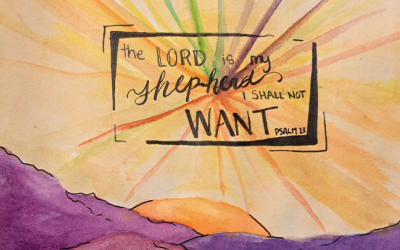
This is part of the worship series, "Psalm 23"Series Introduction Week 1 | Week 2 | Week 3 | Week 4 | Week 5Week 6 | Week 7 | Week 8 | Week 9 | Week 10Week 11 | Week 12Week 2Green Pastures and Still Waters “He makes me to lie down in green pastures;He leads me beside the still waters” (Psalm 23:2, NKJV).Weekly EmailWhat are the green pastures and still waters in your life that God has blessed you with? What blessings bring you peace and rest? Do you have a favorite corner of the couch that you curl up on? Is there a neighborhood coffee shop you feel at home in? Is there a friend who calms you down every time you are in their presence? Praise and thank God for these green pastures and quiet waters. If this verse doesn’t feel true for you this week—if life feels filled with deserts and rough seas—maybe spend some time remembering what God has done for you in the past and allow that to comfort you in the present moment. Sermon Ephesians 1:3–14, “Blessings”Sermon notes by Rev. Stan Mast are available from the Center for Excellence in Preaching.Children’s MessageLast week we talked about God the shepherd, and we mentioned a few different ways God is like a shepherd: God corrects us when we sin, God guides us, and God is all around us when we need him or when we feel sad or lonely. This week we are focusing on a different way that God is like a shepherd. Today’s verse tells us that God “makes me to lie down in green pastures” and “leads me beside the still waters.” Green pastures are places where there is soft green grass and where the water is quiet. [Spend time wondering together, asking questions such as the following.]I wonder what it would be like to lie down in a green pasture—to lie down on soft, green grass. Do you have any ideas about what that would be like? What about lying beside quiet waters? I wonder what that would be like. Have you ever lain down by a small stream? I wonder what quiet water sounds like. Would you like to go somewhere that had green grass and quiet waters?  Where are some places you don’t want to go? Today we are going to be talking about how God brings us to good places like green pastures and quiet waters—places that are safe and comforting. I wonder what some of the safe and comforting places in your life are. How might we thank God for the safe and comforting places in our life? I wonder what we could do right now in our time of worship to praise God for the good things God gives us. [If one of the children says “pray” or “sing a song,” use that to transition into the next part of the service.] Song Suggestions“God Is So Good”  Makai“Ten Thousand Reasons” Redman“Savior, Like a Shepherd Lead Us” ThruppPrompts for Reflection During the WeekPoem: Make an acrostic poem. Write a word or words from the verse vertically on a piece of paper and, for each letter, name a blessing that begins with that letter. Faith Practice: CelebratingArtwork: Take a piece of paper and draw a stream down the center of it lengthwise. On one side of the stream write down ways God has blessed your body; on the other side of the stream write down ways that God has blessed your mind. In the stream itself write down ways that God has blessed your soul. You can make this more creative by using green and blue pencils or pens to write or by making the lists on green construction paper with a blue stream cut out and glued in the center. Faith Practice: RememberingActivity: Find time this week to go for a walk with a notebook and pen near a stream or by a field. Find a place to sit. Breathe in while saying to yourself, “He makes me to lie down in green pastures.” Breathe out while saying to yourself, “He leads me beside the still waters.” Repeat for a few minutes, and then sit in stillness, inviting the Holy Spirit to speak to your heart. After listening, you can spend some time journaling, either recording what God says to you or writing a letter back to God after you’ve listened to him. Faith Practice: ListeningRevised Common LectionaryPsalm 23Years A, B, C: Easter—Fourth Sunday of EasterYear A: Season after Pentecost—Proper 23 (28)Year B: Season after Pentecost—Proper 11 (16)Ephesians 1Year B: Season after Pentecost—Proper 10 (15)

Read The Article
The Lord is My Shepherd Reiffer

This is part of the worship series, "Psalm 23"Series Introduction Week 1 | Week 2 | Week 3 | Week 4 | Week 5 Week 6 | Week 7 | Week 8 | Week 9 | Week 10Week 11 | Week 12Week 1 God’s Work in Ordinary Time“The Lord is my shepherd;I shall not want” (Psalm 23:1, NKJV).Weekly EmailAfter Pentecost, the long season of the church known as Ordinary Time begins. The mountaintop experiences of the liturgical calendar are past, and the church enters into the everyday to experience God’s sanctifying work amid the ordinary. Ordinary Time corresponds at least in part with summertime, a season in which school finishes, travel happens, graduations are celebrated, and transitions are anticipated. If this is a time of change in your daily schedule, celebrating Ordinary Time can offer stability and grounding. Ordinary Time is a good time to return to well-loved and well-known Scripture—passages so well ingrained in us that we don’t remember when we memorized them, as if we’ve always known them. Psalm 23 is one such passage, and its first verse is one of the best known verses in all of Scripture: “The Lord is my shepherd; I shall not want.” What needs do you see met in your everyday life? Imagine your daily routine as a pasture you are being guided through. How does your shepherd care for you as you wake up? As you make coffee? Get the kids dressed? Get to work? Run errands? Make dinner? Get ready for bed? In the ordinary moments of your day, remember that God is your shepherd and that God takes care of you.Sermon Luke 15:1–10, “What’s So Great About a Shepherd?” Sermon notes by Rev. Chelsey Harmon are available from the Center for Excellence in Preaching.Children’s Message [Display or project a picture of a shepherd so that all the children can see it. If you choose, distribute small cards of the image and the blessing found below for the children to take home. You can also print more for congregants to pick up on their way out of the worship space.][Spend time wondering together using questions like these.]Does any of you have a special name that only your family calls you? Or do you sometimes shorten your name a little and just use a part of it? Some people have lots of names. In the Bible, God has lots of names. Can you think of some of God’s names?There is one name for God that we are going to be thinking about a lot this summer: shepherd. What does a shepherd do? I wonder why sometimes the Bible says that God is our shepherd? How is God like a shepherd? [Possible answers: he protects us; he watches over us; he helps us do the right thing.] Yes, and that’s why sometimes we call God our shepherd. This summer we are going to be thinking a lot about how God is our shepherd because we are going to be thinking about Psalm 23. The first verse of Psalm 23 says, “The Lord is my shepherd; I shall not want.” Another version of this verse says “ God, my shepherd! I don’t need a thing” (Psalm 23:1, MSG). Of course we still need some things, like food and water, but the psalm writer is telling us that we can trust God always to be with us and care for us. Isn’t that incredible? God—the Creator of the whole universe!—loves and cares for each of us, and because God takes care of us we can trust God with everything.When you pray to God you can call him God, Shepherd, or [one of the other names the children came up with]. Different names remind us of different things about God. When we pray to God and call him “Shepherd,” we are saying that God is someone we can trust. God is there for us, protects us, and is always with us even if we don’t see him. Let’s pray to our shepherd God now. [The children’s message can end here, or you can continue with the text below if you want to make use of the optional handout.]Optional Handout[Ahead of the service prepare a handout with a picture or line drawing of a Shepherd and the blessing found below. Make extra copies for older children and adults to pick up at the end of the service. A sample handout can be found in the resource section below.]As I was thinking about this name for God, I was reminded of a blessing sometimes given at the end of the worship service. I put it on these cards with a picture of a shepherd, and I’m going to give one to each of you so that you can read it or have a grown up read it to you every day this week. Listen to what it says: God goes before you to lead you, God goes behind you to protect you, God goes beneath you to support you, God goes beside you to befriend you. Do not be afraid. May the blessing of God the Father, Son, and Holy Spirit be upon you.Do not be afraid. Go in peace to love and serve the Lord. Amen.—Source unknownI hope that you will take this home with you and remember that God is always with you. You don’t have to be afraid about the future because God’s already there. You don’t have to be sad about what happened in the past because God is in the past as well. You don’t have to worry about the present because God is with you today too. I hope that helps you as much as it helps me.Song Suggestions“The King of Love My Shepherd Is” Baker“He’s Got the Whole World in His Hands” AnonymousPrompts for Reflection During the WeekJournaling: Make a list of all the ways a shepherd meets the needs of a sheep. Then extend the metaphor: what might God be doing in your life like a shepherd does in a sheep’s life? For example, a shepherd makes sure that a sheep receives food; in what ways does God make sure you are fed, both physically and spiritually? Faith Practice: GratitudeSensory: Using an old egg carton, start a sensory journey through the psalm. Each week, put something small into one of the egg holders that reminds you of that week’s verse. For example, perhaps this week you put a cotton ball in the first spot to give you a sensory memory for the idea of being a sheep in God’s flock. By the end of the twelve weeks you will have developed sensory memories associated with Psalm 23. This prompt will work well with young children who are just beginning to memorize Scripture, but it may also be a meaningful way for someone who has already memorized this psalm to experience it with more than just our eyes or our ears. Think of some creative ways to decorate your egg carton to reflect Psalm 23. Weekly Devotions: Spend time this week with the many different passages of Scripture that consider the metaphor of God as a shepherd, especially Isaiah 40, Ezekiel 34, Luke 15, and John 10. How do these passages shed light on the Psalm 23 meditation on God as our shepherd? Which passages use the metaphor to show God’s gentle and caring side? Which passages use the metaphor of shepherd to show God’s protective and defending side? Faith Practice: Engaging ScriptureRevised Common LectionaryPsalm 23Years A, B, C: Easter—Fourth Sunday of EasterYear A: Season after Pentecost—Proper 23 (28)Year B: Season after Pentecost—Proper 11 (16)Luke 15Year C: Season after Pentecost—Proper 19 (24)

Read The Article
Child Praying

The following originally appeared as part of "Rooted and Established in Love—Week 12: The Healing Tree."Call to ConfessionWe come before God to confess our lack of trust. We sing “Jesus is Lord” and declare him King of kings over all creation, but too often we act as though he is powerless in the face of the events in our world today. Our broken world and our broken lives are in need of Christ our King. The war-torn countries and poverty-stricken cities are in need of Christ our King. Our groaning planets and our aching hearts are in need of Christ our King. In this silent time of confession, let us acknowledge this need.Prayer of ConfessionMighty and tender God, voice of the voiceless, power of the powerless, we praise you for your vision of a community of wholeness, a realm of peace in which all hunger and thirst are nourished, in which the stranger is welcomed, the hurting are healed, and the captive is set free. Guide us by your truth and love until we and all your people make manifest your reign of justice and compassion. Open our minds and our imaginations to see and participate in your kingdom already at work in this world, and help us to dream and continue to long for a kingdom yet to come. We pray in the name of your anointed one, our King and our Savior, to whom, with you and the Spirit, be honor, glory, and blessing, this day and forever. Amen.—Kathryn Roelofs © 2025 ReformedWorship.org, CC BY-NC-SA 4.0.

Read The Article
Child Praying

The following originally appeared as part of "Rooted and Established in Love—Week 10: The Fruitful Tree."Call to ConfessionGalatians 5 calls us to confess our sins: So I say, let the Holy Spirit guide your lives. Then you won’t be doing what your sinful nature craves. The sinful nature wants to do evil, which is just the opposite of what the Spirit wants. And the Spirit gives us desires that are the opposite of what the sinful nature desires. These two forces are constantly fighting each other, so you are not free to carry out your good intentions.—Galatians 5:16–17 NLTPrayer of Confession “Gracious Spirit, Heed Our Pleading”(st. 1–3) Niwaglia Gracious Spirit, you desire good: good in the world and good in our lives. You have given us ways to know you and ways to know what your will is for us. But we confess that our wants and our desires cause us to turn away, to choose our own will and our own way. We think it will lead us to where we want to be, but God, we know that your way is the way of life eternal. So we pray for your Holy Spirit to work within us, to guide and lead us, to help us bear fruit, to grow and cultivate in us the way of life. Come, Holy Spirit, come. —Kathryn Roelofs © 2025 ReformedWorship.org, CC BY-NC-SA 4.0.Revised Common LectionaryYear C: Season after Pentecost—Proper 8 (13)

Read The Article
water

The following originally appeared as part of "Rooted and Established in Love—Week 9: The Giving Tree."Remembering Your BaptismFriends, we are baptized people. God has chosen and named us, and we respond with the faith he alone gives. But we respond. We have to do something. We have to get out of the boat if we want to walk on water. We have to live lives worthy of the grace we’ve been given. So let’s together affirm what God makes possible. I’ll ask a series of questions, and you’ll answer all together with a collective “I do!”[Leader asks a series of questions that resonate with themes that may be present in the sermon. Supplement this list with your own questions.]Do you trust in God’s gracious promises, signed and sealed to you in your baptism?Do you believe that God, who always makes the first step toward us in love, has planted you by streams of water and calls you to bear fruit?Do you turn your back on evil and turn toward God and God’s law as a gracious guide for your life?Do you confess Jesus Christ as your Lord and Savior, as the one who watches over us and continually calls us back to the living waters?Finally, have you decided, by God’s grace, to choose the path of righteousness, turning away from all the wicked things that lead to destruction?Song of Response“I Have Decided to Follow Jesus” Anonymous

Read The Article
water

The following originally appeared as part of "Rooted and Established in Love—Week 9: The Giving Tree."PrayerRefrain: “Take, O Take Me As I Am” BellCreator God, loving Father, Redeemer Son, Holy Spirit, living breath of God:In the waters of baptism you claimed us and marked us as your own. From before time began you hovered over the waters, you called us by name, and you made known your promises of faithfulness and love. It is in these waters that we find our roots. It is water that is life-giving and nourishing, helping us to grow wide our faith and grow out with our love for the good creation you have put around us. In these waters, we see life. In these waters, we dwell with you just as we are meant to be.RefrainBut Lord, how often and how quickly the chaos disrupts us, uproots us, holds back nourishment from the fruit we are called to bear. The way of the wicked seems to flourish and we are unable to find ways to resist it. We know from your Word and we know in our heads that the wicked will not prosper, but how hard it is to remember that when our hearts ache, our eyes see the unimaginable, our minds cannot comprehend. We see wicked prospering all over your world, the world you love so dearly. We see it in the marring and destruction of creation, lives lost in natural disasters and epidemics. We see it in the unfair distribution of goods and wealth leading to poverty, hunger, and a lack of dignity for some and wealth for others. We see it in the seemingly never-ending conflicts between nations. We see it in abuse—of power, of substances, of other human beings. We see it in our cities,  our classrooms, the conference rooms we sit in, and, when we are honest, our own selves. Everywhere around us we see it. And everything inside of us cannot comprehend it. So we sit baffled, stunned, apathetic, and helpless to change the course. So take us as we are, O God. Summon out what we will be.RefrainGod, where we lack wisdom, where we sit baffled and stunned, apathetic and helpless to change course, you remind us that you entered into this mess we have made of your good world and you whisper reminders from the waters that you will be with us. For you are always at work in us, prompting us and leading us by your Holy Spirit, opening opportunities for us to be righteous in our lives because you were already righteous on our behalf. In your uncommon wisdom, you chose us. You work through us. You love us. You use us to do your work here on earth. Open wide our eyes to see you. Open wide our hands to share and serve. Open wide our mouths to declare your praise. Open wide our imaginations to dream, create, and catch a glimpse of your uncommon wisdom. Open wide our hearts to be used by you. Take us just as we are, O God, and live in us.RefrainCall us back to the waters of baptism to again hear your promises—promises that are sure and eternal—and a wisdom that is far beyond our comprehension. Then send us forth, renewed and planted deeply in your streams of water to bear fruit and grow in your grace.—Kathryn Roelofs © 2025 ReformedWorship.org, CC BY-NC-SA 4.0.Oh, the depth of the riches of the wisdom and knowledge of God! How unsearchable his judgments, and his paths beyond tracing out! ‘Who has known the mind of the Lord? Or who has been his counselor?’ ‘Who has ever given to God, that God should repay them?’ For from him and through him and for him are all things. To him be the glory forever! Amen —Romans 11:33–36 NIV

Read The Article
Person kneeling in prayer

The following originally appeared as part of "Rooted and Established in Love—Week 8: The Family Tree."Song“Beneath the Cross”(st. 1–2) GettyPrayer of ConfessionWe stand beneath the cross, confident that God hears our prayers and has already accomplished the great work of redemption for us. But as we look up at the cross and remember the sacrifice of Jesus Christ, we acknowledge the sin and brokenness in our world and in our own lives. Please pray with me.Life-giving God, Creator of all things good, Redeemer of the cosmos, breath of life for all living things, we praise you for the many ways you are at work in this world. At your word, creation came to life—vast oceans with unfathomable depths, mountain peaks reaching up to the heavens, golden prairies that reach as far as the eye can see, trees of every variety and size providing us with shade, air to breathe, colors to stand in awe of. You, O Lord, have also created us in your image and called us to be good stewards of your creation. You call us to tend the earth, to bring forth your kingdom through our vocations, to be your body here on earth, united with your church in doing your will. We confess that in so many ways we fall short of these mandates. Instead of seeking unity, we seek conflict. Instead of seeking community, we choose to isolate. Instead of seeking peace, we tolerate dysfunction. You do not call us to a life of relying on our own selfish pride and independence; you call us to be your body: joined together, working together, seeking you together. Forgive us when our own actions have a negative impact on your world—creation and people alike. May we and all your children strive to bring you all the honor and glory and praise you deserve, until we as your people are united with each other and all the world in singing an unending hymn of praise to you, our Creator, Redeemer, and Lord. Amen.—Kathryn Roelofs © 2025 ReformedWorship.org, CC BY-NC-SA 4.0.Song“Beneath the Cross”(st. 3) Getty

Read The Article
People praying together

The following originally appeared as part of "Rooted and Established in Love—Week 8: The Family Tree."Morning Prayer[The following prayer could be interspersed with the singing of Tommy Walker’s “Beatitudes Song” (charts available at tommywalkerministries.org), another song on the Beatitudes, or a simple prayer refrain. You could also choose to use two voices, one to read the Scripture texts included throughout and the other to offer the prayer.]Using Jesus’ words from the Sermon on the Mount, we turn to our God in prayer. This morning we are praying through the Beatitudes, remembering the weaker parts of our family tree—the branches who lack nutrients, who are suffering from illness, who are tossed about in the winds, who feel alienated from the whole. Let’s bow our heads in prayer.“Blessed are the poor in spirit, for theirs is the kingdom of heaven” (Matthew 5:3).We pray for the poor: for those globally and within our borders who lack basic necessities like healthy and nutrient-rich food, clean water, shelter, and clothing. We pray also for the poor in spirit. We pray that all might have a spiritual humility that turns us towards our saving Lord.“Blessed are those who mourn, for they will be comforted” (Matthew 5:4).We pray for those who mourn the loss of loved ones, good health, regular employment, mental faculties, and more. There are many among us who grieve, some more publicly and some in the quiet ache in their own hearts. Be close to those who mourn.“Blessed are the meek, for they will inherit the earth” (Matthew 5:5).We pray for those who willingly serve God in whatever place or task to which they are called. We pray for their efforts to be obedient in building Christ’s kingdom. We pray for our missionaries: for [name missionaries and their fields]. We pray for the many members of our church family who are currently serving abroad in their own vocations, bringing forth your kingdom all over the world: for [name the families]. “Blessed are those who hunger and thirst for righteousness, for they will be filled” (Matthew 5:6).We pray for those who ardently desire and pursue righteousness and goodness in the world. We pray for those who give their lives and service in pursuit of justice.“Blessed are the merciful, for they will be shown mercy” (Matthew 5:7).We remember those who are daily in the trenches of dealing with human misery and suffering. We pray for health care professionals globally and domestically. We pray for those who work for disaster aid agencies.“Blessed are the pure in heart, for they will see God” (Matthew 5:8).We pray that you will help us all to be pure in heart, to see God and do everything for God’s glory. We pray that our love for you will be unadulterated and unswayed. Give us pure hearts to seek after you, to serve you, and to love you with all our heart, mind, and strength.“Blessed are the peacemakers, for they will be called children of God” (Matthew 5:9).We pray for those who strive for shalom in their own lives and in the lives of others—to be right with God, to trust him wholeheartedly and obey him. In a world where there seems to be little peace between countries, between people and their governments, between brothers and sisters, neighbors and friends, we pray for peace. We pray for mutual respect, for a recognition of each other’s worth, for a willingness to seek peace.“Blessed are those who are persecuted because of righteousness, for theirs is the kingdom of heaven” (Matthew 5:10).We pray for the millions of Christians in the world who are persecuted for their belief in you. Give them strength in the face of trial and courage in the face of danger. On this day, when many around the world are praying for the persecuted church, we join our voices and cry to you. We pray for the persecuted church and the people you love so dearly.“Blessed are you when people insult you, persecute you and falsely say all kinds of evil against you because of me. Rejoice and be glad, because great is your reward in heaven, for in the same way they persecuted the prophets who were before you” (Matthew 5:11–12).We pray for those building the kingdom of God by living with countercultural values—for those who choose your way instead of the easy way. For those who choose to stand up for their beliefs when conforming to popular opinion is the more attractive option.We rejoice and we are glad, for you are blessed, you are holy, you are worthy of all our praise. Hear our prayers and hear our praises. Amen.—Kathryn Roelofs © 2025 ReformedWorship.org, CC BY-NC-SA 4.0.Revised Common LectionaryYear A: Epiphany—Fourth Sunday after the EpiphanyYear A: Season after Pentecost—All Saints Day

Read The Article
Person kneeling in prayer

The following originally appeared as part of "Rooted and Established in Love—Week 7: The Saving Tree."Prayer of ConfessionRefrain: “Jesus, Remember Me” Taizé Father of all creation, before the world began, you were there. Before there was time and before there was space, you—Father, Son, and Holy Spirit—dwelled in perfect unity, in perfect harmony, in perfect knowledge of all that would be in this world and in the world to come. You called this world into being from nothing, filling the earth with the beautiful, the strange, and the unique, the cosmic and the particle. From the dust of the ground you formed us in your own image. Father of all creation, you knew us, you remembered us, you loved us from the very beginning.RefrainGod our redeemer, in the garden, through Adam and Eve, sin entered our world. Your desire for human flourishing and delight was marred and destroyed by sin, and that sin continues in us today. We prove each day that we are guilty sinners through our actions, our inaction, our words, our thoughts, our motivations, and our very lives. Forgive us. Have mercy on us. Remember us.RefrainEmmanuel, God with us, you did not turn away from a world bent on destruction, but instead you turned toward it in love. You are the long-awaited Messiah, the Word that became flesh and dwelled among us in our brokenness and sin. On that night in Bethlehem, you entered in, you chose the path of love, you remembered us.RefrainJesus, Emmanuel, you came into this world for us. You endured trials and temptations for us. You suffered and cried at the last, “It is finished!” for us. For us you rose to newness of life to prove that death no longer has the final word. For us you were victorious, you were obedient, and you are now crowned Lord of all, and now you stand before the Father interceding for us. In the midst of all these things, you remembered us—from death to life, you remembered us.RefrainHoly Spirit, Breath of God, given to us so that through true faith we may share in Christ and all his benefits: you are our comfort, and you promise your presence will be with us through our joys and our sorrows, our fears and our rejoicing. Forgive us for the times we doubt and lose sight of your presence working within us. Forgive us when we ignore your prompting, favoring our own competency and will. Like the wind, you blow through our hearts and our lives, unseen yet ever felt, ever moving, ever changing us, ever challenging us to trust and obey. Through the work of the Holy Spirit, God, you remember us and continue your ongoing work in our lives as we bring forth your kingdom here on earth.RefrainWe praise you, God—Father, Son, and Holy Spirit—for the multitude of ways you remember us, from the beginning of time through your life, death, and resurrection. Thanks be to you, O God. Amen.—Kathryn Roelofs © 2025 ReformedWorship.org, CC BY-NC-SA 4.0.

Read The Article
Breaking Bread

The following originally appeared as part of "Rooted and Established in Love—Week 4: The Justice Tree."Call to ConfessionOn this World Communion Sunday, we are cognizant that there are many around the world—many of our brothers and sisters in Christ—who are on the margins. They gather around the table to celebrate, but some do so in fear of persecution. Some do so with true physical hunger plaguing their bodies so their “feast at the table of the Lord” is only something that is hoped for and longed for. In our broken world, God gathers us all: the marginalized, the powerful, the weak, the strong, the broken, and those seemingly put together. God gathers us together as God’s one church, as brothers and sisters, which means that when they suffer, we suffer with them. So we turn to the Lord in prayer—for them, for us, for all—asking for forgiveness where it is needed and for grace that can always be found.—Kathryn Roelofs © 2025 ReformedWorship.org, CC BY-NC-SA 4.0.We grieve that the church,which shares one Spirit, one faith, one hope,and spans all time, place, race, and language,has become a broken communion in a broken world.When we strugglefor the truth of the gospeland for the righteousness God demands,we pray for wisdom and courage.When our pride or blindnesshinders the unity of God’s household,we seek forgiveness.—Our World Belongs to God, para. 40, © 2008, Christian Reformed Church in North America, Grand Rapids MI. www.crcna.org. Used by permission.Let us pray for the world that God so dearly loves.Let us pray for the troubles and the sufferings of the world.Prayer of ConfessionSung Prayer: “Pelas dores deste mundo / For the Troubles” NetoSpoken Prayer: Lord, we pray for your kingdom to come. While we see glimpses of that kingdom that is already before us, we long for the day when your kingdom and your reign will be complete and all will acknowledge your rule and praise your name.Lord, we pray for your kingdom to come in areas of our world that so desperately need your grace. We pray for all who are on the margins: for those without adequate food and water; for those who have been affected by natural disasters like hurricanes, earthquakes, and flooding.Lord, we pray for your kingdom to come and your peace to reign in areas of conflict: for the fear of nuclear development in North Korea; for the ever present tensions in the Middle East; for terrorist attacks and constant clashes of power. We pray for all the people who live in the shadow of these conflicts, people whose very lives are destroyed because of them.Lord, we pray for your kingdom to come to a world so rich in resources, yet so unfairly distributed; for a world so beautiful, yet cared for so poorly, with waste and little care for creation.Lord, we pray for your kingdom to come to our country: to our government, to our leaders and local officials, to our schools, to our cities and our farmlands.Lord, we pray for your kingdom to come to our city, a hub of political power where many important decisions are made daily that affect not only the city and the country, but the world; a city that struggles with inequality and poverty, a city that needs you.Lord, we pray for your kingdom to come to our own lives, with whatever we face: financial struggle, illness, depression, lack of enthusiasm for our work, boredom, major life transitions, parenting, “adulting,” grieving.For all these things and more, we pray for peace, the blessed peace that comes from seeking justice in your world for all the people you love so dearly.—Kathryn Roelofs © 2025 ReformedWorship.org, CC BY-NC-SA 4.0.Sung Prayer: “Pelas dores deste mundo / For the Troubles” Neto

Read The Article