This is part of the Advent and Christmas worship series
"Remembering the Future"
Series Introduction
Advent 1 | Advent 2 | Advent 3 | Advent 4
Christmas
Second Sunday in Advent
Service Elements
Gospel Reading
Luke 3:1–6
Call to Worship
The Lord has done great things for us!
And we are filled with joy!
Our God has turned our weeping into singing,
Our tears into songs of joy!
O Christ of God, advent anew in our hearts this day,
and remain in us forever.
—adapted from Psalm 126 NIV
People of God,
grace to you, and peace,
from the One who was, is, and is to come;
from the Alpha and the Omega,
the ever-living One.
Amen.
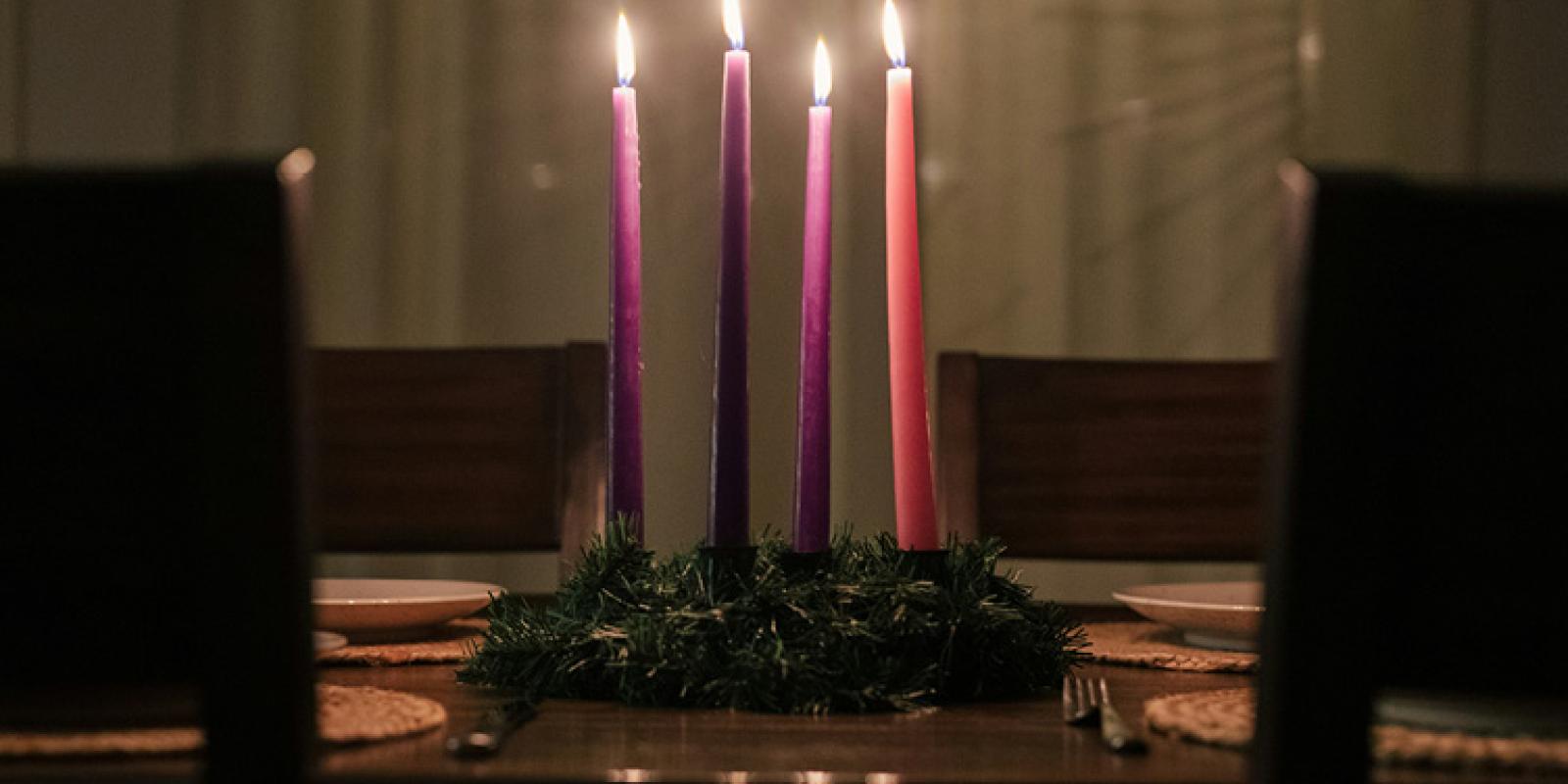
Advent Wreath
Song:
“People in Darkness Are Looking for Light” Carlson
Have the children sing stanza 2 (repeated from last week), followed by this new stanza composed by James Vanden Bosch to accompany the joy candle of the Advent Wreath:
People in sorrow are longing to smile.
Come, come, come, Jesus Christ.
People with sadness need joy all the while.
Come, Lord Jesus Christ.
These days of adventure when all people wait are days for the advent of joy.
Reading
Today we light the candle of joy because the good news of Jesus’ birth brings us and all people the greatest joy. In Luke 2:10 the angel told the shepherds, “Do not be afraid. I bring you good news of great joy that will be for all the people. Today in the town of David a Savior has been born to you; he is Christ, the Lord.”
Prayer
Dear God,
give us joy in our hearts now and forever.
Help us to tell other people about this joy too.
Amen.
Sermon Sketch
Luke was a stickler for detail, often being careful to list the governors, kings, and high priests of his day the way he does in Luke 3:1-2. Luke told his readers right up front that he had “carefully investigated” all these historical matters (Luke 1:3), and the fruits of his research show. Yet it is clear in this chapter that Luke has something more up his sleeve than just nailing down the historical frame of his narrative.
With a fine sense of irony Luke takes readers from the heights of Roman power and splendor in the person of Tiberius Caesar, down through some of his lesser lackeys in the empire, still further down through the ranks of the Temple hierarchy, finally arriving at the bottom of the heap: a lowly man named John, who called the desert his home. And it’s only when we arrive in the dead wasteland of the wilderness that we encounter the Word of God. God’s Word does not come across Caesar’s marble desk. It is not to be found in Herod’s inbox. It is not even heard by Annas and Caiaphas. Instead it is received in the most unlikely of places by the most unlikely of people: a bizarre self-caricature of a person named John.
This is the perfect sequel to the Son of God’s having been born in a barn. This is the God, after all, whose Son will shortly compare the kingdom to things like yeast hidden in dough and mustard seeds buried in the soil. But there is something still more going on in Luke 3, and it has to do with the message that John proclaims: repentance for the forgiveness of sins.
Somehow it is oddly apropos that this message be heard in the wilderness. In the rarified circles of society where the Caesars dwell, folks don’t like to admit they have problems. Politics is about solving other people’s problems, not about admitting to your own. Certainly this is not the arena in which to admit that you are soiled right down to your soul’s innermost depths! Indeed, even when politicians borrow the pious language of confession, it is difficult to overcome the suspicion that it may be an effort to further political ambitions. When President Clinton sought forgiveness in the 1990s, a few took it to be sincere, many scorned its apparent utilitarian invocation, but no one could be completely sure.
The realm of the powerful and the elite is not generally the place to find arrows pointing to a better way to live righteously. Those who already live on the mountaintops of life don’t want to hear John saying that “every mountain and hill shall be made low.” If the promise of the valley’s exaltation is good news to those who live on the low-lying margins of life, it is bad news for those hungry to maintain power over the valleys.
But on this second Sunday in Advent, Luke invites us to the desert. He wants our feet to feel the scorch of the hot ground, our eyes to be irritated by the sting of bright sunshine and blowing sand. John aims to unmake us by exposing all that is wrong with us and our world as the natural prelude to letting God, by grace, remake us.
No one likes to hear they need to repent. Nobody. In the last couple decades of the twentieth century there was much discussion about downplaying messages of sin and guilt—these topics were perceived to be “non-starters” for Baby Boomer seekers interested in returning to the church. But what’s new about that? Seldom, if ever, have people relished having a bony finger wagged in their faces accompanied by the message “Repent!”
We don’t like being told we’re wrong, and we don’t like going to the deserts of life to hear such things. If anything, we scrape and claw to get out of the wilderness to secure a place up on the heights where the beautiful people dwell. Luke reverses course on us in chapter 3, telling us with subtle historical irony the same thing Jesus would say: it’s by losing your life that you save it.
That is the hard message of John, which we need to go out into the wilderness to hear and appreciate. That is the gospel truth we must accept to receive the Christ whose advent this season is all about. For what does it say about us when we are willing, with great historical inaccuracy, to put the glittering Magi into our manger scenes without ever finding a place for John to stand?
Music Suggestions
Organ Music
- Chorale Prelude on “Stuttgart” by Flor Peeters, Festal Voluntaries: Christmas and Epiphany (Novello 18334, 1956)
- “Voluntary and Fughetta on ‘Come, Thou Long-Expected Jesus’” by Charles Callahan, An Advent Suite (MorningStar MSM-10-007, 1994)
- “O Come, O Come, Immanuel” by Gilbert, The Morning Star (Hinshaw HMO-157, 1989)
- “Fantasy Trio and Toccata on ‘O Come, O Come, Emmanuel’” by Austin C. Lovelace (Concordia 97-6724, 1998)
- Triptych on “O Come, O Come, Emmanuel” by Matthew H. Corl (MorningStar MSM-10-009, 1997)
Hymn and Canticle Suggestions
- “O Come, O Come, Immanuel” Helmore
- “On Jordan’s Bank the Baptist’s Cry” Coffin
- “Prepare the Way of the Lord” Taizé
- “Toda la Tierra”/“All Earth Is Waiting” Taule Canadian Presbyterian Book of Praise 109; also available as an anthem (Concordia 98-32-33)
- “Blest Be the God of Israel” (Song of Zechariah) Perry
Children’s Music (for Children’s Choirs or Congregational Singing)
- “Come, Lord Jesus”Landry
Choral Suggestion
- “O Come, O Come, Immanuel” by Natalie Sleeth (CGA-273)
Revised Common Lectionary
Year C: Advent—Second Sunday of Advent