This article was originally written by Elizabeth Vander Haagen and was updated by Lindsay Wieland Capel.
The family of God is not complete unless all are present—people of all ages and races and abilities. What do disabilities have to do with worship and justice? People with disabilities were the last group in the United States to receive legal rights. Until the 1960’s and 1970’s, appropriate care and housing for people with disabilities were not available in the community, so most people with disabilities lived in institutions, often in inhumane conditions. Students with disabilities did not have the right to go to school until the Individuals with Disabilities Education Act (IDEA) was passed in 1975. It wasn’t until 1995 when the Americans with Disabilities Act was passed that people with disabilities were protected by law from discrimination and were given equal rights to access employment, public places and transit, businesses, and more. This legislation literally helped pave the way for people with disabilities to have access to their community and to the accommodations they need.
Here’s what happened when one church set out to make sure it was including people with disabilities in the family of God.
In the early 1990’s, before the Americans with Disabilities Act was even passed, Plymouth Heights Christian Reformed Church in Grand Rapids, Michigan, appointed a Disability Committee to oversee ministry to people with disabilities within their congregation. This was, in part, prompted because of their active Friendship Group (*see note at the bottom of the article), a program designed to build faith and friendship among people with and without intellectual disabilities. They began by coming up with a list of people who had any sort of disability—from attention deficit disorder to muscular dystrophy to stroke victims—and then asking how the church could best minister to them and their families.
In thinking about people with disabilities and worship, Plymouth Heights started considering their worship space, their worship services, even their parking lots. The timing was important because several years later, when the time came for them to renovate their worship space and enlarge their church facilities, they were ready.
The Worship Space
During the process of remodeling, Plymouth Heights was very intentional about making room for people with disabilities. They replaced the pews with new ones without side barriers. They included pew cutouts to make room for people using wheelchairs. They moved the pews farther apart so people with walkers could get in and out of them more easily. They made their platform wheelchair accessible. They improved the lighting in their sanctuary to make reading easier.
All of these changes helped create a more welcoming space for people with disabilities who were a part of Plymouth Heights Church.
The Worship Service
Worship planners became more conscious and careful about introducing each person and each part of the worship service for those who could not read. They intentionally included repetition of short phrases in parts of the service each week, such as having the worship leader follow the reading of Scripture with “The Word of the Lord” and having the people reply, “Thanks be to God.” Such phrases can be memorized and spoken by those who cannot follow a written bulletin.
They also invited members of their Friendship class to lead worship services through singing as a choir, and they were careful to include songs people were familiar with from Friendship class into congregational singing.
More importantly, worship planners invited people with intellectual disabilities to sit with different families, never more than one to a family, so that they were integrated throughout the worshiping community. As a result of these changes, the church has become known as a welcoming place for everyone.
The Parking Lot
By becoming intentional about creating space for all of God’s people to worship together, Plymouth Heights started to grow. Word spread that they were an accessible and friendly church, and more and more people started coming. Soon the twelve parking spaces reserved for people with disabilities were not enough. They had a waiting list of people who wanted to get involved in their Friendship program. Visitors noticed that something was different about this church. By combining their worship with their concern for justice for people with disabilities, Plymouth Heights grew into a fuller awareness and experience of the family of God. Members commented, “The family of God is not complete unless all are present”—including those with disabilities.
People with Disabilities: The Numbers
According to Dr. Erik Carter, researcher and Executive Director of Baylor University Center for Disability and Flourishing, more than 7.5 million children and youth with disabilities live all across the United States and one in three households have a person with a disability. One out of every six children and youth has a disability. He asks, “Does your church serve more than 6 children or youth?” One in four Americans has a disability, he wonders, “Do you have more than 4 members in your church?” Of seniors, one in two have a physical, sensory or health impairment. He inquires, “Are you in a church that happens to be getting older every year?”
In his research with parents of children and youth with disabilities in Texas, he found that 48% of families with a child with a disability have left a church because their child with disabilities was not welcomed or included. “There are 350,000 Churches in the United States, and 100% of them are called to faithful inclusion of people with disabilities,” he says.
More information about Erik Carter’s research and the Baylor Center for Disability and Flourishing are available at: disability.research.baylor.edu
Preaching Tips
Every sermon should be created while keeping in mind worshippers with intellectual disabilities. You may also have other services where you are tuning your message more specifically to them. Here are some things to keep in mind in either instance.
-
Be an integral part of the worship planning team. The entire service must reinforce the sermon theme in singing, prayer, offering, sacraments, and other faith responses.
-
Don’t “talk down.” This remains gospel proclamation for the ecclesia, not a cutesy children’s chat. Each worshiper is your sister or brother for whom Christ died.
-
Keep it simple but not simplistic. You’ll be amazed at what registers with worshipers who have intellectual disabilities. And—like many types of universal design—you’ll likely find that others in the congregation find that helpful, too.
-
Keep it personal. You can tap into rich reserves of people’s knowledge and interest areas, especially where intellectual skills aren’t strong.
-
Repeat one theme many times, approaching it from various perspectives.
-
Invite meaningful verbal response and interaction by the worshiping body as a whole.
-
Let the message “breathe.” Segment the message into bite-sized pieces and use “change-ups” and “hooks” more often to refocus attention.
-
Use story instead of analogy—Bible stories and personal stories.
-
Use lots of humor that’s respectful, uncomplicated, and directly relevant.
-
Use examples that are especially relevant to the life circumstances of people with disabilities—adults as well as children.
-
Incorporate lyrics of favorite songs.
-
Use visuals.
-
Incorporate simple dialogue with people with intellectual disabilities or with persons they know and respect (be sure to arrange that beforehand).
-
Start with lots of energy but end with meaningful calm (care providers will bless you for it!).
-
Give due weight to experiencing and doing as well as understanding. Our faith needs nourishment on all these levels.
-
Summarize the theme at the end and keep it “good news.” But don’t cut corners with addressing the need for faith, confession, commitment, and discipleship throughout your message.
-
Keep it short but not too short—15-20 minutes.
-
Remember three key points: Show them Jesus. Show them Jesus. Show them Jesus.
—Robert DeMoor
Friendship Ministries
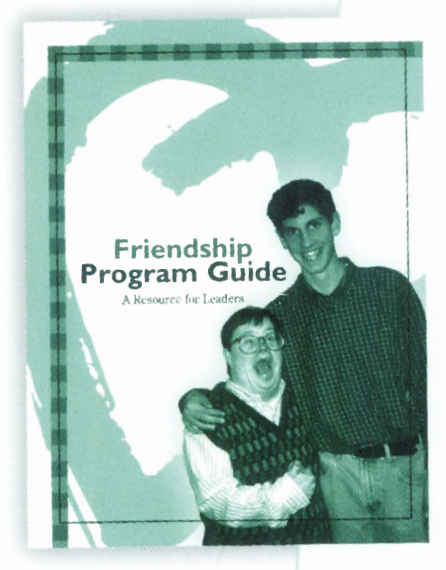
Kevin (right) began helping out at Friendship when he was in grade school. Kevin's profound communication disorder (apraxia) didn't bother Jim (left), then a young adult with Down Syndrome. Jim gave Kevin unconditional acceptance and love as Kevin learned to accept his own disability. Nearly every Sunday for three years, Jim greeted Kevin with a huge smile and followed him down the aisle to sit with Kevin's family. People in the balcony smiled-often through their tears-as Kevin stooped down to nudge Jim to sing the hymn. When Jim sang from his heart, the people at church knew Jim belonged to them and to God! It just took a little nudging from two young men.
*Friendship Groups are a ministry of With Ministries. Friendship Groups create space for individuals with and without disabilities to grow together in faith and community. A Friendship Group Starter Kit is available if you are interested in starting a Friendship Group at your church.